 Login








AI Summary
The best pest control software in Australia depends on whether the business mainly needs better scheduling, pest specific chemical records, recurring treatments, route optimisation, commercial site management or broader field-service coordination.
- Arrivy: Best for pest control businesses that need scheduling, routing, recurring jobs, field documentation and customer communication connected.
- Nexus Service Manager: Best for Australian pest control businesses wanting locally developed pest management and job-management software.
- GorillaDesk: Best for pest businesses focused on chemical tracking, recurring routes and straightforward field management.
- PestPac: Best for larger pest control companies with complex commercial, termite and multi-location requirements.
- Jobber: Best for small and midsize pest control businesses wanting simple scheduling, customer management and billing.
- FieldRoutes: Best for growing pest businesses with high-volume recurring services and advanced routing requirements.
Important distinction
Australian pest control requirements are not identical across every state and territory. The APVMA regulates agricultural and veterinary chemical products nationally, while technician licensing, pesticide-use records and other operating requirements can also depend on state or territory rules.
Recommended Reads:
Pest control businesses have a scheduling problem that many ordinary service businesses do not.
A technician may have several recurring treatments spread across a service area, a termite inspection requiring more time than expected, a customer asking for an urgent visit and chemical-use information that still needs to be documented before the day is finished.
Once several technicians and territories are involved, a calendar alone is rarely enough. The business needs to know who is going where, which customer is due for treatment, what happened during the previous visit, what products were applied and when the next service should occur.
That is where pest control management software becomes useful.
This guide compares six of the best pest control software platforms for Australian businesses in 2026, looking at scheduling, routes, recurring services, chemical records, field mobility, customer communication, reporting and the practical limitations of each system.
What Is Pest Control Software?
Pest control software helps pest management businesses organise customers, technicians, service visits and field records in one system.
Depending on the platform, this can include:
- Recurring treatment scheduling
- Technician dispatch
- Route planning
- Chemical and pesticide records
- Inspection forms
- Termite documentation
- Customer histories
- Photos and signatures
- Quotes and invoices
- Customer reminders
- Payments
- Reporting
Pest-specific platforms may go further with chemical inventories, bait or monitoring-device records, termite inspections and specialised compliance documentation.
For Australian businesses, software should support good record keeping, but it should not be treated as a substitute for understanding the regulatory requirements applying in the state or territory where the work is performed.
Product features and pricing reviewed in October 2026. Plans, pricing and availability can change.
Pest Control Software Compared at a Glance
| Company | Best For | Editorial Rating | Free Trial |
|---|---|---|---|
| Arrivy | Connected pest control field operations | 4.8/5 | Yes |
| Nexus Service Manager | Australian pest management businesses | 4.8/5 | — |
| GorillaDesk | Chemical tracking and recurring routes | 4.7/5 | Yes |
| PestPac | Complex commercial and termite operations | 4.6/5 | — |
| Jobber | Small and midsize pest control businesses | 4.6/5 | Yes |
| FieldRoutes | High-volume recurring pest services | 4.6/5 | No, demo available |
Editorial ratings are our assessment of each platform for Australian pest control operations and are not customer-review scores.
How We Selected the Best Pest Control Software
We compared each platform based on:
- Availability and suitability for Australian businesses
- Pest-control-specific functionality
- Recurring treatment scheduling
- Technician scheduling and dispatch
- Route planning and optimisation
- Chemical and pesticide records
- Digital forms and treatment reports
- Mobile technician access
- Offline functionality
- Customer history
- Termite and commercial pest capabilities
- Customer reminders and communication
- Quotes, invoices and payments
- Reporting
- Accounting integrations
- Scalability
- Pricing transparency
Arrivy publishes this comparison. Each product has been considered against the same criteria, including areas where dedicated pest-control platforms provide deeper chemical, termite or regulatory functionality. The comparison is based on publicly available vendor documentation and current pricing information, rather than undisclosed hands-on testing.
6 Best Pest Control Software Platforms in Australia
1. Arrivy — Best for Connected Pest Control Field Operations
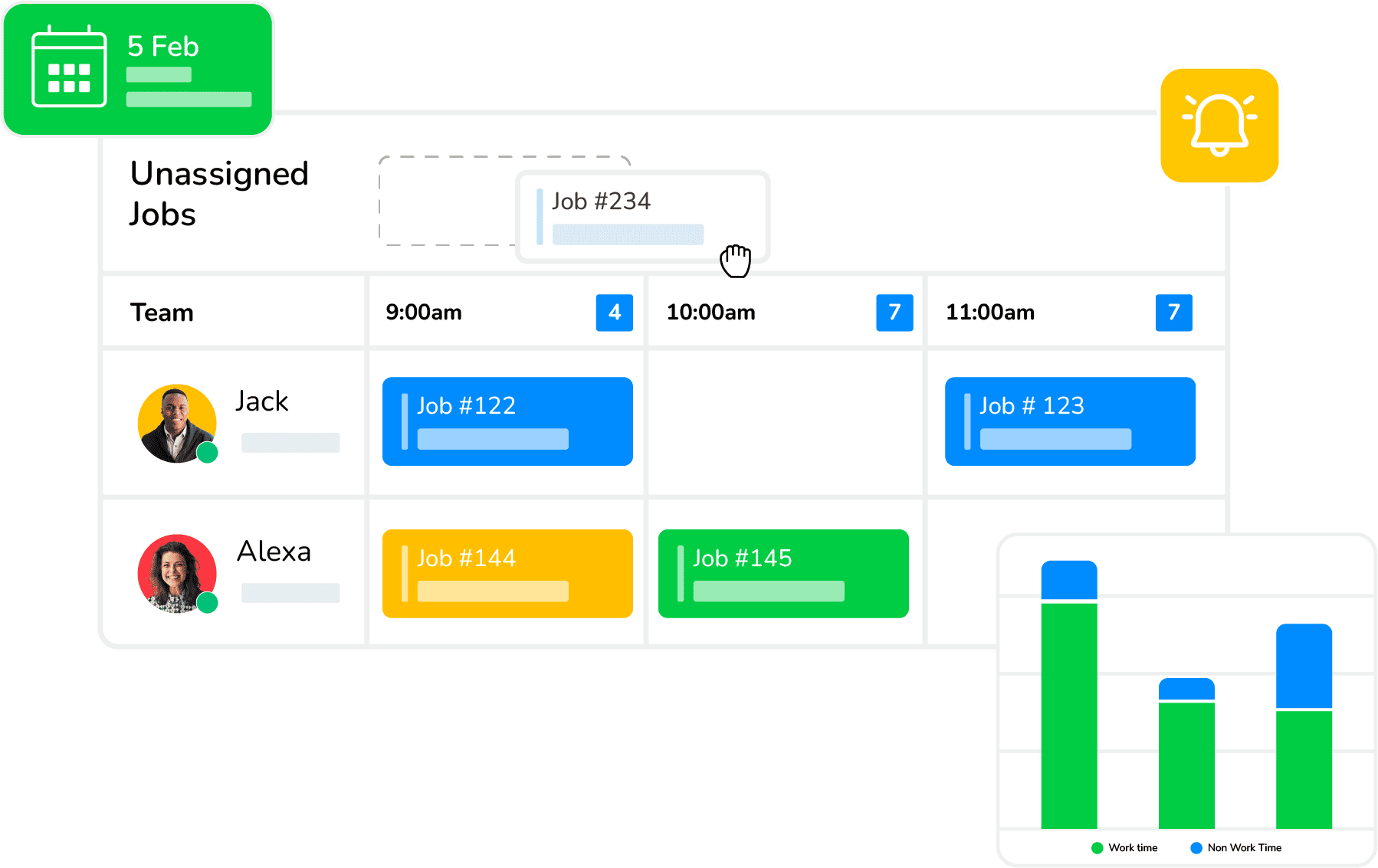
Arrivy is a field service management platform with a dedicated pest control software offering. Its strength is connecting the operational parts of pest management: recurring scheduling, technician assignments, route planning, live job progress, digital forms and customer communication. Technicians can access jobs from the mobile app, complete documentation and capture photos or signatures, including when connectivity is limited. This makes Arrivy particularly useful when the challenge is coordinating several technicians and treatment appointments rather than managing each visit as an isolated job.
Key Features:
Pest control scheduling
Recurring treatment scheduling
Technician assignment
AI-assisted scheduling
Route planning and optimisation
Live technician location
Pros:
-
Strong connection between scheduling, routing and field activity
-
Useful for recurring pest-control appointments
-
Real-time technician and job visibility
-
Strong customer ETA and status communication
-
Digital forms keep treatment documentation with the job
-
Offline field functionality
-
Supports multi-technician and multi-route operations
-
Can connect with CRM, accounting and other business systems
-
Suitable for businesses expanding across territories or service areas
Cons:
-
Businesses requiring highly specialised chemical inventory functionality may need additional configuration
-
Australian pest-control forms may need to be tailored to the applicable state or territory requirements
Pricing:
Arrivy’s Premium plan starts at US$50 per full-access user per month. It begins with a minimum of three full-access users. Premium adds capabilities including route planning, digital forms, advanced reporting and an advanced integration. A 14-day free trial is available without a credit card.
Best for:
Arrivy is best suited to growing pest control businesses that need recurring jobs, technicians, routes, field documentation and customer communication managed together.
2. Nexus Service Manager — Best for Australian Pest Management Businesses
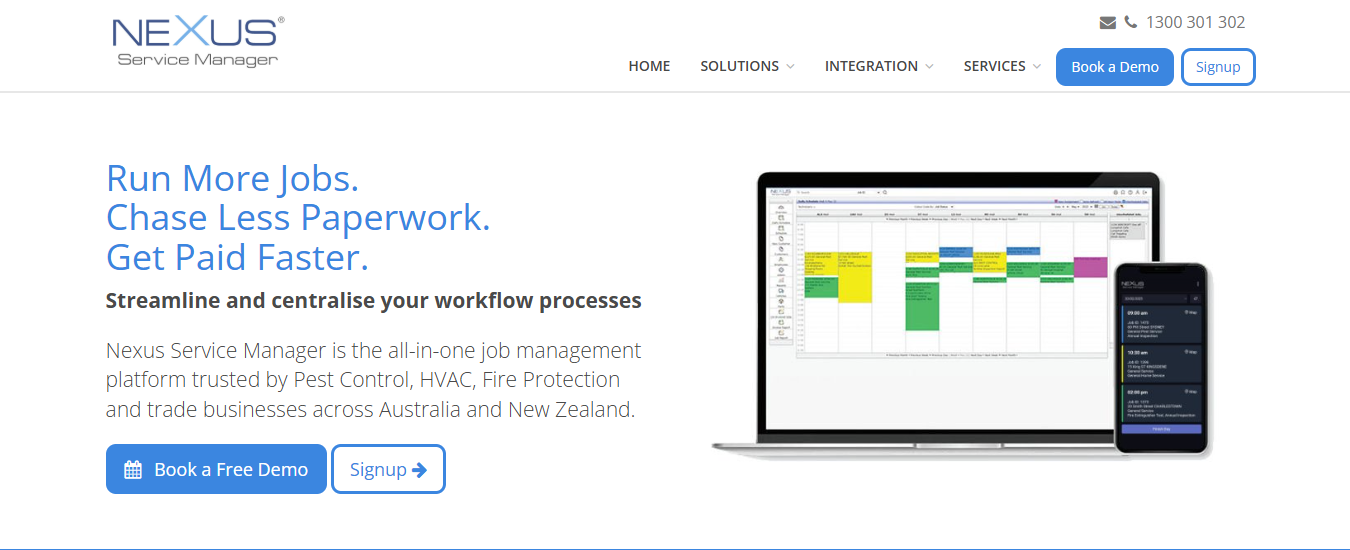
Nexus Service Manager is Australian owned and developed and was originally designed around Australian pest control businesses. Its pest-control functionality covers scheduling, customer management, technician assignments, job history, field service reports, stock, onsite equipment and accounting connections. Mobile technicians can access their runs, add notes, take photographs and complete service reports from the field. Nexus also describes support for treatment jobs, chemical usage and recurring visits, making it one of the most locally relevant pest-specific platforms in this comparison.
Key Features:
Pest treatment job management
Scheduling
Recurring visits
Chemical-use records
Technician assignments
Customer management
Pros:
-
Designed specifically for Australian service businesses
-
Strong pest-control focus
-
Australian support
-
Chemical-use and treatment records
-
Good customer and site history
-
Stock and onsite-equipment management
-
Xero, MYOB and Reckon integrations
-
Useful for commercial and recurring pest services
-
No lock-in contract
Cons:
-
More substantial setup than lighter field-service applications
-
No free trial because the platform requires configuration
-
Smaller pest businesses may not need its full range of modules
-
A setup fee applies
Pricing:
Nexus uses module- and user-based subscription pricing. Its current public pricing states that subscriptions start at A$440 per month, including GST. The configuration shown on its signup calculator includes five users and a A$1,100 one-off setup fee. Pricing changes as additional users or modules are added.
Best for:
Nexus Service Manager is best suited to established Australian pest control companies that want pest-specific job management, local support, service records and accounting integrations in one system.
3. GorillaDesk — Best for Chemical Tracking and Recurring Routes
GorillaDesk is built heavily around pest control and field-service businesses. One of its clearest strengths is chemical tracking: technicians can capture products and quantities used during jobs, while office staff can retrieve material-use records later. It also provides recurring scheduling, dispatch, route planning, invoicing and customer communication. Pricing is based on the number of routes rather than customers or general users, which can suit companies where each technician operates a dedicated daily schedule.
Key Features:
Chemical tracking
Material-use reports
Chemical templates
Scheduling and dispatch
Recurring services
Route planning
Pros:
-
Built with pest-control businesses in mind
-
Strong chemical-use records
-
Useful recurring scheduling
-
Straightforward route-based pricing model
-
Unlimited customers and users
-
Route planning included
-
Route optimisation available
-
Good customer communication tools
-
14-day free trial
Cons:
-
More advanced features such as route optimisation and the customer portal require higher plans
-
Pricing increases as the number of routes grows
-
Its compliance messaging is primarily written around US regulatory requirements, so Australian businesses need to confirm local record fields
-
Accounting integration centres heavily around QuickBooks rather than Australian-specific accounting requirements
Pricing:
GorillaDesk’s Basic plan starts at US$49 per month and includes client management, scheduling, dispatching, route planning, invoicing and the mobile app. Pro starts at US$99 per month and adds features such as route optimisation, subscription billing, QuickBooks sync and the customer portal. Pricing is based on the number of routes being managed.
Best for:
GorillaDesk is best suited to small and midsize pest control businesses that want strong chemical tracking, recurring scheduling and route management without paying separately for each user.
4. PestPac — Best for Complex Commercial and Termite Operations
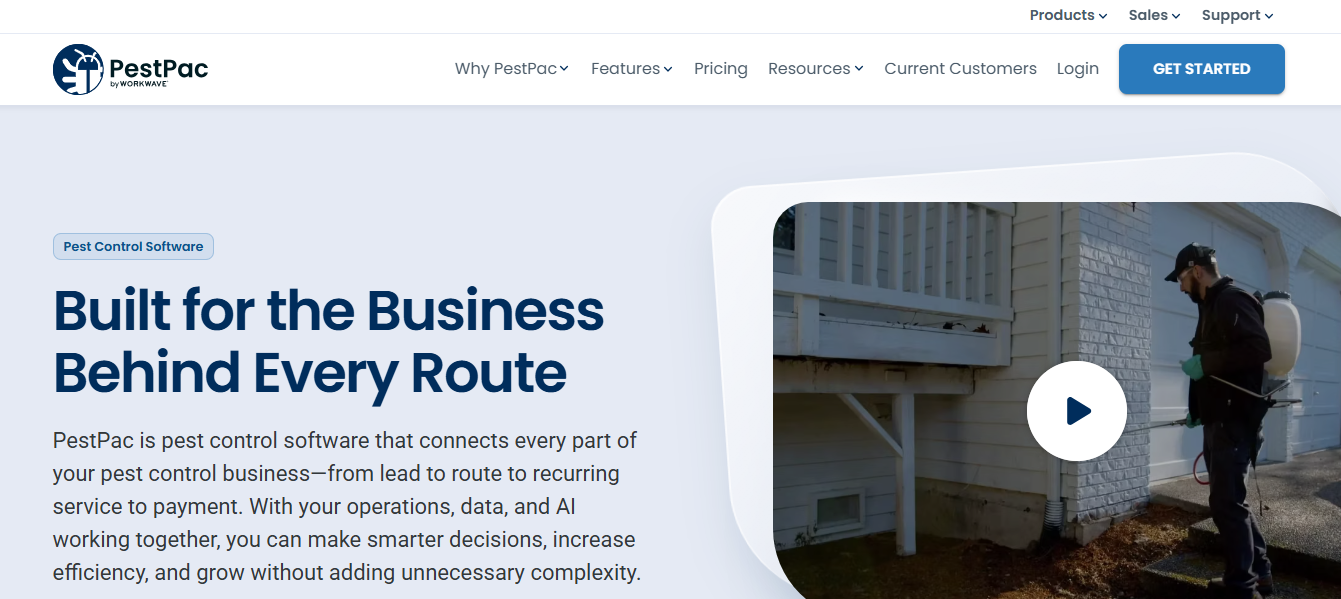
PestPac by WorkWave is one of the most pest-specific platforms in this comparison. It supports residential and commercial pest control with scheduling, route optimisation, chemical tracking, termite inspections, integrated pest management, multi-unit accounts and customer communication. Its mobile app lets technicians access service information, collect signatures, accept payments and document pest activity from the field. PestPac also provides inventory and chemical tracking that connects material usage with service records.
Key Features:
Pest-specific CRM
Recurring service scheduling
Smart scheduling
Route optimisation
Chemical tracking
Chemical inventory
Pros:
-
Deep pest-control-specific functionality
-
Strong termite capabilities
-
Chemical and inventory tracking
-
Suitable for commercial pest management
-
Handles multi-unit properties
-
Advanced routing
-
Strong reporting
-
Supports larger and multi-branch operations
Cons:
-
Pricing is not publicly displayed
-
The platform can provide more functionality than a small pest business needs
-
More advanced features depend on the selected package or modules
-
Some compliance features and documentation are built specifically around US regulatory requirements
Pricing:
PestPac uses custom pricing rather than publishing a fixed subscription rate. It offers Small Business, Professional and Enterprise packages, with features increasing across scheduling, routing, digital forms, commercial functionality, reporting and multi-branch management. Businesses need to contact PestPac for a quote.
Best for:
PestPac is best suited to larger or more complex pest control companies managing termite services, commercial properties, multiple branches or detailed chemical and inventory requirements.
5. Jobber — Best for Straightforward Pest Control Business Management
Jobber is a broader home-service platform, but its current pest-control offering has become more industry-specific. Pest businesses can schedule one-off or recurring visits, dispatch technicians, manage customers, create quotes and invoices, and use route optimisation. Importantly, Jobber now also supports chemical and pesticide tracking, including products applied, registration numbers, targeted pests and application history. That makes it considerably more relevant to pest-control businesses than older comparisons may suggest.
Key Features:
Recurring pest-control jobs
Scheduling and dispatch
Chemical and pesticide tracking
Application history
Customer CRM
Route optimisation
Pros:
-
Relatively straightforward to learn
-
Strong customer-management functionality
-
Native chemical tracking now available
-
Good quoting and invoicing
-
Recurring service support
-
Route optimisation
-
14-day free trial
-
Xero integration is available to Australian accounts
-
Useful client-facing tools
Cons:
-
It remains a general home-service platform rather than an Australian pest-control-specific system
-
More advanced routing and profitability features require higher plans
-
Pricing is published in US dollars
-
Australian businesses should verify that chemical and treatment fields meet their local regulatory requirements
Pricing:
Jobber’s Core plan starts at US$29 per month when billed annually for one user. Higher plans add automation, routing, job costing and larger team allowances. Jobber provides a 14-day free trial, and its pricing is listed in USD.
For Australian users, Jobber supports Xero integration and payment integrations in Australia on eligible plans.
Best for:
Jobber is best suited to small and midsize pest control companies that prioritise simple scheduling, recurring services, customer management, quoting and invoicing.
6. FieldRoutes — Best for High-Volume Recurring Pest Services
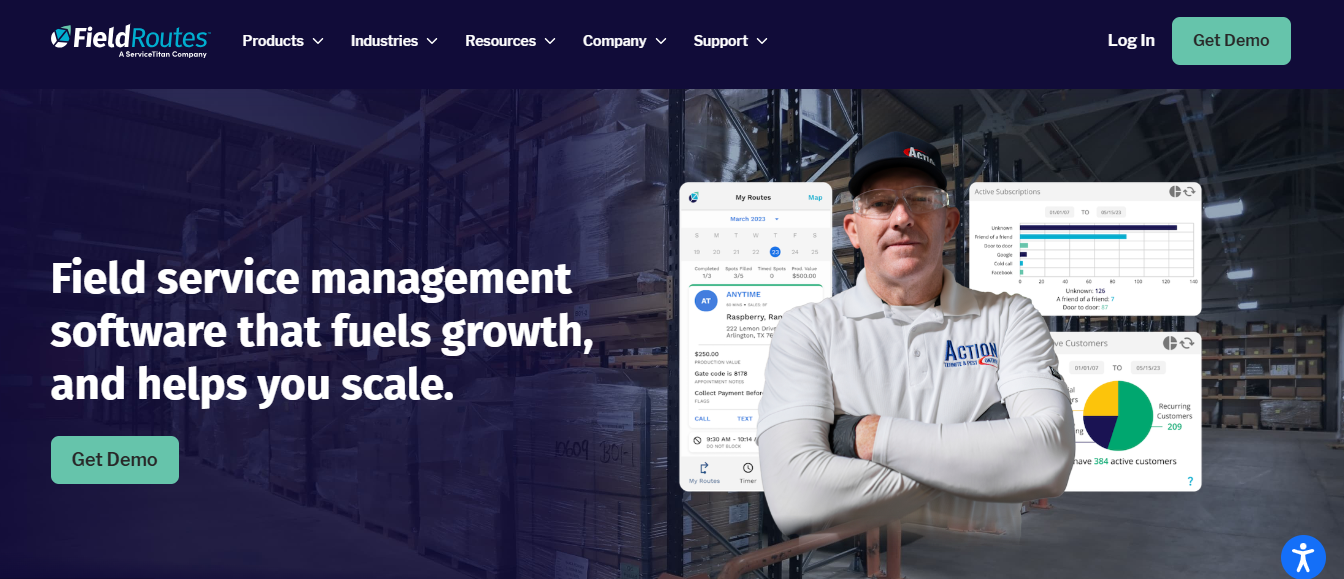
FieldRoutes is a pest-control-focused platform designed around scheduling, routing, CRM, billing, reporting and recurring service operations. Its routing engine can build schedules using technician skills, customer preferences, service dates and travel considerations, while its CRM keeps locations, balances and service requests together. It also provides commercial pest functionality, mobile tools and chemical or pesticide inventory capabilities.
The main consideration for an Australian buyer is regional fit. Much of FieldRoutes’ public compliance material references US requirements such as California WDO reporting and NPMA documentation, so businesses should establish which Australian-specific records and integrations would need configuration before purchasing.
Key Features:
Automated scheduling
Recurring service management
Route optimisation
Technician skill matching
Territory and route planning
Pest-control CRM
Pros:
-
Purpose-built for pest control
-
Strong recurring-service scheduling
-
Advanced route optimisation
-
Useful for large route volumes
-
Strong CRM
-
Commercial and multi-unit capabilities
-
Detailed operational reporting
-
Unlimited-user pricing approach
-
Suitable for businesses scaling service territories
Cons:
-
No free trial
-
Public pricing is not transparent
-
Implementation is more involved than lighter software
-
Australian businesses should carefully verify regional compliance and payment requirements because much of the product’s public regulatory content is US-focused
Pricing:
FieldRoutes uses custom pricing based on the business and selected capabilities. It does not offer a free trial because implementations are configured around individual businesses, but a free demonstration is available.
Best for:
FieldRoutes is best suited to larger or fast-growing pest control companies with high recurring-job volumes where routing, territories, automation and operational reporting are major priorities.
What Features Should Australian Pest Control Businesses Compare?
Pest control software should be evaluated against the work technicians actually perform. A business doing residential cockroach treatments has different requirements from a company managing commercial food sites, termite inspections or hundreds of recurring appointments.
Recurring Treatment Scheduling
Pest control is often repeat work.
Customers may need monthly, quarterly, annual or treatment-specific follow-up appointments. Software should make these visits easy to schedule without forcing staff to recreate every job manually.
Check what happens when one appointment in a recurring series changes. The system should allow the business to move the visit without losing the wider service schedule.
Route Planning and Technician Territories
A technician may complete many relatively short appointments in one day, making travel time a major part of operating cost.
Good route-planning software should help group jobs geographically, sequence daily stops and reduce unnecessary backtracking.
For growing businesses, also check whether routes can be adjusted when a cancellation, urgent treatment or technician absence changes the day.
Chemical and Pesticide Records
Chemical documentation is one of the biggest differences between pest-control software and generic scheduling applications.
Look for the ability to record information such as:
- Product used
- Quantity
- Treatment area
- Target pest
- Application method
- Technician
- Service date
- Relevant product or registration information
Australian chemical products are regulated nationally through the APVMA, which maintains the PubCRIS database of registered agricultural and veterinary chemical products and approved product information.
However, the exact records a pest management business needs to keep can depend on where it operates and the type of treatment performed.
Australian Licensing and Compliance
Do not buy pest-control software on the assumption that a button labelled “compliance” automatically satisfies Australian law.
Requirements can differ by jurisdiction. For example, NSW has specific licensing, training and record-keeping requirements for pest management technicians and fumigators, while Queensland requires a current pest management licence for regulated pest management activity using pesticides or fumigants.
Software should make it easier to capture the required information, but the business remains responsible for confirming the rules that apply to its technicians and services.
Mobile Field Access
Technicians should be able to see the customer, site, treatment history, instructions and required documentation from their phone or tablet.
Offline access can matter when work takes place in basements, plant rooms, rural properties or other locations with poor connectivity.
Inspection Forms, Photos and Signatures
A completed pest-control visit may involve more than marking a job “done.”
Technicians may need to document pest activity, conducive conditions, treatment locations, chemicals used, recommendations, photographs and customer acknowledgement.
Digital forms can make these records easier to standardise across technicians.
Termite and Asset Tracking
Businesses performing termite work should look more closely at inspection records, property diagrams, device or bait-station management and treatment history.
Commercial pest companies may also need to track monitoring devices, traps and individual site locations over repeated visits.
This is an area where specialised products such as PestPac and Nexus may offer advantages over broader service-management software.
Customer Communication
Customers want to know when the technician is arriving, whether the visit has been completed and what happens next.
Useful functionality can include:
- Appointment confirmations
- Reminders
- On-the-way notifications
- Live ETAs
- Treatment reports
- Follow-up reminders
- Online booking
- Customer portals
Automating routine communication can reduce the number of calls the office needs to make during a busy day.
Reporting
Pest-control reporting should help answer operational questions such as:
- How many treatments does each technician complete?
- How much time is spent travelling?
- Which service areas generate the most repeat work?
- Which customers are due for another visit?
- How frequently are callbacks occurring?
- Which products are being used most often?
- How many recurring services are coming due?
The right reporting depends on whether the business is focused on residential routes, commercial contracts, termite work or a mixture of services.
Why Choose Arrivy for Pest Control Software in Australia?
Arrivy is most relevant when a pest control company’s main challenge is coordinating recurring jobs, technicians, routes, field records and customers throughout the working day.
Its pest control business software connects scheduling and dispatch with route planning, live technician activity, digital forms, customer ETA notifications and recurring service work. Technicians can also continue accessing job information and completing field documentation offline.
Consider a pest business with six technicians covering several suburbs. One customer cancels, another needs an urgent treatment and a technician finishes early. Arrivy gives the dispatcher a live view of jobs and locations so the day’s appointments can be adjusted without relying on repeated phone calls.
The digital side is equally important. Treatment forms, photographs, signatures, notes and other visit records can remain attached to the relevant job instead of being spread across paper sheets and individual phones.
There is an important distinction, though. Products such as Nexus, GorillaDesk and PestPac provide deeper pest-specific functions in areas such as chemical inventories, specialist pest records or termite functionality. Australian businesses with those requirements should compare that depth carefully.
Arrivy is a stronger fit when the priority is field execution: getting the right technician to the right pest-control job, keeping the schedule moving, documenting the visit and keeping the customer informed.
Conclusion
The best pest control software in Australia depends on what your business needs to control most closely.
Nexus Service Manager stands out for its Australian development, local support and pest-specific business management. GorillaDesk provides strong chemical tracking and recurring-route tools, while PestPac offers deeper functionality for large commercial, termite and multi-location operations. Jobber is a practical choice for smaller service businesses that want scheduling, quoting, invoicing and customer management without moving into a heavier enterprise system. FieldRoutes is built for pest companies managing higher recurring volumes and more advanced routing requirements. Arrivy is particularly relevant when pest control businesses want scheduling, route optimisation, technicians, digital field records and customer communication to stay connected as work moves through the day.
Before choosing software, test it with a realistic week of pest-control work. Include recurring services, an urgent treatment, route changes, chemical records and a customer follow-up. That will tell you far more about the fit than a long feature checklist.