 Login
Login






















A Bill of Lading, or BOL, is the backbone of every professional move. It’s the legal paper (or digital file) that says what was picked up, who picked it up, where it’s going, and who is responsible for what along the way. For movers it’s a contract, a receipt, and the single most important record when customers question charges, file claims, or ask for proof of delivery. This blog walks through the BOL’s parts, the problems with paper, and a practical path to digitize the document using field service software like Arrivy.
Recommended Reads
What Is a Bill of Lading in Moving?
In moving, the BOL is the formal document a carrier issues before loading goods. It’s not optional since the FMCSA requires movers to issue a BOL prior to loading. The BOL names the shipper (the customer) and the carrier (the moving company), lists pickup and delivery addresses, records inventory and condition, and sets out rates and payment terms. When signed at pickup and again at delivery, it becomes the audit trail that proves what was agreed and what actually happened.
Residential carriers use the BOL as a receipt for the household goods being moved. It documents the items on the truck and their condition so movers and customers agree on what was transported and when signatures were taken. Commercial carriers use the BOL as a contract of carriage and a receipt of goods. It establishes chain of custody, supports invoicing (internal and external), and fulfills contractual or reporting obligations. Usually the carrier prepares the BOL, and both parties review and sign it to lock in the legal terms.
Key Elements of a Moving Bill of Lading
A complete BOL contains several mandatory and practical fields. If any are missing, you create problems and delays on move day and risk future disputes.
- Shipper and carrier details: Legal names, addresses, and contact numbers for both sides.
- Pickup and delivery addresses: Exact service addresses, plus any special access notes.
- Itemized inventory or shipment description: Count, weight or estimated volume, and notes on special or high-value items.
- Valuation coverage/insurance declaration: What the carrier is liable for, whether the customer bought additional coverage, and how claims are handled.
- Rates, charges, and payment terms: Binding or non-binding, estimates, accessorials (additional services), and accepted payment methods.
- Signatures: Sign-off by shipper at pickup and recipient (or agent) at delivery; carrier signature at relevant stages.
Types of Bills of Lading in the Moving Industry
Not every BOL is the same. The terms in a BOL determine how final charges are calculated and who carries pricing risk.
-
1. Binding Estimate BOL: The customer pays exactly what’s quoted. If the carrier underestimates, the carrier absorbs the difference. This gives customers price certainty.
2. Non-Binding Estimate BOL: Final charges depend on actual weight, services, or time. The estimate is a guideline; final billing can vary.
3. Not-to-Exceed BOL: The carrier guarantees the customer will not pay more than the estimate, though final charges may be lower.
Ocean, air, and rail BOLs exist, but for household and commercial moving the three above are the most common and the most important to get right on the paperwork.
Challenges with Paper-Based BOLs in Moving
Paper BOLs break in obvious ways. They get lost, torn or misplaced in vans and warehouses. Handwritten inventories suffer from illegible entries and omitted fields. Moreover, customers frequently miss fine print and misunderstand valuation terms, which turns routine billing into a complaint or a chargeback. The absence of timestamped, searchable records slows claims processing and drags out cash collection.
These bottlenecks are not small when the industry’s revenue footprint is large. The moving services market was about $21.694 billion in 2023, and the broader moving sector pulls in roughly $86 billion annually. When average transaction revenues fall in the $500 to $2,000 range, repeated administrative problems eat into your already thin margins. And peak season makes the problem worse. Almost 60 percent of moves fall between May and August, and that seasonal concentration magnifies every paperwork failure.
What is an Electronic Bill of Lading (eBOL) for Movers?
An electronic BOL is the same legal document, created, signed, and stored digitally. When you implement it properly, it satisfies FMCSA rules that accept electronic signatures and electronic records, provided the signature method meets legal standards and the data is retained and accessible.
Key characteristics of an eBOL:
- It mirrors the paper BOL’s fields in a structured template.
- It accepts electronic signatures on phones or tablets.
- It stores the record securely in the cloud and allows instant sharing with customers and back-office teams.
- It ties directly to digital inventories, photos, and timestamps for a single source of truth.
Platforms that support eBOLs reduce the time from job completion to invoicing and give customers clarity at every step.
Why Moving Companies Should Digitize Their Bill of Lading
Digitization practically changes the following things on move day:
Speed: Crews finish sooner when fields auto-fill and signatures happen on a device already in hand. Faster sign-off means crews move to the next job sooner.
- Fewer disputes: Digital inventories with timestamps and photos leave little room for “he said / she said.”
- Transparency: Customers get a copy of the BOL immediately and can review charges and valuation terms before the crew leaves. That reduces call-backs and chargebacks.
- Better flow into billing: An eBOL feeds proof-of-delivery and invoicing in one continuous stream. That shortens DSO and reduces administrative rework.
- Sustainability and storage: Less paper and fewer filing rooms in the office. Cloud storage means instant retrieval for audits and retention policies while cutting hidden emissions from printing and couriering.
- Scalability: eBOLs standardize data capture across crews and sites so the same process scales from a single truck to hundreds. Templates and integrations with dispatch and accounting let you handle peak volume without extra staff.
These benefits matter more in a market where a moving business’s annual revenue often approaches seven figures. Small efficiency gains from digitizing BOLs and the subsequent steps (proof of delivery, invoicing, audit trail, etc) pay off in big numbers.
How to Digitize the Bill of Lading (Step-by-Step for Movers)
Digitizing a BOL is a workflow change, and once implemented properly, it smooths out the entire operation. Follow these practical steps in Arrivy.
Create a digital BOL template
Build a template that mirrors your legal BOL. Pre-fill job details automatically from estimates or booking data.
Capture e-signatures on-site
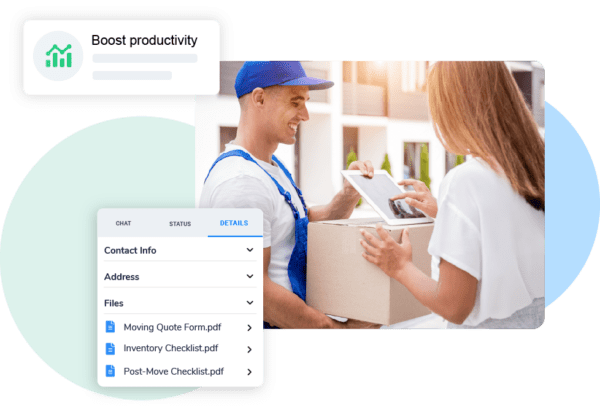
Use the Arivy app on tablets or phones. Make signature capture part of the crew’s final tasks. Sign, timestamp, and upload.
Attach digital inventories and photos
Link photos to specific line items or damage notes. A picture next to an item reduces the need for future back-and-forth.
Sync with CRM / moving management software
Integrate your key systems, like CRM or any software you use for operation management, communication, and lead capture, to avoid re-entry. The integration allows pushing job data from booking to crew assignment to BOL without manual effort.
Store automatically in the cloud
Set retention rules for compliance and save all job data (including all documents and timestamped events) on the cloud. This makes data retrieval simple for claims or audits.
Connect to proof of delivery and invoicing
When the BOL closes, trigger proof-of-delivery records and a draft invoice by integrating with your financing system (QuickBooks, Xero, etc). That keeps cash flow predictable.
This sequence keeps the crew focused and the back office out of triage mode.
How Arrivy Helps Moving Companies Beyond Digitizing the Bill of Lading
Arrivy layers practical features onto this workflow to remove the busywork.
Ready-to-use BOL templates
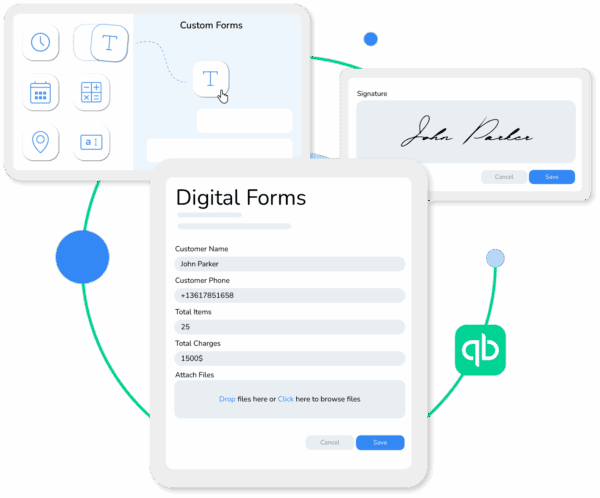
Arrivy offers standardized, industry-friendly forms that auto-populate from jobs, tasks, and schedules. You can customize the fields as per your state/region requirements.
E-signatures on any device
Customers and crews sign on phones or tablets, and this requires no printing or scanning of the documents.
Real-time updates during the move
One of the most important features is crew activity tracking (start, transit, completion). These status updates sync live to the office, so everyone sees the same information.
Proof of delivery + linked docs
Photos, notes, and signatures attach to the BOL and stay linked to the job record.
Compliance & storage
Secure cloud storage and a journaled audit trail record every edit and signature for quick retrieval.
End-to-end workflow
Connect the entire operation from estimate to BOL to job execution to POD to invoice. Arrivy keeps the chain intact so documents don’t get lost between teams.
These features target the exact pain points that cost time and money on busy move days. By organizing the workflow, teams move faster, documentation stays intact, stakeholders stay updated, and cash flow improves.
When You Finally Go Paperless with Digital BOLs
Have you considered the productivity gains when you adopt digital BOLs? Say that you are a mid-size mover doing 1,200 moves a year. You switch from paper BOLs to a digital workflow. The workflow would look like this for you:
As a result, you have fewer billing disputes, faster invoicing, and an overall smooth operation instead of dealing with messed-up paperwork.
ROI of Digital BOLs for Moving Companies
ROI starts with two simple facts: labor is the largest moving expense, and disputes are an invisible cost. Digitizing the BOL reduces administrative touchpoints, shortens dispute resolution, and speeds invoicing. That translates into measurable outcomes you can track:
- Lower administrative hours per job (fewer calls and less data entry).
- Faster cash collection (invoices tied to a finished, signed BOL move into billing automatically).
- Fewer write-offs for disputed claims (photo-backed evidence closes more claims in favor of the carrier).
- Higher customer experience (instant records and clear terms reduce complaints and drive referrals).
Construct a simple ROI model for your company. Multiply reduced administrative hours by labor cost, add estimated reductions in disputed revenue, and subtract subscription or implementation costs. For many operators, the payback on software investments arrives within months and compounds significantly over the years.
Think About the Numbers
If digitizing BOLs saves 10 admin hours a week at $30/hour, that’s $300 weekly or $1,200 a month.
Add another $500/month from fewer disputes → Total savings: $1,700/month.
And that’s before factoring in other Arrivy features (automated scheduling, real-time crew tracking, and digital proof of delivery), which cut overtime, reduce missed jobs, and speed up billing. Those savings stack on top of the BOL benefits and create a compounding return that goes well beyond paperwork reduction.
Summing Up
In moving, the Bill of Lading is the legal and operational record that underpins delivery, liability, and payment. Paper BOLs create repeated costs in terms of lost time, slow invoices, and avoidable disputes. Digitizing the BOL with a field service platform that ties estimates, jobs, photos, and signatures into one record removes those problems from where they originate. It replaces paper and makes the move-day workflow predictable and auditable.