 Login
Login






















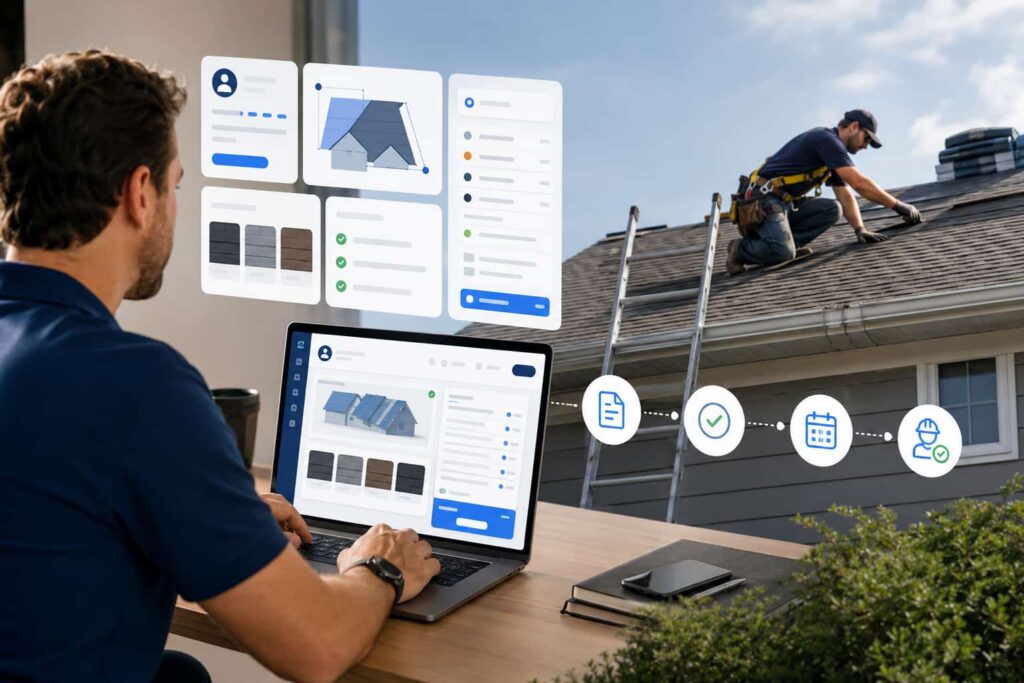
Roofing contractors deal with constant pressure to produce estimates that are fast, precise, and easy for customers to review. Manual measurements, scattered notes, and spreadsheet-based calculations slow down the process and often introduce avoidable errors. In an industry where timing decides whether a contractor wins or loses a job, the need for reliable estimating software is unavoidable.
IBISWorld reports that the U.S. roofing industry includes more than 27,000 businesses and generates over $81 billion in annual revenue. With increasing competition, contractors are turning to software for improved estimate consistency, reduced administrative overhead, and better coordinated field operations.
This guide reviews the top six roofing estimating software tools for 2026. You will see what each platform offers, who it serves best, and where it may fall short. Arrivy appears on this list as the option suited for teams that want a connected system for scheduling, digital forms, routing, crew management, customer communication, and estimate creation.
Whether your roofing business handles residential replacements, commercial inspections, or high-volume service calls, this guide will help you choose software that improves operations and supports accurate estimating.
Recommended Reads
Who This Guide Is For
This guide supports roofing businesses that manage structured operations and require dependable estimating tools for daily work. It is written for contractors who run small to large teams, office staff responsible for scheduling or coordination, and business owners who want a system that connects estimating with field execution.
What Is Roofing Estimating Software?
Roofing estimating software replaces manual calculations with digital tools that help contractors price materials, labor, and measurements more reliably. These platforms support common tasks such as building estimates, producing proposals, and organizing job details in one place. Many tools also import aerial or satellite measurements to speed up the pre-estimate process. The right choice depends on how your roofing business operates and the level of automation your team needs.
Types of Roofing Estimating Tools
Roofing estimating tools fall into three main categories. Each type serves different parts of the estimating workflow, so roofing businesses often use more than one system to support office and field teams.
1. Measurement and Takeoff Tools
These platforms focus on aerial, satellite, or drone-based measurements. They help contractors calculate roof dimensions quickly and prepare material lists. Tools like RoofSnap and Roofr fit this category.
2. CRM and Job Management Systems
These tools support lead tracking, proposals, scheduling, invoicing, and communication. They help office staff manage the full customer cycle. JobNimbus and Jobber are examples of this group.
3. Field Operations and Workflow Platforms
These systems connect estimating with scheduling, routing, digital forms, territory management, and crew coordination. They support multi-step workflows for teams working across different job types or locations. Arrivy fits into this category.
These categories create a background knowledge to understand why modern roofing businesses are shifting toward software-driven estimating.
Why Roofing Estimating Software Matters in 2026
Roofing businesses face rising material costs, higher customer expectations, and tighter competition. Accurate estimates play a direct role in winning jobs and protecting profit margins. Software helps teams handle these demands with consistent pricing, organized job data, and faster proposal turnaround times.
Industry projections indicate continued growth in the roofing sector over the next decade ($33 billion by 2030), increasing pressure on contractors to manage estimates accurately and coordinate teams efficiently. While software cannot control material prices, it helps teams track costs, document estimates, and maintain consistent workflows as project volumes increase.
Key Features of the Best Roofing Estimating Software
Roofing teams depend on reliable tools to price jobs, organize project details, and keep field and office teams aligned. The following features often guide contractors when comparing platforms.
1. Roofing Measurement and Takeoff Tools
Software that uses aerial, satellite, or drone data helps contractors quickly measure roof sections. Field teams can verify dimensions during inspections to keep estimates accurate.
2. Roofing Estimate Templates and Material Lists
Reusable templates for roof systems, labor rates, and material packages help teams produce estimates with consistent pricing across different job types.
3. Roofing Proposal and Document Creation
Contractors can prepare branded digital proposals, attach photos, and collect signatures. Clear documents help customers review pricing without delays.
4. CRM and Roofing Job Management Connections
Linking estimates with customer records, job files, and schedules reduces repetitive work for office staff. Estimates move smoothly into the job pipeline when the customer approves the proposal.
5. Mobile Roofing Apps for Field Teams
With mobile apps, crews can capture photos, complete inspection forms, and update job notes on site.
6. Digital Roofing Forms with Calculation Fields
Some platforms offer custom forms for inspections, material counts, and cost calculations. These fields can be configured to calculate totals within the form, depending on setup and workflow design.
7. Routing and Scheduling Tools for Roofing Estimates
Routing features help assign estimates to the right team based on location, job type, or skill set. Scheduling tools help contractors manage inspection visits and avoid overbooking.
8. Territory or Multi-Location Support
Businesses that cover multiple service areas can divide jobs by region, ZIP code, or crew type. This structure keeps assignments organized and reduces travel time.
9. Roofing Photo Documentation and Job Records
Field staff can record before-and-after photos, attach notes, or add inspection details.
10. Integrations with Accounting, CRM, and Field Tools
Connections with platforms like QuickBooks, HubSpot, Xero, Pipedrive, or ERPs help contractors keep financial and customer data consistent across the business.
11. Clear and Predictable Pricing
Contractors often look for platforms with straightforward pricing that avoids extra fees for users, measurement reports, or add-ons.
With these features in mind, the next step is to decide which platform fits your operating style and long-term plans.
Want to Bring Structure to Your Roofing Operations?
Roofing software helps manage scheduling, crews, jobs, and customer communication in one place.
How to Choose the Right Roofing Estimating Software
Roofing businesses should select estimating software based on long-term operational needs. Below are important points to consider when making a decision:
✓
Assess the learning curve and onboarding requirements<br />
✓
Review support availability and vendor reliability
✓
Consider scalability for growing teams
✓
Evaluate reporting and visibility needs
✓
Check user permissions and access control
✓
Validate data handling and security standards
✓
Consider the long-term fit with your business model
Quick Overview of the Top 6 Roofing Estimating Software
This table provides a quick comparison of the leading roofing estimating software tools in 2026. Contractors can use it to match each platform with their operational needs.
| Tool | Best For | Not Ideal For | Published Pricing | Free Plan | Free Trial | Average Rating |
|---|---|---|---|---|---|---|
| Arrivy | Workflow automation, routing, scheduling, digital forms, and customer communication | Teams that only need simple measurement reports | Starts at $75 for 3 users per month | No | 14 days | 4.8 |
| ServiceTitan | Large or multi-crew operations with CRM, dispatch, and reporting needs | Small teams | Custom pricing | No | Demo only | 4.7 |
| JobNimbus | Contractor-focused CRM and job management | Teams that prefer fixed per-user pricing | Custom pricing | No | 14 days | 4.6 |
| RoofSnap | Fast roof measurements and estimate creation | Companies needing broad field coordination features | Published plans start near the $100/user range | Pay-as-you-go | 7 days | 4.5 |
| Jobber | Small to mid-size contractors needing scheduling, invoicing, and basic estimating | Teams needing roofing-specific features | Published plans start around the $90–$250 per month range | No | 14 days | 4.5 |
| Roofr | Quick measurements, proposals, and light CRM tasks | Large teams with complex workflows | Pro Plan starts around $89–$99 per month | Pay-as-you-go | Varies by plan | 4.6 |
Note: Pricing reflects publicly available information at the time of writing and may vary by plan, usage, or region. Contractors should confirm details directly with vendors.
How We Evaluated These Roofing Software
We reviewed more than twenty roofing and field-service platforms before selecting the six tools featured in this guide. Our evaluation focused on criteria that matter to roofing companies managing residential and commercial projects. Each platform was assessed using the points below. It is important to note that the list we finalized is not exhaustive. Some broader construction platforms offer estimating or scheduling features, but were not included if estimating was not their primary focus.
1. Practical Usability
We looked at how easily office staff and field crews can learn the system. A strong tool supports quick adoption, clear layouts, and predictable workflows.
2. Core Estimating Capabilities
We checked whether each platform supports accurate pricing, proposal creation, and job documentation. Tools that help teams handle estimates from start to finish received a higher weight.
3. Workflow and Coordination Functions
Routing, scheduling, job tracking, notifications, and team assignment influence how smoothly roofing jobs progress. We gave preference to platforms that support these tasks in a structured way.
4. Integration Strength
Many roofing businesses use accounting systems, CRMs, or measurement tools. We reviewed which integrations each platform offers and how easily data moves between systems.
5. Scalability and Pricing Structure
We compared published pricing, flexibility for different team sizes, and cost transparency. We also considered how well each tool adapts as a business grows.
6. Customer Ratings and Feedback
We reviewed user feedback from G2 and Capterra and applied our own scoring model to assign ratings. These reviews helped validate performance claims and reveal practical strengths or limitations.
This evaluation approach helped us present a fair comparison that reflects the day-to-day needs of roofing contractors. Our evaluation references publicly available product documentation, user feedback on review platforms, and widely used workflows across roofing businesses.
Spend Less Time Managing, More Time Roofing
Reduce back-and-forth calls and paperwork with simple tools built for roofing teams.
Detailed Reviews of the Top 6 Roofing Estimating Software Tools in 2026
Below are detailed summaries of the six roofing software platforms included in this guide. Each tool offers a different mix of estimating, management, and coordination functions. These reviews help contractors understand where each option fits within daily roofing operations.
1. Arrivy — Best for Workflow Automation and Connected Roofing Operations
Arrivy supports roofing companies that want to connect estimating with the day-to-day work by office staff and field crews. It provides tools that help teams manage estimated visits, inspections, follow-ups, and customer communication in one system. The platform suits contractors who handle several job types and need reliable coordination between their schedulers, estimators, and crews.
Roofing teams can build digital estimate forms, assign jobs by territory, and track estimator skills to match each visit with the right person. The system also records photos, notes, and inspection details, which helps estimators prepare accurate proposals and maintain consistent job files.

Key Features include:
Routing Forms for Lead Qualification
Roofing companies can create forms that ask customers specific questions based on the service needed. This helps office teams avoid manual sorting of leads.
Territory Management for Regional Assignment
Contractors working across multiple cities or ZIP codes can assign territories to estimators or crews.
Static Booking Calendars with Job Type Variables
Teams can set capacities for different roofing services, such as residential inspections or commercial estimates.
Custom Digital Forms with Calculation Fields
Roofers can create forms that include fields for material counts, labor time, square footage, and custom cost formulas. These fields calculate totals inside the form, helping estimators avoid manual errors. Teams using Arrivy’s survey-to-estimate workflow automation can generate estimates faster with fewer errors.
Skill-Based Assignment
Arrivy allows managers to tag team members with skills such as “Metal Roofing,” “Sloped Roof Estimator,” or “Commercial Roofing.”
Linked Tasks for Multi-Step Jobs
Inspections, follow-up visits, and revisions can be linked together under a single job record. This gives the office team a clear view of all related activity for each customer.
PDF Annotation and Documentation
Estimators can add drawings, signatures, dates, and notes directly to PDF files.
Customer Communication and Tracking
Arrivy automatically shares live ETAs, arrival updates, and status notifications with customers. This helps reduce no-shows and missed appointments for teams that consistently use automated customer notifications.
Integration Options
Arrivy integrates with CRM platforms such as Pipedrive, HubSpot, and Salesforce, as well as accounting tools like QuickBooks and Xero. These integrations allow teams to sync customer and job data, while financial workflows may require configuration or third-party setup depending on business needs.
Pros
Cons
Best For: Roofing companies that want a connected operational system for inspections, estimates, routing, and communication.
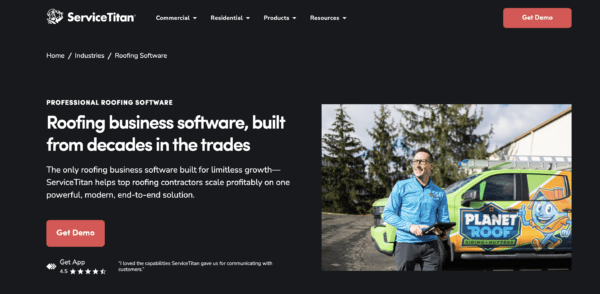
2. ServiceTitan — Best for Large Roofing Operations
ServiceTitan serves roofing companies that manage several crews, office staff, and complex workflows. It offers CRM tools, dispatching, reporting, and financial tracking.
Key Features
- CRM tools for lead tracking and follow-ups
- Advanced dispatch board with drag-and-drop scheduling
- Job costing and financial reporting
- Mobile access for field staff
- Integrations with accounting platforms
Pros
Cons
Best For: Enterprise-level roofing companies with multi-crew operations.
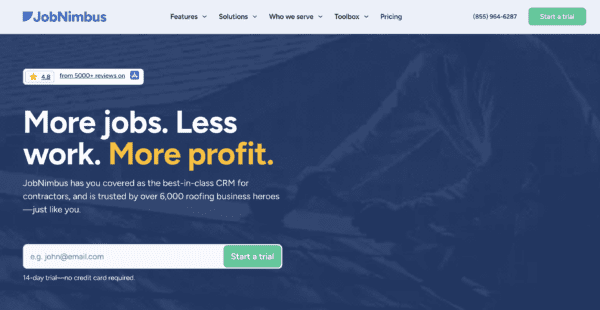
3. JobNimbus — Best for Contractor-Focused CRM and Project Management
JobNimbus focuses on CRM and project management needs for roofing contractors. The platform helps teams organize leads, proposals, schedules, and job files in one place.
Key Features
- Roofing-focused CRM framework
- Estimate creation and proposal management
- Task and job tracking
- Integrations with measurement tools and accounting systems
Pros
Cons
Best For: Mid-size roofing companies that depend on CRM-driven operations.
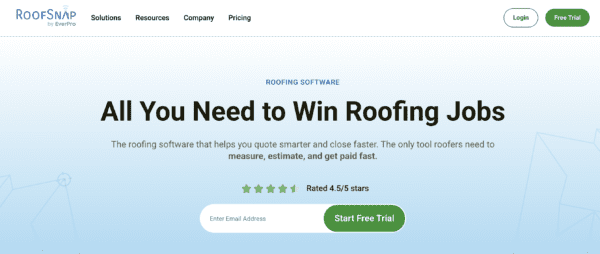
4. RoofSnap — Best for Measurement and Fast Estimate Creation
RoofSnap supports contractors who want fast measurement reports and quick estimate generation. The platform uses aerial and satellite imagery to prepare roof outlines and material lists.
Key Features
- Aerial and satellite measurement tools
- Estimate generation based on roof diagrams
- Mobile app for on-site updates
- Material and labor cost inputs
Pros
Cons
Best For: Small roofing teams that prioritize measurement speed and estimate accuracy.
5. Jobber — Best for Small to Mid-Size Contractors Handling Daily Operations
Jobber supports day-to-day operational tasks, including scheduling, invoicing, estimating, and customer communication.

Key Features
- Scheduling and dispatching tools
- Invoicing and payment collection
- Customer communication and reminders
- Mobile app for field staff
Pros
Cons
Best For: Small to mid-size roofing companies that want general service management tools.
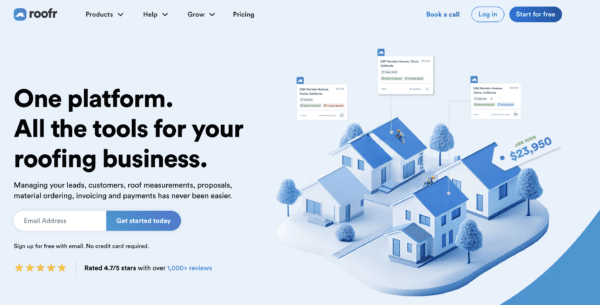
6. Roofr — Best for Quick Measurements and Proposal Building
Roofr offers measurement reports, proposals, and basic CRM functions for roofing contractors.
Key Features
- Measurement reports at flat rates
- Proposal builder
- Basic CRM features and pipeline tracking
- Integration options for material lists
Pros
Cons
Best For: Contractors who want quick measurement delivery and simple proposals.
Feature-by-Feature Comparison Matrix
This comparison matrix highlights the operational differences between the six roofing software platforms.
Roofing Estimating Software Buyer’s Checklist
Contractors often keep a printed version on hand during demos or internal evaluations. Use this checklist to assess whether a roofing estimating software supports your operational and financial goals. Check each item as you confirm the capability.
Conclusion
Roofing companies handle a mix of estimating, scheduling, crew coordination, and customer communication throughout each job cycle. Software plays a practical role in keeping these tasks organized and reducing the time spent on manual steps.
The tools reviewed in this guide offer different strengths. Arrivy stands out for teams that want estimating to connect closely with scheduling, routing, digital forms, and field coordination. Contractors should evaluate how much operational integration they need alongside estimating when selecting a platform.
The right software depends on the size of your team, the type of projects you handle, and how closely you want estimating to connect with the rest of your operations. Evaluating these needs carefully helps roofing contractors choose a platform that supports reliable estimating and smoother job execution.
Get Clear Visibility Across Crews and Jobs
This guide was prepared by the Arrivy content team, specializing in workflow and operations systems for field-service businesses. It is based on publicly available product documentation, industry research, and user feedback from software review platforms. Feature availability may vary by plan or configuration.