 Login
Login



















Quick Answer:
Q. What Is the Best Field Service Management Software for Construction?
Construction field service management software gives contractors a single operational record that moves with the job, from the first site survey through crew assignment, on-site documentation, and final payment collection.
The right platform eliminates handoff gaps that cause delays: missing permits before a crew arrives, undocumented labor hours that stall invoicing, or customer calls chasing status updates that no one has sent.
Key capabilities to prioritize:
- Mobile job access for field crews
- Structured digital documentation
- Automated client notifications
- Two-way sync with estimating and accounting systems
Arrivy handles all of these for construction businesses.
Construction projects involve dozens of handoffs, and every delay in scheduling, documentation, or billing slows down cash flow.
A lead turns into a site survey. The survey becomes a quote. The quote becomes a scheduled job. Crews complete the work. Supervisors collect photos, forms, and digital timesheets. Finance sends the invoice.
Each step depends on accurate information. Still, many construction companies manage these steps manually.
According to McKinsey & Company, construction productivity improved by only 10 percent between 2000 and 2022, compared with a 50 percent improvement across the total economy.
One reason is that critical job information often remains fragmented across disconnected systems.
Field service management software for construction addresses this problem by integrating scheduling, field execution, and billing on a single platform.
This guide explains what construction field service management software does, where construction operations break down, and how Arrivy helps construction teams keep every phase connected from survey to payment.
What Is Construction Field Service Management Software?
Field service management software for construction is the operational system that turns approved work into scheduled, documented, and billable jobs.
It connects your office team, field crews, subcontractors, and customers into a single workflow. Once a project is ready to execute, the software handles the day-to-day operational work.
In practical terms, construction field service management software sits between your CRM and your accounting system. It takes the information collected during sales and estimating and turns it into work your field teams can execute.
At a glance, here is how it fits into your technology stack:
| Tool | Manual Tracking | Automated Tracking |
|---|---|---|
| CRM | Tracks leads and deals | Does not manage field execution |
| Construction management software | Manages budgets, contracts, and project timelines | Focuses on project controls rather than daily field operations |
| Construction field service management software | Manages scheduling, dispatch, work orders, and billing | Connects field operations from start to finish |
Construction companies use this software to:
Schedule site surveys, installations, inspections, and service visits
Dispatch crews based on skill set, availability, and location
Share permits, drawings, and work orders with field teams
Capture photos, forms, signatures, and timesheets
Send automated customer updates
Generate invoices from completed work
Arrivy combines these capabilities in one platform. It helps construction companies connect scheduling, field execution, customer communication, and billing in a single workflow.
What Construction Field Service Software Does for Your Operation?
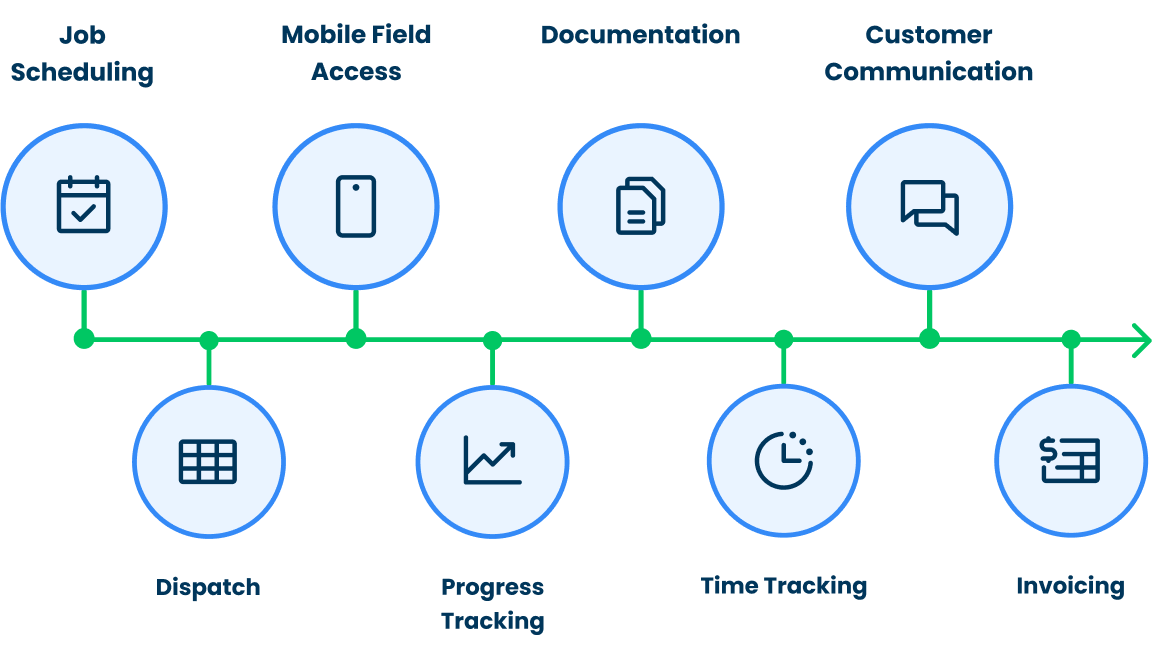
Construction field service management software manages the operational tasks that keep construction jobs on schedule and fully documented.
It gives your team one system to plan work, coordinate crews, capture field data, and close jobs faster.
Here is what the software does in practice:
| Operational Need | How FSM Software Supports It |
|---|---|
| Job scheduling | Assigns crews, equipment, and subcontractors based on availability and skill set |
| Dispatch | Sends work orders, drawings, and schedule updates to field teams in real time |
| Mobile field access | Gives crews access to job details, forms, and checklists from a mobile app |
| Progress tracking | Shows live job status across active job sites |
| Documentation | Captures photos, notes, signatures, and inspection records |
| Time tracking | Records labor hours by crew, task, or subcontractor |
| Customer communication | Sends confirmations, ETAs, and completion updates automatically |
| Invoicing | Converts completed work into billable records |
| Reporting | Tracks productivity, delays, and operational performance |
Construction companies often adopt field service software for contractors when spreadsheets and manual updates no longer support the volume and complexity of their work.
As job counts increase, construction scheduling software keeps crews organized.
Where Construction Operations Break Down
Construction operations break down when critical job information does not move cleanly from one stage to the next.
The estimate may be accurate, but site notes never reach the scheduler. The job is scheduled, but the crew does not receive the latest drawings or permits. The work is completed, but photos, signatures, and timesheets are missing when the invoice is due.
This creates problems at every stage of execution.
Dispatchers schedule work without a full project context.
Field teams spend time calling the office for missing information.
Project managers rely on manual updates to track progress.
Billing teams wait for documentation before they can invoice.
Customers receive inconsistent updates.
These issues become more frequent as job volume increases and more crews, subcontractors, and active sites need to stay coordinated.
Labor shortages add further pressure. According to the Associated General Contractors of America, 92 percent of construction firms report having a hard time filling open positions, and 45 percent say those shortages have already delayed at least one active project.
Arrivy helps construction companies maintain work continuity, so every team works from the same job record from the initial survey to the final invoice.
Benefits of FSM Software for Construction Teams
Construction field service management software improves coordination, visibility, and cash flow across construction operations. Key benefits include:
| Benefit | Impact on Construction Operations |
|---|---|
| Better scheduling and resource allocation | Assign the right crews and subcontractors based on availability, skills, and certifications |
| Faster field execution | Give crews mobile access to work orders, drawings, permits, and checklists without calling the office |
| Stronger documentation and compliance | Store photos, forms, signatures, and timesheets in one job record for compliance and customer approvals |
| Real-time visibility | Track jobs in progress, delayed, and completed without manual updates |
| Faster invoicing and cash flow | Generate invoices as soon as labor records and supporting documentation are complete |
| Improved customer communication | Send confirmations, ETAs, and status updates automatically to reduce inbound calls |
| Better reporting | Monitor labor, productivity, and project performance in one system |
Arrivy helps construction teams turn these operational improvements into faster, more predictable project delivery.
How Arrivy’s FSM Software for Construction Works End-to-End
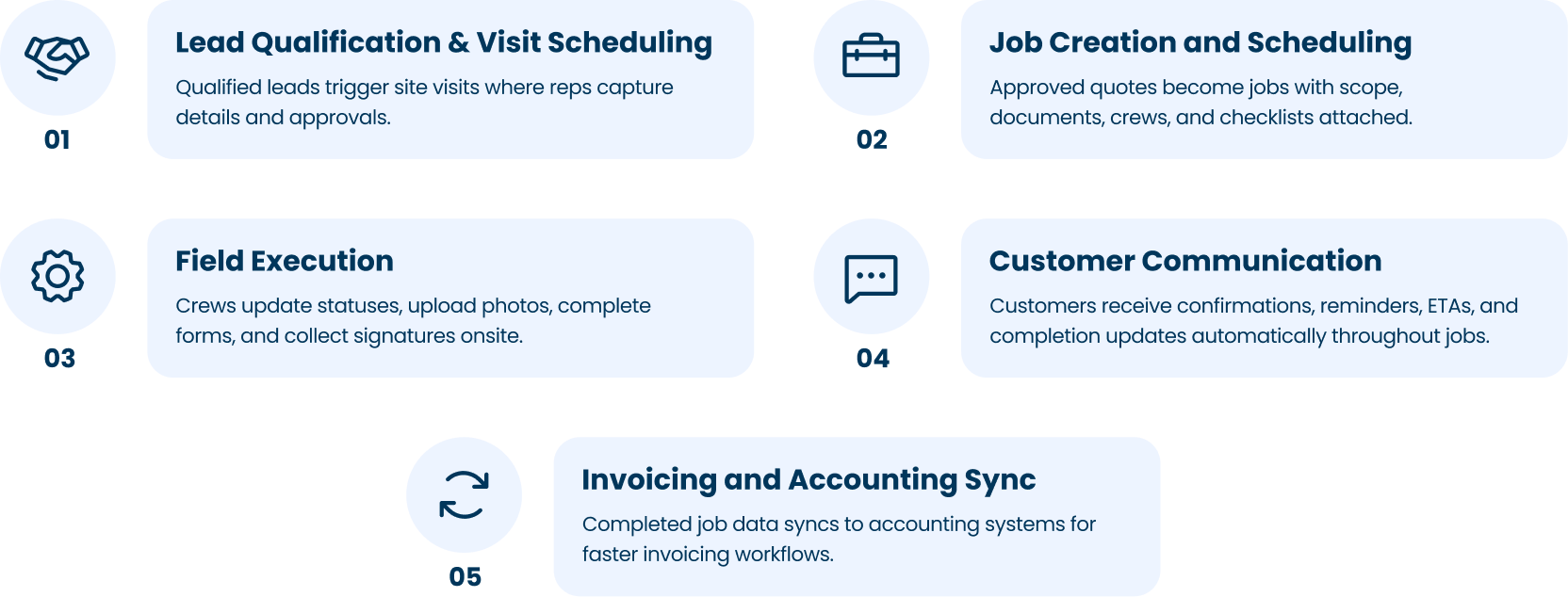
Here is how a construction contractor can move a job through Arrivy, from the first qualified lead to the final invoice
1. Lead Qualification and Site Visit Scheduling
When a lead reaches a qualified stage in your CRM, Arrivy automatically schedules a site visit. Customers can also book site visits directly through Arrivy self-scheduling, where the platform validates crew availability, skills, and location before confirming the appointment.
Sales reps receive the appointment in the mobile app, where they can review customer details, capture measurements, create a quote, and collect approval during the visit.
2. Job Creation and Scheduling
Once the quote is approved, Arrivy creates a job record with the scope details and supporting documents.
Dispatchers assign crews and subcontractors, and permits, drawings, and checklists are attached to the work order before the job begins.
3. Field Execution
Crews access the work order from the mobile app.
They update job status, upload photos, complete digital forms, record labor hours, and collect customer signatures on site.
4. Customer Communication
Customers receive automated confirmations, reminders, ETAs, and completion updates throughout the job.
5. Invoicing and Accounting Sync
When the work is completed, Arrivy syncs job data with accounting systems such as QuickBooks, Xero, etc., to support faster invoicing.
End-to-End Workflow Summary
| Benefit | Impact on Construction Operations |
|---|---|
| Qualified lead | Schedules site visits automaticallys |
| Site visit | Captures measurements and creates quotes |
| Approved quote | Creates a complete job record |
| Automated Scheduling/ Self-Scheduling | Assigns/book crews and subcontractors |
| Pre-job preparation | Shares permits, drawings, and checklists |
| Field execution | Captures status updates, photos, forms, and timesheets |
| Customer communication | Sends automated notifications |
| Invoicing | Syncs completed job data to accounting |
This workflow is especially valuable for contractors managing high volumes of site visits, installations, inspections, and warranty calls across multiple crews.
Want to see this workflow in action?
Sign up for free
Why Construction Teams Choose Arrivy Over Other FSM Tools?
Construction operations fail when the right information does not reach the right person at the right time. Arrivy solves this at the system level, and the results show up in measurable outcomes.
Customers save an average of 30% on operations time, generate 5x more customer reviews, reduce missed opportunities by 50%, and recover up to $50,000 annually in operational losses. Results like these come from teams that use Arrivy as their primary operations system.
This consistency shows up in how customers rate Arrivy. On G2, one of the most trusted software review platforms in the industry, Arrivy holds a 5/5 rating from verified users. Reviewers point to the same qualities across the board:
How Different Construction Teams Use Arrivy?
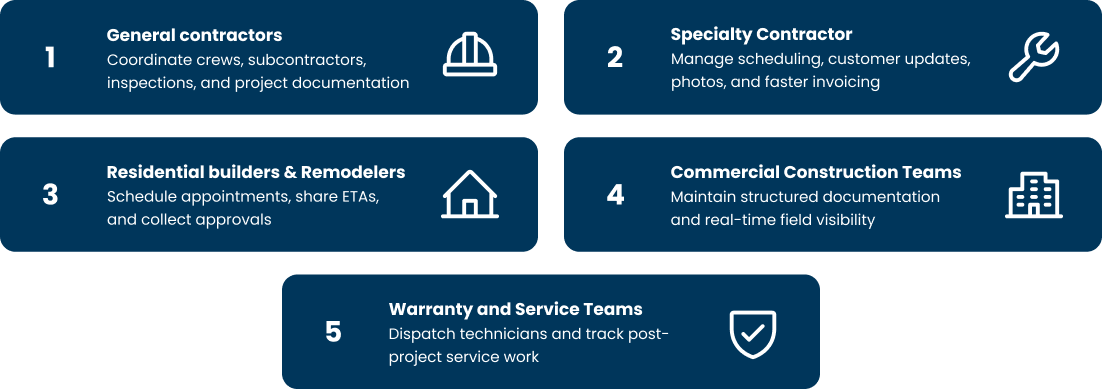
Construction companies may work in different trades, but the operational requirements are similar. Arrivy supports workflows across a wide range of construction businesses.
| Team Type | How Arrivy Helps |
|---|---|
| General contractors | Coordinate crews, subcontractors, inspections, and project documentation |
| Specialty contractors | Manage scheduling, customer updates, photos, and faster invoicing |
| Residential builders and remodelers | Schedule appointments, share ETAs, and collect approvals |
| Commercial construction teams | Maintain structured documentation and real-time field visibility |
| Warranty and service teams | Dispatch technicians and track post-project service work |
Whether you manage new construction, remodeling, specialty installations, or warranty work, Arrivy provides one system that manages your operations.
What to Look for in Field Service Software for Construction?
Before you select a construction field service management software platform, make sure it can support the operational demands of your projects.
Use the following questions to evaluate whether a platform will improve execution across your field and office teams.
☐ Does the software support the full workflow from site visit and quoting to scheduling, field execution, and invoicing?
☐ Can crews access work orders, drawings, permits, and checklists from a mobile app?
☐ Are photos, forms, signatures, and timesheets stored within the same job record?
☐ Does the platform work offline on job sites with limited connectivity?
☐ Can it integrate with your CRM and accounting systems?
☐ Does it support multi-stage projects involving surveys, installations, inspections, and follow-up visits?
☐ Will it reduce manual data entry and follow-ups?
☐ Can it scale as your project volume grows?
If a platform handles these requirements well, it will give your team better control over execution, documentation, and cash flow.
Conclusion
As project volume increases, operational efficiency depends on how reliably information moves between sales, scheduling, field teams, and finance.
Arrivy gives construction companies a single operational system to coordinate these handoffs and maintain complete job records from the first site visit through invoicing.