 Login





















AI Summary
To start a landscaping business, choose services that match your skills, research local demand, estimate startup and ongoing costs, and register the business. Confirm any licenses, permits, and insurance required for your services before accepting work. Buy the equipment you need, build quotes around labor, materials, travel, and overhead, and attract customers through referrals and local search. Establish a process for estimates, scheduling, fieldwork, and payments. Startup costs and launch timelines vary by state, service type, and equipment needs. Focus on profitable jobs and reliable service as you grow.
Before you buy a mower or register your landscaping business, there’s a more important question to answer: Can you turn the services you offer into a profitable operation?
A job that looks worthwhile at first can become far less attractive once you account for labor, travel, equipment, and materials. That’s why starting a landscaping business involves more than knowing how to maintain a property. You also need to understand pricing, customer acquisition, and day-to-day operations.
This guide walks you through 12 practical steps to get started, from choosing your services and calculating costs to securing customers and managing jobs.
Is Starting a Landscaping Business Worth It?
Landscaping offers a mix of recurring and project-based work. Lawn maintenance, trimming, and seasonal care can bring customers back regularly, while planting, renovations, and hardscaping create opportunities for larger individual projects.
Demand exists, but it doesn’t guarantee profit. The U.S. Bureau of Labor Statistics (BLS) projects employment of grounds maintenance workers to grow 5% from 2025 to 2035.
Your success will depend on local competition, pricing, labor, travel, and seasonality. Residential maintenance can be a practical starting point. Commercial contracts may offer recurring work but often involve stricter documentation and service expectations.
The better question isn’t simply whether landscaping is profitable. It’s whether you can consistently charge more than it costs to deliver your chosen services while leaving enough to pay yourself and sustain the business.
How Much Does It Cost to Start a Landscaping Business?
Startup costs depend on the services you provide and what you already own. A solo operator offering basic maintenance won’t have the same expenses as a company installing irrigation systems or building patios.
Following are the planning estimates:
| Startup expense | Range |
|---|---|
| Equipment and supplies | $2,000–$10,000 |
| Work truck | $10,000–$50,000 |
| Licensing and permits | $50–$500 |
| Insurance | $1,000–$4,000 |
| Marketing and branding | $150–$1,000 |
| Initial operating expenses | $1,000–$3,000 |
Note
These are third-party estimates, not verified national averages. Expenses vary by location, coverage, equipment choices, and business model; not every category applies to every operator.
Create your own budget using supplier prices, insurance quotes, government fee schedules, and expected monthly costs. The Small Business Administration (SBA) recommends separating one-time startup purchases from ongoing expenses and calculating how much cash is needed before the business becomes self-supporting.
If capital is limited, start with services you can perform safely using suitable equipment you own. Consider reliable used tools or renting specialized machinery for occasional jobs. Keep a reserve for repairs, fuel, and delayed payments rather than spending everything on equipment.
When comparing startup figures, distinguish between a vehicle you own, finance, or buy outright. Also check whether insurance figures represent an initial payment or a full year’s coverage. These assumptions materially change your budget.
What Do You Need to Start a Landscaping Business?
Before taking a job, make sure you have a defined service list, appropriate skills, a realistic budget, and a plan for getting customers. You’ll also need the business registrations, licenses, permits, and insurance that apply to your location and work.
Prepare a basic equipment checklist, a written estimate template, a customer contact process, and a scheduling method. You can start small, but you should be ready to deliver the services you advertise safely and consistently.
How to Start a Landscaping Business in 12 Steps
1 Choose Your Services and Target Customers
Trying to offer everything from mowing to retaining-wall construction can create unnecessary expenses and risks. Each service has different equipment, estimating, and sometimes licensing requirements.
Start with work you understand and can perform well.
| Service | Common work pattern | Main considerations |
|---|---|---|
| Lawn mowing and edging | Recurring visits | Mower, trimmer, transport |
| Garden and shrub care | Recurring or seasonal | Pruning skills, hand tools |
| Mulching and planting | Seasonal projects | Materials, handling, labor |
| Irrigation services | Projects and repairs | Technical skills, possible license |
| Hardscaping | Larger projects | Machinery, permits, construction skills |
Next, choose between residential customers, commercial properties, or a defined niche. Residential clients may be easier to approach initially. Commercial customers may require formal contracts, proof of insurance, and consistent multi-property service.
No experience? The BLS notes that entry-level grounds maintenance work often involves on-the-job training rather than formal educational credentials. That doesn’t mean you should take on unfamiliar or regulated projects. Gain practical experience, learn equipment safety, and get specialist training where needed.
2 Research Your Local Market
Before buying equipment, find out which landscaping services people near you need and what competitors offer.
Search Google Maps and local directories for landscaping businesses in your intended area. Review service lists, websites, customer feedback, and publicly listed prices. Look for recurring concerns such as inconsistent communication, missed appointments, or unclear quotations, but don’t assume a handful of complaints proves a market gap.
Talk to prospective customers and property managers. Ask what services they buy, how often they need them, and what they value when selecting a contractor.
Also assess property types, climate, seasonal demand, and disposal requirements. A maintenance business serving suburban homes will operate differently from one maintaining large commercial sites.
Define a workable service area. Travel time adds labor and vehicle costs, even when the crew is not performing billable work. Concentrating compatible jobs in nearby neighborhoods can make your schedule easier to manage.
Turn your findings into a positioning statement, including which customers you serve, which problems you solve, and how your service differs. Test that proposition through customer conversations before investing heavily in advertising.
3 Write a Landscaping Business Plan
A useful business plan explains what you’ll sell, who will buy it, how you’ll deliver the work, and how the numbers might add up.
Cover your target market, services, competitors, startup expenses, pricing, marketing, staffing, and expected cash needs. The SBA business-plan guidance offers traditional and lean approaches, depending on how much detail you need.
Keep maintenance and installation forecasts separate. You can estimate maintenance revenue by multiplying expected completed visits by price per visit. For installation work, estimate the projects you can realistically deliver and their expected prices.
Don’t confuse revenue with profit. Subtract direct job expenses, allocated overhead, and any owner compensation not already included. Track cash flow separately, because a profitable invoice won’t pay today’s fuel bill if the customer pays later.
For comparable jobs, the SBA’s break-even calculator can be expressed as:
Break-even jobs = Fixed expenses ÷ (Price per job − Variable cost per job)
The denominator is each job’s contribution toward fixed expenses. If you sell different services with different margins, calculate them separately instead of using one contribution figure for everything.
Plan for payment collection and seasonal slowdowns. Your cash reserve must cover expenses while invoices remain unpaid. For a consistent billing format, use Arrivy’s free landscaping invoice template to itemize completed services and payment details.
4 Register Your Landscaping Business
Choose a business name, check its availability through your state, and select a legal structure. Common choices include a sole proprietorship, partnership, limited liability company (LLC), or corporation.
A sole proprietorship may be simpler to establish. An LLC creates a separate legal entity and may offer certain liability protections, but it doesn’t remove every personal risk or replace insurance. The right choice depends on your ownership, taxes, and legal circumstances.
Depending on your structure and location, you may need to register the entity or a trade name, obtain an Employer Identification Number (EIN), and set up tax records. An eligible business can apply for an EIN directly through the IRS at no charge.
Open a separate business bank account and establish bookkeeping from the beginning. Clear records make it easier to monitor costs, collect payments, and prepare tax returns.
5 Check Landscaping Licenses and Permits
There is no single US landscaping license that covers every service. Rules depend on the state, municipality, and work involved. Routine mowing may be treated differently from pesticide application, irrigation installation, or hardscape construction.
For example:
- California: The Contractors State License Board (CSLB) regulates landscaping contracting through the C-27 classification. Its guidance explains when landscaping construction requires a contractor license and distinguishes certain maintenance activities. Check the CSLB landscaping guidance before accepting work.
- Texas: Regulated landscape irrigation activities are subject to licensing through the Texas Commission on Environmental Quality (TCEQ). Responsibilities vary by license type. Review the TCEQ irrigation licensing requirements.
- Pesticide work: Federal rules require certification for users or supervisors of restricted-use pesticides, while states can impose additional commercial application requirements. See the EPA’s applicator certification guidance.
Verify the exact requirements with your state contractor board, department of agriculture, and local permitting authorities. Registration alone does not authorize every landscaping activity.
Keep copies of licenses, permit approvals, and renewal information in an accessible place. If you expand from lawn maintenance into irrigation or construction, check the rules again, since an existing business registration does not necessarily cover a new service category.
6 Get Appropriate Business Insurance
A mower can damage a customer’s window, tools can be stolen, and employees can be injured. Insurance helps address covered losses, but the policy must match your activities.
Common coverage to investigate includes general liability for covered third-party injury or property damage, commercial auto for business vehicle risks, workers’ compensation where applicable, and equipment or property insurance for covered losses involving tools and machinery. Some projects or contracts may also require bonds or other coverage.
A solo lawn maintenance business won’t necessarily need the same policies as a landscaping contractor with multiple crews. Commercial customers may also request proof of insurance.
Get quotes from insurers familiar with landscaping. Compare not just premiums, but also coverage limits, exclusions, and deductibles, and confirm any workers’ compensation obligations before hiring.
Ask specifically whether your policy covers every activity you advertise. A policy suitable for mowing and light trimming may not offer the same protection for tree work or construction. Make sure employees and vehicles are declared accurately, and review coverage when the business changes.
7 Buy Equipment for the Jobs You’ll Perform
For basic maintenance, your equipment may include a mower, string trimmer, edger, blower, rake, shovel, pruning tools, protective equipment, and suitable transportation. Some work also requires a trailer or secure storage.
Larger installation, irrigation, or hardscaping projects may call for specialized tools and machinery. Before purchasing, compare the total ownership cost with rental charges and how frequently you expect to use the equipment.
Don’t overlook servicing and safety. A broken mower affects both repair expenses and scheduled work. Establish routine checks, safe storage, and clear operating procedures.
OSHA’s landscaping hazard guidance covers machinery, lifting, noise, chemicals, and outdoor working conditions. Provide task-appropriate training and protective equipment, particularly when introducing unfamiliar tools.
8 Set Prices That Cover Your Costs
Pricing only the hours spent on a property can leave out significant expenses. A reliable quote should account for labor, materials, equipment, travel, disposal, overhead, and profit.
Different services need different estimating methods. A routine mowing visit may suit a flat price, while planting or hardscaping generally requires a detailed project estimate.
Build each estimate around the work actually required:
| Cost category | What to include |
|---|---|
| Labor | Paid hours and employment-related costs |
| Materials | Plants, mulch, soil, stone, and supplies |
| Equipment | Rental, fuel, wear, and relevant maintenance |
| Travel and disposal | Vehicle expense, paid travel time, waste fees |
| Overhead | Appropriate share of insurance, storage, administration |
For context, the BLS reports a May 2025 median hourly wage of $18.82 for landscaping and groundskeeping workers. This is an employee wage benchmark, not a billing rate or fully loaded labor cost. Actual costs vary by location and payroll obligations. Arrivy’s free labor cost calculator can help you account for employment expenses beyond base wages.
Once all expected costs are included, you can calculate a quote for a chosen margin:
Required quote = Total estimated job cost ÷ (1 − Target profit margin)
Here the margin is written as a decimal. A profit margin is not the same as a markup. Margin compares profit with selling price, whereas markup compares profit with cost.
Before sending an estimate, specify the scope, materials, exclusions, schedule expectations, payment terms, and procedure for approving additional work.
After each job, compare estimated costs with actual spending. If a service routinely takes longer than expected, adjust future quotes instead of repeating an unprofitable price.
9 Build Your Brand and Online Presence
Customers need to understand what you do, where you work, and how to contact you.
Create a simple website listing your services, service areas, contact details, and estimate-request process. Show actual completed projects where possible, using customer-approved photographs. Before-and-after images can be particularly helpful for garden care and installations.
Set up a Google Business Profile if your business is eligible. Keep your service information and contact details accurate. Home-based businesses that travel to customers should follow Google’s service-area business guidance.
Ask satisfied customers for honest reviews, without offering incentives or requesting only positive feedback. Clear information and authentic project examples matter more than elaborate branding when you’re first establishing credibility.
10 Find Your First Landscaping Customers
Start with people and organizations likely to need your services. These may include neighbors, existing contacts, property managers, real estate professionals, and complementary home service providers.
Focus early marketing on areas you can serve efficiently. Local referrals and repeat maintenance work may be especially useful when you’re building a schedule.
You also need a reliable way to turn enquiries into accepted jobs:
- Record the customer’s contact details, property, and requested service.
- Ask relevant questions or arrange an inspection.
- Prepare a written estimate with a clear scope.
- Follow up professionally when appropriate.
- Confirm accepted work and schedule the appointment.
- Document completion and any follow-up needs.
After a one-time cleanup, you might suggest an appropriate recurring maintenance plan. Don’t push services that the property doesn’t need.
Ask customers how they found you and track enquiries, quotes, and accepted jobs. This shows which marketing channels produce business before you increase spending.
Track your response process as well as your marketing. A lead is wasted if its details are lost or the estimate never gets sent. Record property access, contact preferences, and service frequency for future visits.
11 Organize Scheduling and Daily Operations
Landscaping work involves coordinating customers, crews, equipment, and travel, not just completing tasks on-site. Weather, delays, and rescheduled appointments can disrupt the day’s plan.
Create a consistent workflow like this:
inquiry → assessment → quote → approval → scheduling → crew assignment → completion.
Before a visit, field workers should know the location, work instructions, equipment requirements, and relevant site notes. Afterward, the office should be able to confirm what was completed and whether follow-up work is needed.
Route planning matters too. Two profitable jobs become less attractive if crews spend excessive paid time driving between them. Group nearby appointments while respecting availability, job requirements, and crew capabilities.
A basic calendar may work for a solo operator. As recurring appointments and crews increase, disconnected spreadsheets and calls become harder to manage. Standardized digital field forms can also help crews record site notes, photos, and completed work.
Plan for rainouts and last-minute changes: who reschedules, how crews receive updates, and when customers are notified. Consistent communication matters for recurring maintenance.
12 Hire and Grow Carefully
Adding employees or buying another truck can increase capacity, but it also increases wages, insurance, training, and equipment expenses. Review your workload before expanding.
Ask whether you’re consistently turning away profitable work, whether repeat customers can support more capacity, and whether your existing crews spend too much time traveling or waiting.
When hiring, provide clear responsibilities, safety instruction, and service standards. Classify workers correctly. The IRS explains the distinction between employees and independent contractors, which depends on the working relationship rather than the label in an agreement.
Track job profitability, estimate acceptance, customer retention, travel time, equipment expense, and cash flow. These reveal whether growth requires more resources or better use of the ones you have. As you add employees, a consistent crew-management process helps coordinate assignments and responsibilities.
Before adding another crew, establish ways to supervise quality and handle complaints. Written procedures and clear job notes help maintain consistency.
Common Mistakes to Avoid
Underpricing work: Include travel, maintenance, disposal, and overhead—not just labor and materials.
Buying equipment too early: Purchase or rent tools according to realistic service demand.
Serving customers too far apart: Long journeys can consume billable capacity.
Ignoring permits or safety: Business registration doesn’t replace specialized licenses or safe work procedures.
Using vague agreements: Put the scope, price, payment terms, and change process in writing.
Neglecting seasonal cash flow: Budget for expenses that continue when demand slows.
Expanding before checking margins: More jobs and more staff don’t automatically mean more profit.
Conclusion
Starting a landscaping business is more manageable when you choose services you can deliver, verify legal requirements, and understand what each job costs. Build your first customer relationships carefully and use actual results to refine prices and operating processes.
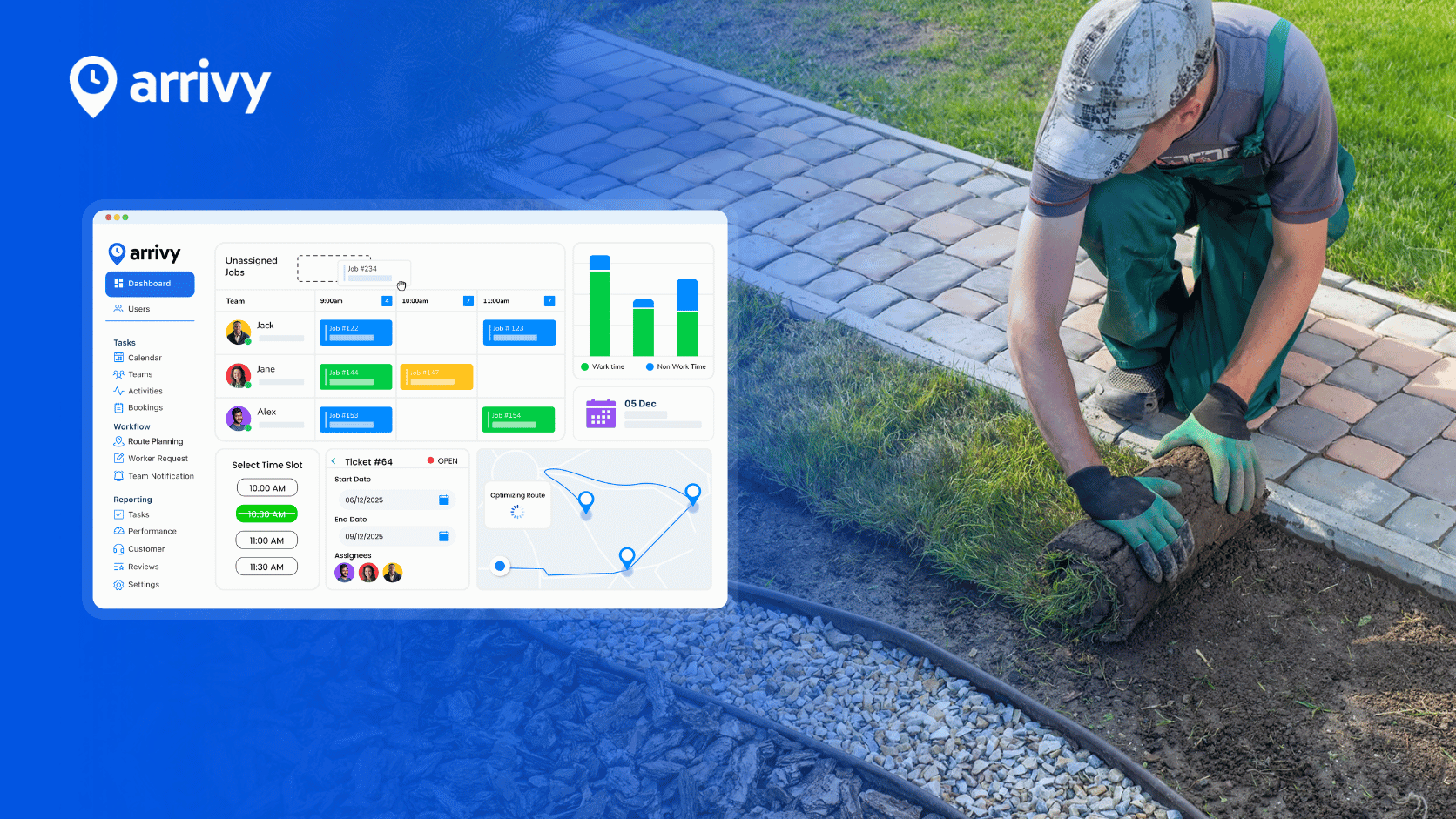
As recurring appointments and crews grow, pay attention to route efficiency, scheduling, and customer communication. Arrivy’s landscaping business software can help connect those activities in a single workflow.