 Login
Login






















AI Summary
The biggest solar industry challenges in 2026 include grid constraints, curtailment, policy uncertainty, permitting delays, supply-chain exposure, financing costs, skilled-labour shortages, installation quality, land use, energy storage, recycling, and operational complexity.
Solar businesses have limited control over grid capacity, interest rates, and national policy. They have much more control over scheduling, crew coordination, project handoffs, installation quality, field documentation, and customer communication.
Solar is growing quickly, but scale brings a different set of problems.
Looking at the state of the industry, you can spot certain problems easily. Grid connections are taking longer in some markets. Permitting remains fragmented. Financing can make an otherwise viable project difficult to justify. Skilled labour is unevenly available, and installation businesses still lose time between surveys, approvals, scheduling, field work, inspections, and final activation.
These challenges facing the solar industry do not all have the same cause or owner. Some require action from utilities, regulators, governments, manufacturers, and financial institutions. Others sit inside solar businesses themselves.
Knowing the difference matters because it shows where a company has leverage, and where it does not.
What Are the Biggest Challenges Facing the Solar Industry?
The main challenges are:
12. Operational complexity for solar installation companiesExplore the challenges facing the solar industry right now, from grid delays and financing to labour shortages, permitting, recycling, and project execution.
Is the Solar Industry Still Growing?
Yes. IRENA’s Renewable Capacity Statistics 2026 reported that 692 GW of renewable power capacity was added globally in 2025. Solar accounted for nearly three-quarters of those additions, with about 510 GW added during the year.
Installed capacity, however, does not tell the whole story. Projects still need grid connections. Electricity has to reach demand. Permits, financing, storage, labour, and field execution all affect how quickly solar capacity becomes useful electricity.
Solar’s main challenge is no longer proving the technology works. It is supporting deployment at scale.
12 Solar Industry Challenges Businesses Need to Understand
1. Limited Grid Capacity and Connection Delays
Solar projects can be developed faster than electricity networks can be expanded. That creates connection queues, transmission constraints, transformer shortages, lengthy grid studies, and expensive upgrade requirements.
A project may therefore be substantially complete while still waiting for permission or infrastructure to export power.
Distributed solar can face the same problem at local-grid level. Grid expansion, faster interconnection processes, advanced inverters, storage, and better use of existing network capacity can help, but installers have limited direct control over these issues.
What they can control is the quality of applications, visibility into approval status, and the timelines communicated to customers.
2. Solar Curtailment and Electricity-Market Imbalances
Solar curtailment happens when available solar generation has to be reduced because the grid cannot accept it or demand is insufficient. It becomes more significant as large amounts of solar generation arrive at similar times of day.
The problem is not solar production itself. It is the mismatch between production, network capacity, storage, and demand.
Curtailment reduces output and can weaken project economics. In some wholesale markets, heavy daytime generation can also contribute to very low or negative electricity prices.
Storage, transmission, demand response, flexible industrial loads, better forecasting, and electricity-market reform all help address the problem. More solar capacity therefore needs to be matched by more system flexibility.
3. Policy and Regulatory Uncertainty
Solar investment depends on rules that can change during the life of a project. Tax incentives, subsidies, net-metering arrangements, feed-in tariffs, import tariffs, planning regulations, and local-content rules can all affect project economics.
Policy also varies significantly by market, so country-specific rules should not be treated as universal solar-industry conditions.
For businesses, the practical response is understanding exposure. A company heavily dependent on one incentive, tariff structure, financing programme, or customer segment has more policy risk than one with several viable routes to market.
4. Permitting and Inspection Still Slow Projects Down
Permitting is more than just one approval. A project may require engineering review, planning approval, electrical permits, utility applications, inspections, fire-code compliance, and permission to operate.
The problem is often the dependency between them because a typical project might move through:
If one stage is incomplete, the next may have to wait.
Installers cannot control how quickly every authority works. They can control whether submissions are complete, whether approval status is visible internally, and whether a crew is scheduled before the project is actually ready.
For businesses struggling with the sales-to-field handoff, Arrivy’s guide to integrating a solar CRM with scheduling software covers how approved work can move into surveys, installations, and inspections without repeated manual entry.
5. Supply-Chain Risk Goes Beyond Solar Panels
A solar project depends on modules, inverters, mounting systems, batteries, cables, transformers, switchgear, connectors, and other components. One missing part can hold up the whole installation.
Substituting equipment can also trigger new design, certification, warranty, or approval requirements. For installation companies, this makes material readiness an operational issue as much as a procurement issue.
Installation dates should reflect what is actually available, not what is expected to arrive. Practical safeguards include approved alternative suppliers, earlier material confirmation, clear substitution processes, and better coordination between procurement and scheduling.
6. Financing Can Matter as Much as Equipment Cost
Lower equipment prices do not automatically make a solar project affordable. Interest rates, the cost of capital, currency exposure, customer credit, PPA terms, and project risk all affect the final economics.
These pressures are particularly significant in markets where financing is expensive or difficult to access. Solar businesses cannot control interest rates, but they can improve how accurately projects are priced and how clearly financing assumptions are communicated. They also need a realistic view of their own delivery costs.
Arrivy’s free Service Cost Calculator can help account for labour, materials, overhead, travel, and other service costs when reviewing job economics.
7. Solar Needs More Than More Installers
Workforce pressure affects electricians, engineers, surveyors, designers, roofers, permit specialists, project managers, battery technicians, crew supervisors, and O&M teams.
The problem is therefore not simply headcount. It is having the right capability available at the right stage of the project. A labour shortage can extend project timelines. Poorly trained teams create a different cost through failed inspections, safety incidents, rework, and warranty claims.
Training, apprenticeships, manufacturer certification, standard field procedures, and clearer career pathways all help.
At company level, operations teams also need visibility into crew availability and capability. Crew management software can help when those assignments become difficult to manage across calendars, spreadsheets, and messages.
8. Installation Quality Still Has to Catch Up With Growth
Good equipment can still produce a poor result if the system is badly designed, installed, commissioned, or documented. Problems can include roof damage, electrical faults, poor weather sealing, incorrect system configuration, missing commissioning records, or incomplete customer documentation.
There is also a commercial cost. Every avoidable return visit uses another crew slot and delays closeout.
Quality control works best when critical checks happen during the job rather than being reconstructed afterwards. That may include required photographs, commissioning values, installation checklists, signatures, and inspection records.
Arrivy’s digital forms can be used to capture structured field data, photos, signatures, and required checks, while the free Inspection Checklist Template provides a simpler starting point for teams still standardising their process.
9. Land Availability Is More Complicated Than Finding Open Space
Utility-scale solar competes with other land uses. Agriculture, biodiversity, transmission access, visual impact, community rights, environmental restrictions, and local economic priorities can all affect whether a site is viable.
Community concerns should not automatically be dismissed as resistance to clean energy. Poor consultation can turn a technically sound project into a planning problem.
Rooftop solar, car-park solar, brownfield projects, agrivoltaics, and floating solar can reduce some land pressure where they are suitable. For utility-scale development, early site assessment and consultation remain critical.
10. Solar Needs a More Flexible Electricity System
Solar output changes with daylight, weather, season, and location. The challenge is not that solar is inherently unreliable. The challenge is balancing variable generation with electricity demand.
Storage is one part of that solution. Batteries can shift daytime production into later hours, reduce curtailment, and provide fast grid-balancing services.
Other tools matter too: stronger transmission, demand response, regional interconnection, flexible loads, smart EV charging, complementary generation, and better forecasting. As solar’s share of electricity increases, these supporting systems become more important.
11. Solar-Panel Recycling Needs to Scale Before Waste Does
Solar panels can be recycled. The harder issue is doing it economically and consistently at scale. Panels contain recoverable glass, aluminium, silicon, and metals, but collection, transport, processing, regulation, and recycling infrastructure vary considerably between markets.
Reuse also matters. Not every panel removed from service is necessarily at the end of its useful life. As the installed solar fleet ages, the industry will need clearer rules around producer responsibility, reuse, decommissioning, traceability, and material recovery.
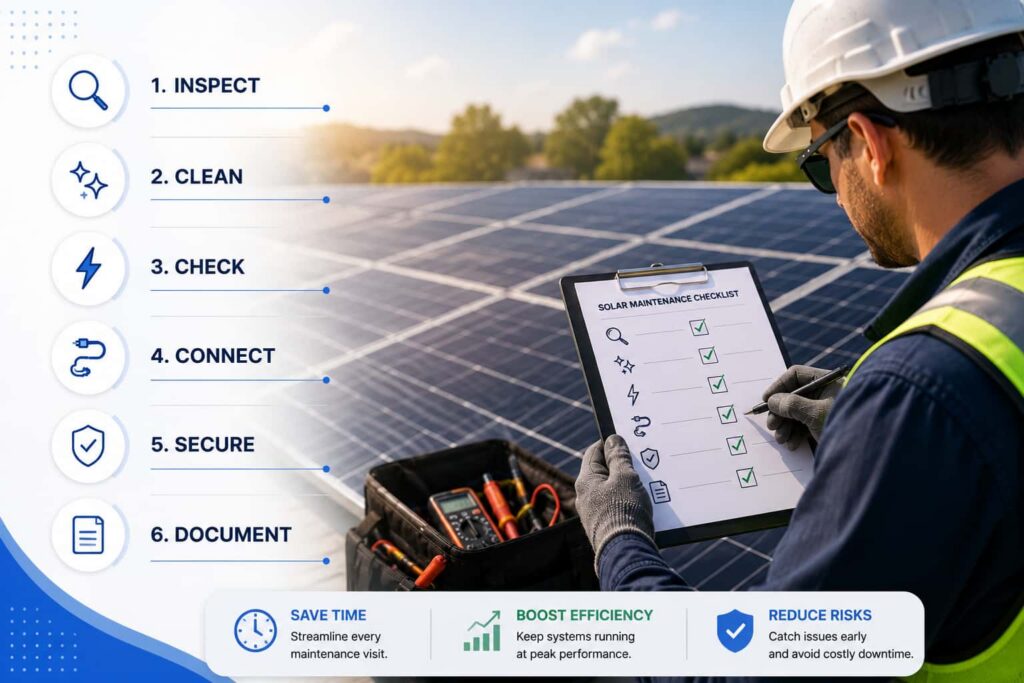
O&M records will also become more valuable as assets move through longer service lives. Arrivy’s solar panel maintenance checklist guide covers the field checks and records useful for maintaining installed systems.
12. Solar Projects Lose Time Between the Stages
This is the challenge solar installation businesses have the most direct influence over. A project can involve:
The field work may only occupy a small part of the overall timeline. The rest is handoffs.
Projects slow down when sales and operations are working from different information, installation is scheduled before materials arrive, permit status is unclear, inspection evidence is incomplete, or a schedule change does not reach the customer. None of these problems is as large as grid reform. They are still expensive.
Signs You Have an Execution Problem
A few patterns are worth watching:
Arrivy’s guide to the best field service management software for solar businesses explains which software capabilities matter when these issues start affecting project volume.
Before Scheduling a Solar Installation, Check Readiness
A sold project is not necessarily a schedulable project.
Before committing an installation slot, confirm:
This is a simple control, but it prevents calendars from filling with work that is not actually ready.
Arrivy’s free Work Order Template can help teams organise scope, customer information, schedule, parts, and job instructions.
For companies managing larger volumes, scheduling and dispatch software can connect job readiness, crew availability, assignments, schedule changes, and field progress in one workflow.
Free Resources for Solar Operations Teams
A few simple resources can help identify where the current process is breaking down before adding another system.
| Need | Arrivy Resource |
|---|---|
| Standardise field inspections | Inspection Checklist Template |
| Organise job scope, customer details, parts, and instructions | Work Order Template |
| Understand service delivery costs | Service Cost Calculator |
| Improve solar O&M checks | Solar Panel Maintenance Checklist |
Where Arrivy Fits
Arrivy does not solve grid constraints, interest rates, national policy, or global supply-chain concentration. Rather, it focuses on the execution side of solar operations.
Arrivy’s solar business management software connects surveys, scheduling, crew assignments, job information, field documentation, customer communication, inspections, and follow-up work across the solar project lifecycle.
That becomes particularly useful when a CRM is already managing the customer and sales process. The CRM can tell you the deal is approved. But operations still needs to know:
What happens next? Is the project ready? Who is assigned? What happened on site? What is blocking the next stage?
Arrivy helps manage that layer.
Work order management keeps field work and job information connected, while customer communication tools help automate appointment confirmations, status updates, and arrival information.
Control the Part of Solar Growth You Can Control
Grid queues may remain slow. Policy will continue to change. Equipment availability will fluctuate. But your team can still improve how projects are scheduled, handed off, documented, and communicated.
Explore Arrivy for Solar to see how solar businesses can connect site surveys, schedules, crews, field records, customer updates, and project completion.
What Does the Future of the Solar Industry Look Like?
Solar is likely to keep growing, but future growth will depend increasingly on the systems around the technology.
Grid investment will matter more as renewable penetration increases. Storage and demand flexibility will become more important in markets with heavy daytime solar production. Permitting will need to become faster and more digital. Manufacturing resilience and recycling will receive more attention.
The workforce challenge will also change. The industry will need not only more installers but more experienced electricians, designers, project managers, commissioning specialists, O&M technicians, and operations teams.
For solar businesses, scale creates its own pressure. Informal coordination can work when a few people know every customer and project. It becomes less reliable as crews, locations, and job volume grow.
At that point, operational efficiency is not mainly about getting technicians to work faster. It is about reducing the time projects spend waiting between stages.
Final Takeaway
The solar industry’s biggest challenges now reflect its scale. More deployment creates pressure on grids, permitting systems, financing, supply chains, labour markets, land, recycling infrastructure, and field operations.
No individual solar business controls all of that. It does control whether jobs are scheduled before they are ready, whether field evidence is captured properly, whether teams know what happens next, and whether customers are kept informed.
That is a smaller part of the industry’s challenge. For the businesses delivering solar projects every day, it is a consequential one.