 Login
Login




















AI Summary
Recommended Reads:
Installing a solar PV system in Dubai is not a single site visit followed by switching the system on. A project moves through several connected technical, administrative and field stages, and delays at one stage can affect everything that follows.
The survey team has to capture the right site information. Designers need that information before producing the technical submission. The solar application must move through DEWA’s process, any applicable building-authority requirements must be addressed, installation has to follow the approved design, and the completed system must be ready for inspection and connection.
This guide follows the practical solar installation process in Dubai from the first site survey to DEWA inspection, meter installation and connection, with a focus on what solar EPC companies and project teams need to coordinate at each stage.
What Is the Solar Installation Process in Dubai?
For projects connecting solar PV generation to DEWA’s distribution network, the process involves both physical installation work and an approval-and-connection workflow.
DEWA’s published guidance describes the solar connection procedure through NOC, design approval, inspection and connection, and generation stages. Its current digital service simplifies part of this process by bundling the Solar NOC and Solar Connection requests into one application.
For practical EPC project management, the wider survey-to-connection workflow can be organised into the following six stages.
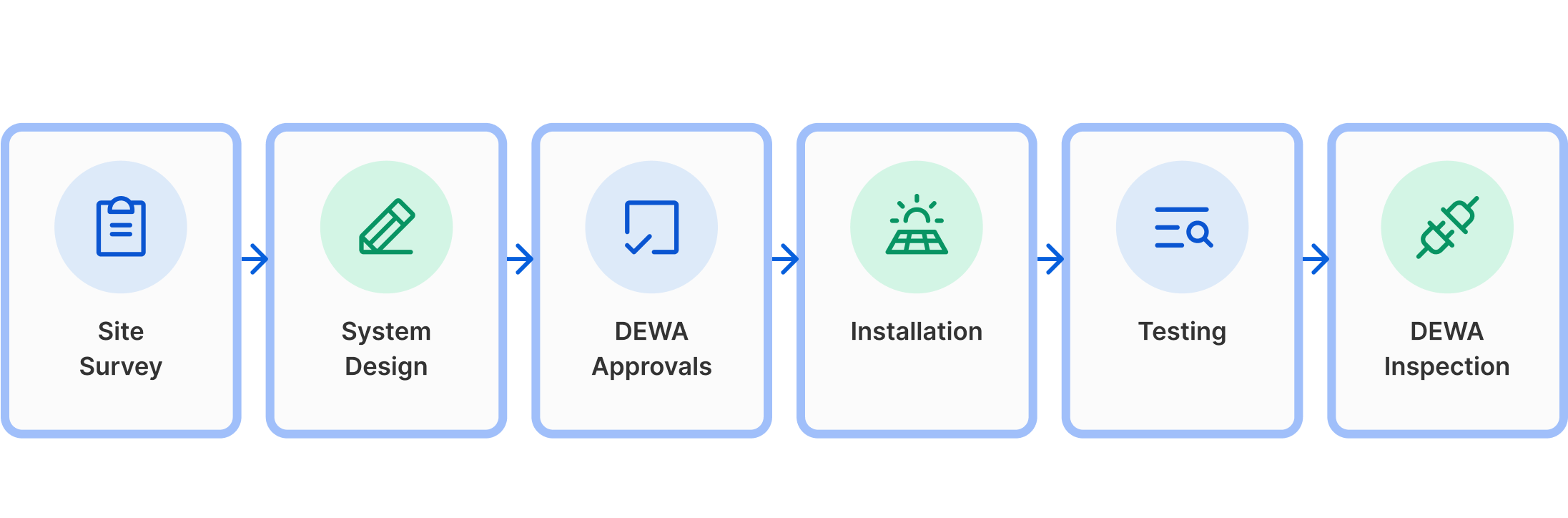
The important point is that these stages depend on one another. An inaccurate site survey can cause design revisions. A design change can affect procurement. An installation deviation can create an inspection issue. And passing the physical installation stage does not by itself mean the solar system is ready to operate.
Solar Installation Process in Dubai: 6 Key Steps
Step 1 — Site Survey and Feasibility Assessment
The process begins with checking whether the site can support the proposed solar system. The survey team reviews usable roof area, shading, roof condition, structural considerations, site access, electrical infrastructure, metering, inverter space and customer electricity demand.
The survey should produce measurements, photographs, site conditions and the information needed for system design. For a deeper walkthrough of the survey itself, see Arrivy’s solar site survey guide: Solar Site Survey: A Step-by-Step Guide
Step 2 — System Design and Document Preparation
The design team uses the survey findings to prepare the proposed PV layout and technical submission.
Typical information may include
- Site layout
- Single-line diagram
- Connected-load schedule
- PV module and inverter details
- Production estimates
- Installation details
- Wiring layout
- Other project-specific documents required by DEWA
The final submission should always be checked against DEWA’s current requirements. Project teams should also make sure everyone is working from the latest approved design.
- The original survey identifies space for 180 modules.
- The final design is revised to 168 modules after access-clearance requirements are considered.
- Procurement receives an earlier bill of materials.
- The installation crew opens an outdated drawing on site.
Before procurement and installation begin, the project team should be able to identify exactly which design is approved, which equipment is associated with that design and which drawing revision the field team must use. Arrivy’s digital forms can help teams capture and keep site information, approvals, photos and field records connected to the relevant job, reducing the risk of outdated or scattered documentation.
Step 3 — DEWA Application and Other Required Approvals
A DEWA-enrolled Solar Consultant or Contractor submits the solar application and technical documents.
DEWA currently combines the Solar NOC and Solar Connection request into one application. The submission may be approved, rejected or returned for corrections.
DEWA approval should not be confused with building or structural approvals. Where required, these are handled separately by the relevant building authority.
That level of separation prevents a common coordination error: the installation team seeing “DEWA approved” and assuming every prerequisite for site work has been cleared.
Step 4 — Equipment Procurement and Solar Installation
Once the required approvals are in place, equipment can be procured and installation can begin.
Installation may include:
- Site preparation
- Equipment delivery
- Mounting structures
- PV modules
- Inverters and electrical equipment
- Labelling
- Field documentation
The equipment installed should match the approved design. Any equipment substitution or design change should be reviewed before installation continues.
Field teams should also record photographs, checklists, site issues, design deviations and outstanding work.
Step 5 — Testing and Inspection Readiness
Finishing installation does not automatically mean the project is ready for DEWA inspection.
Before requesting inspection, the project team should confirm:
Installation matches approved drawings
Equipment matches the approved submission
Required testing is complete
Installation records are available
Outstanding work has been resolved
Site access is ready
Required authority documents are available
Connection invoice requirements are completed
DEWA’s official technical guidance should be used for the actual testing and inspection requirements.
Step 6 — DEWA Inspection, Snag Resolution, and Connection
Once the site is ready, the enrolled consultant or contractor requests DEWA inspection.
The result may be approval or a snag list. If snags are identified, the required corrections must be completed before another inspection request is submitted.
Passing inspection is an important milestone, but it does not always mean the system becomes operational immediately. Remaining steps may include connection requirements, meter installation and solar connection activation.
For systems above 100 kW, additional performance-test requirements may also apply.
It is therefore more accurate to tell customers that inspection has been completed and connection or activation is still pending, rather than saying the system is live immediately after inspection.
Who Is Responsible at Each Stage?
Responsibility changes as the solar project moves from survey to activation.
The following table is a practical project-management view rather than a substitute for DEWA or building-authority requirements.
| Party | Main Responsibility | Typical Handoff to the Next Stage |
|---|---|---|
| Building Owner / Customer | Appoints provider and provides site access and project information | Site access, authorisations and project information |
| DEWA-Enrolled Solar Consultant | Prepares compliant design and manages the DEWA submission | Approved technical information and application status |
| Installation Contractor / Crew | Completes installation, testing and field documentation | Completed and documented installation |
| Relevant Building Authority | Reviews applicable building, structural and civil requirements | Approval/completion documentation where applicable |
| DEWA | Reviews the application, inspects the system and manages connection stages | Approval, inspection result and grid connection/activation |
DEWA specifically limits submission of the Solar Permits & Connections application to enrolled solar consultants and contractors. The owner should therefore verify that the company handling the DEWA process appears on the applicable enrolled-provider list.
How Long Does the Solar Installation Process Take in Dubai?
There is no reliable universal survey-to-activation timeline for every solar installation in Dubai.
A simple rooftop project with an uncomplicated design and available equipment can move differently from a commercial project requiring structural coordination, equipment procurement, several installation visits and authority interaction.
The overall schedule can be affected by:
- Quality of the initial site survey
- Design complexity
- Missing submission information
- DEWA comments or returned applications
- Design revisions
- Applicable building-authority approvals
- Equipment availability
- Site-access restrictions
- Customer approvals
- Crew availability
- Installation complexity
- Testing and documentation
- Inspection availability
- Inspection snags
- Rectification work
- Reinspection
- Connection-invoice status
- Performance-test requirements for larger systems
- Meter-installation and connection scheduling
What does DEWA’s “17 working days” mean?
DEWA currently lists 17 working days as the service delivery time for its Getting Solar Permits & Connections service.
That should not be interpreted as:
“A solar project in Dubai takes 17 working days from site survey to activation.”
The 17-working-day figure applies to the named DEWA service. It does not represent the time required for your company to conduct the survey, prepare the design, obtain any separate applicable authority approvals, procure equipment, install the system, resolve site problems, complete inspection, correct snags or wait for meter installation and connection.
How Solar Companies Keep Each Stage Organised
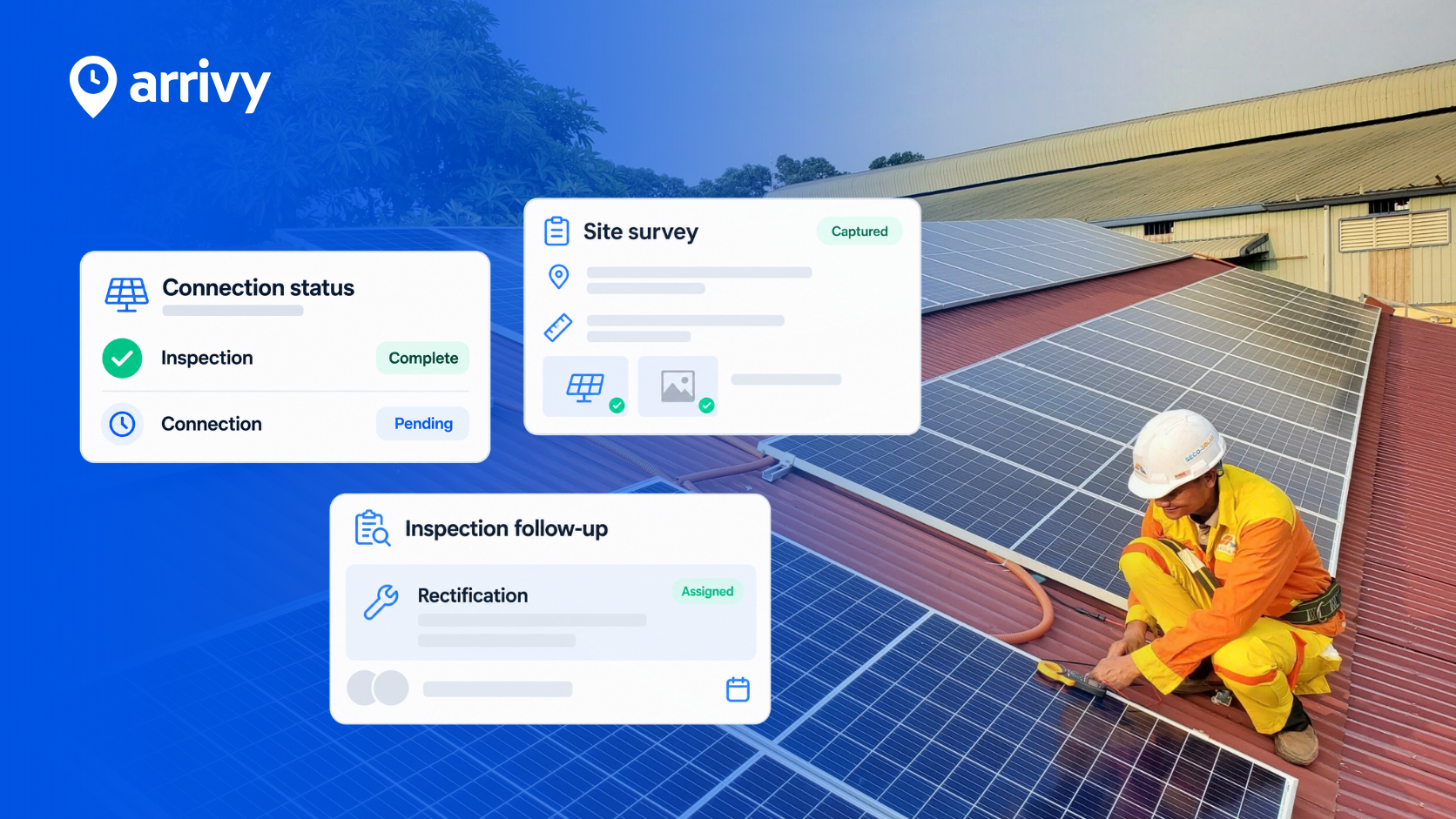
Solar EPC projects depend on clean handoffs between survey, design, approvals, procurement, installation, QA, inspection, and connection. When project information is scattered across spreadsheets, emails, phones, and chat threads, delays and version errors become more likely. Arrivy’s solar operations software helps keep surveys, crew assignments, field forms, photos, inspection tasks, project stages, and customer updates connected so teams can manage the operational side of the project from one place.
Keep survey information connected to the project
Survey forms can capture required field information, photographs and site constraints so estimators or project teams do not have to reconstruct what happened during the visit.
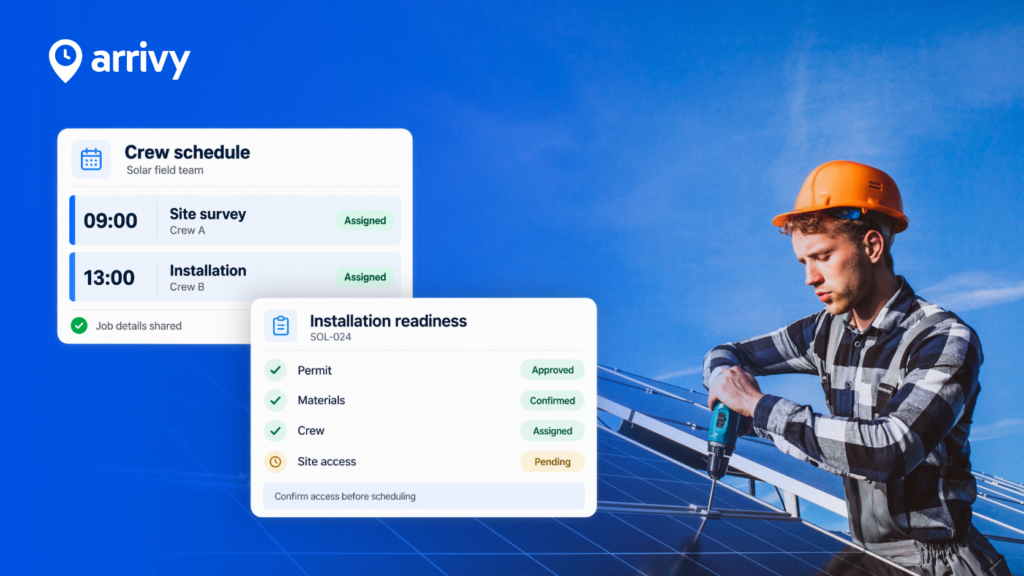
Schedule installation around real crew availability
Solar installations may need different crew types across survey, installation and follow-up stages. A scheduling system should show which work is upcoming, who is assigned and what has changed.
Keep field evidence with the job
Installation photographs, checklists, signatures and issue records are more useful when they remain attached to the corresponding project rather than scattered across phones and chats.
Create follow-up work instead of relying on memory
An inspection snag should create actionable work:
- Snag identified
- Rectification task created
- Crew assigned
- Corrective work completed
- Inspection follow-up scheduled
Keep the customer informed
A solar project can have long gaps between visible site activity. Automated appointment and status communication can help customers understand whether the next visit is a survey, installation, rectification or inspection-related appointment.
Arrivy does not issue DEWA approvals, submit authority decisions on behalf of DEWA or certify that a project complies with Dubai regulations. Its role is operational: keeping the people, appointments, field records and project stages connected while the solar company manages its regulatory responsibilities.
Conclusion
The solar installation process in Dubai is best understood as a connected project rather than a single installation job. The survey establishes what is possible, the design converts that information into an approvable system, the enrolled consultant or contractor manages the DEWA solar application, and the field team installs and documents the approved scope.
Once installation is complete, the project still needs to be genuinely inspection-ready. Any DEWA snags must be corrected, and the remaining connection stages—including applicable post-inspection requirements, meter installation and activation—must be completed before the project reaches generation.
For EPC companies, the biggest operational advantage comes from keeping survey information, approved designs, site visits, crews, photographs, issues, inspection tasks and customer communication connected from one stage to the next.