 Login
Login























Imagine you are a pool builder, and summer is just around the corner. Now you have to work on five builds at once due to high demand. Your excavation equipment is on standby waiting for the permit approval. Teams of subcontractors are shifting between sites; a tile shipment is stuck at the port.
Due to all this, customers are calling for updates, teams are upset about wasted time, and the office team is swamped with calls to change schedules. Pool construction is tough work, very different from general construction. During peak season, you need to adapt to various stages, and you need a lot of subcontractors.
A misstep at any point, whether it’s in excavation, plumbing, putting in the gunite, tiling, decking, or at inspection, can start a chain reaction of delays. The complexity itself is half the problem; it’s about the lack of tools that are specifically designed to solve these problems.
Ordinary spreadsheets or project management platforms might work for simple builds, but pool builders need something more substantial. They need a unique scheduling software that understands the different stages in building a pool and can recalibrate when there are delays. This keeps everyone from the team, suppliers, and customers in the loop.
In this article, we will explore the following topics:
- The unique challenges that pool builders face.
- The problems with using generic construction tools.
- The features of a tool that can solve these issues.
- Actual examples showing the saved time.
- The role of integrations in creating a smooth work process.
- A real-life case study about the transition from spreadsheet chaos to a simplified process.
By the end, you’ll get why specialized scheduling isn’t just a luxury but the key to the future of pool building.
Recommended Reads
Why Pool Projects Break Down More Than General Construction?
It’s no secret that building a pool can take a while. Most often, it’s a process of 8–12 weeks, or even up to six months for a complicated plan. That’s if everything runs like clockwork. But it doesn’t. Here are the reasons why pool jobs can be delayed:
Busy times of the year: Builders usually have lots of work lined up. They can be booked up to two years in advance. The most work comes in summer, so one small hold-up can push jobs into next calendar year.
Different stages of work overlap: First, there’s digging. Then, setting up pipes, followed by inspections. Finally comes the concrete, tiles, decks, and planting. If one thing is delayed, it slows everything afterwards.
Waiting for the materials: Some special pool parts, like coping, plaster, or foreign tiles, can be subject to backorders or even be held up in transport.
Many people are involved: A pool build is not just one team’s job. Different trades are added for their specialized work. There are digging teams, pipefitters, concrete specialists, tile experts, electricians, landscapers, and inspectors. Getting them all coordinated is a big challenge.
Problems with subcontractors: Subcontractors may work with several builders at once. If they miss a spot, it can cause more delays.
Mistakes on scheduling: Traditional scheduling methods – like whiteboards and sticky notes, phone calls – aren’t foolproof. Mistakes happen. And field workers often don’t get updates instantly.
Weather problems: Certain stages of work, like digging and decking, need good weather. A rainy week can really mess with the schedule.
Red tape: In many areas, getting a pool permit can take between 2 and 6 weeks.
Communication mishaps: The office handles papers, the workers are on site, and customers always want updates. Without a clear system to make sure everyone knows what’s happening, confusion happens. And this leads to extra work and frustration.
In short, pool projects are not linear like most construction projects—they’re fragile sequences of dependent tasks.
Miss one, and the whole project stumbles.
Why Generic Construction Tools Leave Pool Builders Struggling?
It makes sense that most pool builders start with what they know, which for many of us is Excel, Google Sheets, or some general construction platforms. But here’s the problem:
- If it rains for a week, then you might be stuck because Excel can’t auto-adjust to excavation delays. And now you have to do the shifting manually and hope you moved everything in sync.
- While the Generic project ‘trackers’ capture the tasks, they fail to follow through with pool-specific sequencing. They never send anything in real-time to subs or field crews.
- Lastly, lead-generation tools for CRM portals might be easy to add, but they don’t connect with suppliers or marry billing with construction milestone accomplishments.
The outcome? Builders are the choke point, spending most of their time rescheduling and calling crews to build pools.
Why Do Pool Builders Need Specialized Scheduling Software?
This is how pool scheduling software is turning the tables by addressing special issues plaguing everyday builders:
Overlapping Phases Made Simple: Drag-and-Drop Scheduling
The excavation overlaps the plumbing, and plumbing overlaps the inspections, and the gunite cannot start till the inspections pass. It is hard to monitor all this manually.
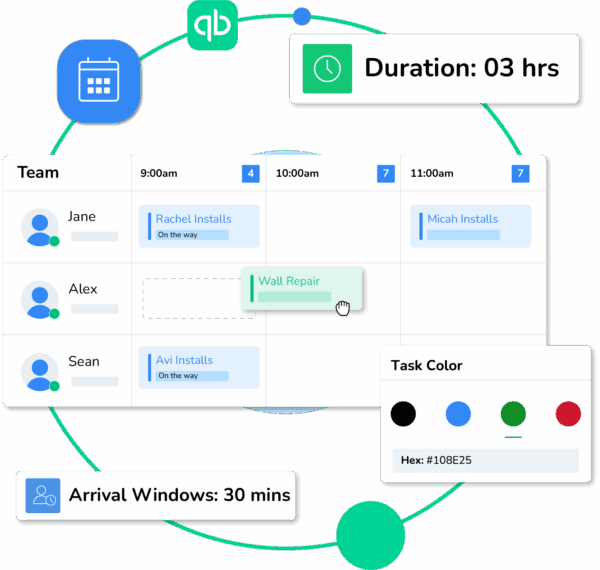
Drag and drop Dispatch Console has a calendar and visual Gantt charts. Through the system, you can automatically visualize and adjust plumbing and inspections, as well as all the work that comes after. When you drag the pre-existing job from one date to another, the change is immediate, and everyone is notified, in the office as well as in the field crews.
In Arrivy, you get three calendar views, and both you and your admins can choose the one that works best. The interface makes it easy to reschedule, cancel, or set any job to recur.
Subcontractors Out of Sync? Resolve It With Real-Time Crew Coordination
Subcontractors are late, skip inspections, or overbook themselves, causing costly downtime. That’s why crew coordination is critical, especially when multiple teams need to work in sync. The Pool Construction Software:
- Put specialized crews to work.
- Drive real-time messages via cell apps.
- To furnish the crews with work orders, routes, and information about customers.
For example, in Arrivy, you can use the worker request feature to add additional subcontractors to your workflow. They get all the details, timing, and skills needed in their email invite and can accept or decline right away. You can also set up messages like “Crew Approaching” or “Next piping” so your subs get the same alerts as your customers. No more phone calls trying to figure out who was doing what; there is no more guessing, and it is all clear to everyone.
Weather and Supply Delays Don’t Have to Derail Projects
Storm destroys the excavation. Delays in the delivery of tile are experienced. All at once, things are a mess in your schedule. Smart scheduling can create the ability to reschedule quickly. Move a schedule, inform affected teams in real-time, and proactively update clients. You are more proactive than reactive.
Office vs. Field: Bridging the Disconnect
The office workers are using spreadsheets to operate the scheduling, and the crews end up not getting the updates until they are too late.
Centralized Scheduling Systems allow there to be a source of truth. The schedule is updated once by the office, and the changes are real-time visible to the field crews and the clients.
How Specialized Scheduling Speeds Up Pool Projects
The benefits of the specialized scheduling are not limited to convenience, though it is very important; it has a direct influence on profitability. The strengths include the following:
Less idle time between Phases: Crews that are standing around are costly. Automated sequencing cuts down on wasted hours.
Streamlined crew deployment: The best use of crew in peak season allows building more pools in a shorter period of time.
Proactively risk: Be aware of the aspects of weather and material risk and adapt prior to it growing.
Example: A builder with a number of concurrent projects operating at any one time faces an average build time of 12 weeks, which could be sharply decreased to 9 weeks. It can be easily attained by proactive scheduling and automated updates. That is 25 percent of output, and even without hiring more people.
Integrations That Turn Scheduling Into Growth
Even more effective is software that is specifically designed for your business and integrated with other systems you use. So, what are the possible integrations that we can use & to assist? Let us take a look:
HubSpot integration: Feed forms back and convert leads into a job. Operations and sales remain synchronised.
QuickBooks integration: Can tie project phases to billing milestones so cash flow can keep up to speed.
Supplier portals: Shipment tracking avoids having to call to ask where the shipment is.
API/CRM connections: Develop an end-to-end workflow that connects sales, scheduling, to field operations and finance.
Pro Tip: You need your scheduling software to be networked throughout your business, not only a tool, but the foundation of your operation.
Arrivy’s Approach: Scheduling Designed for Pool Builders
You see, no two pools are alike. A family desires a simple, easy-to-clean rectangle where their children can splash around during the summer. The fantasy of another client to have a backyard oasis encompassed waterfalls tumbling over rock, glass tiles shimmering in the sun, and mood lighting so she could swim at night.
The dreams may vary, but generally, behind the scenes, the game is always the same: to keep the subcontractors on time and lined up so the inspections are all lined up, the material deliveries are chasing, and the homeowner calling you again and just wanting to know when the pool is going to be finished.
That is precisely where Arrivy came in to bridge. Arrivy addresses the distinct pain points of the pool construction niche by creating an application that is designed to be used by multiple crews, and it can support multiple phases of the project.
A little more closely:
Arrivy doesn’t just schedule tasks; it orchestrates the entire project lifecycle.
Effects of Traditional Scheduling Vs Construction Scheduling Software
Before
- Spreadsheets controlled the schedule.
- Office staff spent hours calling subs and inspectors.
- Missed inspections created weeks-long delays.
- Customers complained about “radio silence.”
After
- Centralized scheduling platform adopted.
- Automated notifications replaced phone tag.
- Field crews accessed work orders on mobile.
- Inspections and subcontractors aligned seamlessly.
- Customers received real-time updates on progress.
Result: Projects that once dragged out 12–14 weeks were consistently completed in under 10. Customer satisfaction improved, referrals increased, and the builder gained bandwidth to take on more jobs during peak season.
Conclusion: The Future of Pool Construction Runs on Smart Scheduling
Pools are too complicated, too seasonal, and interrelated to rely upon spreadsheets and generic tools. Builders regain their control thanks to specialized scheduling software: control over the crews, control over timelines, and control over client expectations.
Convenience is not the only difference, but also profitability. Builders that manage downtime at its source and seek to maximize crew output as well as deal with any hold-ups will have the opportunity to complete more pools during a season, and with less stress.
Hoping to pull out of the fire and move towards a smarter building? Learn why picking Arrivy pool construction scheduling software over our competitors changes the manner in which you deliver projects.