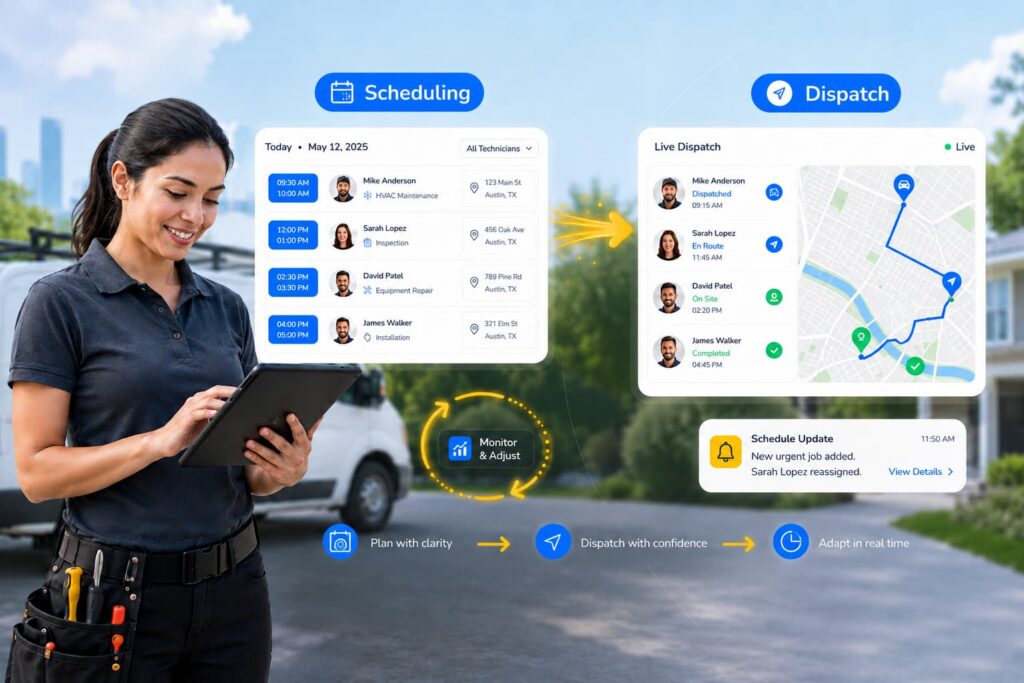























Field sales management is the process of planning, coordinating, and improving sales activities that happen in person at customer or prospect locations. It connects the commercial side of selling (leads, opportunities, and pipeline) with the operational work required to get the right sales rep to the right location, at the right time, with the information needed to move the opportunity forward.
For teams that rely on inspections, consultations, surveys, estimates, property assessments, or onsite quotes, field sales management involves much more than assigning leads. It includes scheduling visits, matching reps to opportunities, planning travel, supporting the onsite sales process, tracking outcomes, and keeping the CRM updated.
A useful way to think about it is:
Update CRM
When the process is managed well, reps spend less time coordinating logistics and more time selling.
What Does Field Sales Management Include?
Field sales management covers the activities required to turn a sales opportunity into a successfully executed field visit and, ideally, a closed deal.
The exact workflow varies by company. A door-to-door sales organization will operate differently from a roofing company scheduling property inspections, for example. But most field sales operations include several common elements.
Lead readiness and handoff
Not every lead needs an immediate field visit.
Many organizations first qualify opportunities through marketing, inside sales, a call center, or a CRM workflow. Once a lead reaches the point where an onsite inspection, consultation, estimate, or sales appointment is required, the field sales process begins.
A clear handoff matters because field visits consume considerably more time and resources than phone calls or emails. Sending a rep to an unqualified opportunity wastes travel time and reduces the number of productive visits the team can complete.
Territory and rep assignment
Once a visit is required, someone needs to decide which rep should handle it.
Assignment may depend on:
Simple teams may assign leads manually. But larger field organizations often need rules or software to prevent managers from spending large portions of the day coordinating schedules.
The goal is not simply to find an available salesperson. It is to match the opportunity with the rep most likely to handle it efficiently and effectively.
Appointment scheduling
Field sales happen on the customer’s schedule as well as the rep’s.
A prospect may only be available during a particular window. Or a property inspection may require an owner to be present. Similarly, commercial consultation might involve several stakeholders.
That makes appointment scheduling a core part of field sales management.
Teams need to coordinate customer availability, rep calendars, territory rules, travel time, and expected visit duration without creating unnecessary gaps in the day.
Route and travel planning
Travel is one of the biggest differences between field sales and desk-based selling.
Two reps may each have five appointments scheduled, yet one could spend substantially more time driving because of poor sequencing.
Effective field sales management considers not only where appointments are located, but also:
This is why field sales software often includes routing or route-optimization capabilities alongside scheduling and assignment.
The onsite sales workflow
Getting the rep to the customer is only part of the job.
Once onsite, the rep may need to review lead history, complete an inspection, collect measurements, discuss options, prepare an estimate, build a proposal, capture customer approval, or obtain a signature.
Field sales management therefore includes standardizing what should happen during the visit.
Without a consistent workflow, results can vary dramatically from rep to rep. Important details may be recorded in personal notes, quotes may be delayed until the rep returns to the office, and managers may have little visibility into what happened.
CRM updates and reporting
After the visit, the rest of the organization needs to know what happened.
Field sales management should create a reliable feedback loop between activity in the field and the company’s CRM or system of record.
That closes the gap between what a rep does onsite and what sales leaders see in the pipeline.
The Field Sales Management Process
Although every organization has its own sales motion, a structured field sales management process usually follows eight stages.
1. Qualify the opportunity
Start by establishing whether the prospect is ready for an onsite visit.
Qualification criteria may include service area, customer need, budget, property type, project timing, or another business-specific condition.
The purpose is to protect field capacity. Reps should not spend valuable travel time on opportunities that could have been screened earlier.
2. Schedule the field visit
Once the opportunity qualifies, schedule the required inspection, consultation, survey, estimate, or sales appointment.
The appointment should account for both customer availability and operational constraints such as travel time and rep schedules.
3. Assign the right rep
Match the opportunity with an appropriate field salesperson.
Territory is often the starting point, but availability and expertise can be equally important.
For example, sending the geographically closest rep may not make sense if another team member has the expertise needed for a complex consultation.
4. Plan the route
The day’s visits should then be sequenced efficiently.
Good route planning reduces unnecessary driving while respecting appointment windows and visit durations.
This is different from simply finding the shortest path between addresses. Field sales schedules contain real-world constraints that must be considered alongside distance.
5. Prepare the rep
Before arriving, the salesperson should have the information needed to conduct the visit.
That may include:
A field rep should not have to reconstruct the history of an opportunity from scattered systems while sitting in a driveway.
6. Execute the onsite sales visit
The rep completes the consultation, inspection, estimate, demonstration, or other required sales activity.
Ideally, the workflow makes it easy to document the visit and move the deal forward while the rep is still with the customer.
For organizations that sell through onsite estimates or consultations, shortening the distance between the visit and the proposal can be especially valuable.
7. Quote, close, or define the next step
Depending on the sales model, the rep may generate a quote, present a proposal, capture a signature, schedule a follow-up, or record why the opportunity did not advance.
The important point is consistency.
Every completed visit should produce a clear outcome rather than disappearing into an undefined “follow up later” stage.
8. Update the CRM and hand off when appropriate
The visit outcome should flow back into the CRM so the opportunity record reflects what actually happened in the field.
If the sale results in work that another team must perform, an operational handoff may follow.
Field Sales Management vs. General Sales Management
Field sales management sits within the broader discipline of sales management, but it deals with a different set of constraints.
General sales management typically includes:
Field sales management adds the physical operating layer required when reps leave the office and visit customers.
| General Sales Management | Field Sales Management |
|---|---|
| Pipeline forecasting | Appointment scheduling |
| Quotas and targets | Territory and rep assignment |
| Coaching | Travel and route planning |
| Opportunity reviews | Onsite visit execution |
| Revenue reporting | Mobile customer context |
| CRM oversight | Field outcomes and CRM updates |
| Sales strategy | Field capacity and coverage |
Field Sales vs. Outside Sales: Is there a Difference?
The terms field sales and outside sales overlap substantially and are sometimes used interchangeably.
Both generally describe salespeople who spend meaningful time away from a traditional office environment meeting prospects or customers in person.
However, outside sales is the broader term.
An outside salesperson might spend the day visiting existing accounts, prospecting door to door, attending industry meetings, or working a geographic territory.
Field sales often places greater emphasis on the execution of in-person sales activity: scheduled customer visits, account calls, inspections, consultations, estimates, and other workflows that require mobile coordination.
That difference becomes important when choosing processes and software.
A canvassing organization may prioritize territory coverage and door-knocking activity. But a company selling roofing, HVAC, solar, construction, installation, or other onsite services may instead prioritize qualified-lead scheduling, appointment routing, property visits, estimating, proposals, and CRM synchronization.
The software should reflect the sales motion rather than forcing every field team into the same model.
Common Field Sales Management Challenges
Most field sales problems come from coordination gaps rather than a lack of sales activity.
Too much time spent traveling
Every unnecessary mile reduces selling capacity.
Poor territory assignments, inefficient scheduling, and badly sequenced appointments can leave reps spending more of the day behind the wheel than with prospects.
Slow qualified-lead handoffs
A lead may be ready for an onsite appointment but sit untouched because the CRM, scheduler, manager, and field rep are disconnected.
Reducing the time between qualification and the field visit can create a smoother customer experience and prevent opportunities from going cold.
Manual scheduling and assignment
Spreadsheets, group texts, phone calls, and manually maintained calendars can work with a small team.
As appointment volume grows, however, managers may become full-time coordinators.
Manual processes also make it harder to adapt when a customer reschedules or a rep becomes unavailable.
Inconsistent onsite processes
One rep may collect detailed information and prepare a quote immediately.
Another may write notes on paper and wait until the next morning to update the opportunity.
That inconsistency affects both customer experience and management visibility.
Delayed quoting
When an onsite visit produces the information necessary to build an estimate, requiring additional office work afterward can slow the buying process.
Field sales teams benefit from workflows that help reps move from visit to quote or proposal with fewer administrative steps.
Poor CRM synchronization
If field activity is not reflected quickly in the CRM, managers can end up working from outdated information.
Pipeline meetings then become exercises in asking reps what actually happened instead of analyzing reliable data.
Limited manager visibility
Sales leaders need more than dots on a map.
Useful visibility connects field activity to business outcomes, like visits completed, quotes created, opportunities advanced, travel time, rep capacity, and close performance.
What Capabilities Should Field Sales Management Software Include?
Software becomes useful when the coordination required to run the field sales process starts consuming too much management or rep time.
The right capabilities depend on the sales model, but several functions are especially relevant.
Scheduling
Teams should be able to coordinate appointments around customer requirements and rep availability without creating unnecessary calendar gaps.
Rep assignment
Assignment tools can help route opportunities according to territory, availability, expertise, or other business rules.
Route optimization
Routing should help reduce unnecessary travel while respecting the realities of appointment-based sales.
For a deeper look at this workflow, sales teams should evaluate route planning specifically in the context of customer visits rather than generic point-to-point navigation.
Mobile access
Field reps need access to schedules and customer or lead context while away from the office.
A usable mobile experience reduces dependence on calls back to coordinators or separate systems.
CRM integration
Field sales management software should complement the CRM, not create another isolated database.
The CRM remains the system of record for contacts, opportunities, relationship history, and pipeline. The field-sales layer helps execute the activity required outside the office and return the resulting information to the CRM.
Onsite quoting and proposals
For companies where a field visit produces an estimate or proposal, supporting that activity onsite can reduce administrative delay.
Digital approvals or signatures may also help the rep move the opportunity forward while meeting with the customer.
Customer communication
Confirmations, reminders, appointment updates, and, where appropriate, live visit information can help customers understand what is happening and when to expect the salesperson.
Visibility and analytics
Managers should be able to understand both activity and outcomes.
That includes schedules and visits, but also the commercial results those activities create.
If you are evaluating platforms, see our guide to the best field sales software for a broader comparison of field-sales tools and selling models.
Field Sales KPIs Worth Tracking
Field sales management should improve outcomes, not merely create more activity data.
A useful KPI set connects operational efficiency with sales performance.
| KPI | What It Helps Measure |
|---|---|
| Lead-to-visit time | How quickly qualified opportunities reach the field |
| Visits per rep per day | Field capacity and scheduling efficiency |
| Travel time per visit | Routing and territory efficiency |
| Appointment show rate | Scheduling quality and customer engagement |
| On-time arrival rate | Route and schedule reliability |
| Quote turnaround time | How quickly visits become commercial proposals |
| Close rate by rep | Individual conversion performance |
| Close rate by territory | Geographic performance differences |
| Reschedule rate | Appointment stability and planning effectiveness |
| CRM update latency | How quickly field outcomes become visible to the organization |
No single metric tells the full story.
For example, maximizing visits per day is not necessarily productive if reps are rushing consultations and close rates fall. Similarly, minimizing driving distance does not help if the routing process sends the wrong rep to a high-value opportunity.
The best measurement system connects operational efficiency to revenue outcomes.
Field Sales Management Best Practices
Strong field sales operations are usually built on a few repeatable principles.
Automate the qualified-lead handoff
Define the point at which an opportunity becomes ready for a field visit.
Once that condition is met, the next action should be clear: schedule the appointment and move the opportunity into the field workflow.
Removing ambiguity prevents qualified leads from sitting between teams.
Use territory, availability, and expertise together
Geography matters, but proximity should not be the only assignment rule.
Consider the rep’s calendar, workload, experience, and fit for the opportunity.
The goal is efficient assignment without sacrificing sales effectiveness.
Standardize the field visit
Create a repeatable process for what reps should review, collect, present, and record during an appointment.
Consistency makes training easier and reporting more reliable.
It also gives customers a more predictable experience regardless of which salesperson arrives.
Give reps the context they need before arrival
The field rep should understand the customer and opportunity before reaching the site.
Providing schedule and lead context in a mobile-friendly workflow reduces preparation friction and avoids unnecessary calls to the office.
Quote onsite when the sales motion allows it
When enough information is available during the visit, moving directly into an estimate, proposal, or approval can shorten the sales cycle.
The goal is not to rush the customer. It is to remove avoidable administrative delay between the field conversation and the next buying step.
Keep the CRM synchronized
Avoid treating CRM updates as end-of-day paperwork whenever possible.
Field outcomes should feed back into the system that the wider sales organization relies on.
That keeps forecasting, follow-up, and pipeline management aligned with what is happening outside the office.
Measure outcomes as well as activity
Visits, miles, and schedules are operational measures.
Quotes, opportunity progression, close rates, and lead-to-close time show whether those operations are helping the business sell more effectively.
Field sales management works best when both sides are measured together.
Where Arrivy Fits in Field Sales Management
Arrivy Sales Ops Management is designed for businesses where a qualified sales opportunity needs to become a scheduled onsite visit before the work is sold.
Rather than replacing the CRM, Arrivy works as an operational layer for the field portion of the sales process.
A typical standalone workflow looks like this:
This model can fit businesses where selling involves inspections, surveys, consultations, estimates, and onsite quotes.
The distinction between CRM, field sales operations, and post-sale execution is important.
The CRM continues to manage contacts, opportunities, pipeline stages, and relationship history. Arrivy Sales Ops coordinates the scheduled field sales workflow that occurs between qualification and close.
If a business also chooses to use Arrivy Field Service Management, the sold job can then continue into post-sale scheduling, dispatch, field documentation, customer communication, job execution, and completion.
Build the Field Sales Process Around How Your Team Actually Sells
Field sales management is ultimately about connecting sales strategy with real-world execution. The strongest field sales operations create a clear path from qualified lead to scheduled visit to successful onsite sales outcome to CRM update.
Technology can help, but the software should support the way your team actually sells. If you’re evaluating platforms, start with our Best Field Sales Software guide to compare different approaches.
And if your sales process depends on scheduled onsite inspections, consultations, estimates, or quotes, explore Arrivy Sales Ops Management to see how a CRM-connected field sales workflow can help coordinate the process from qualified lead to close.