 Login
Login






















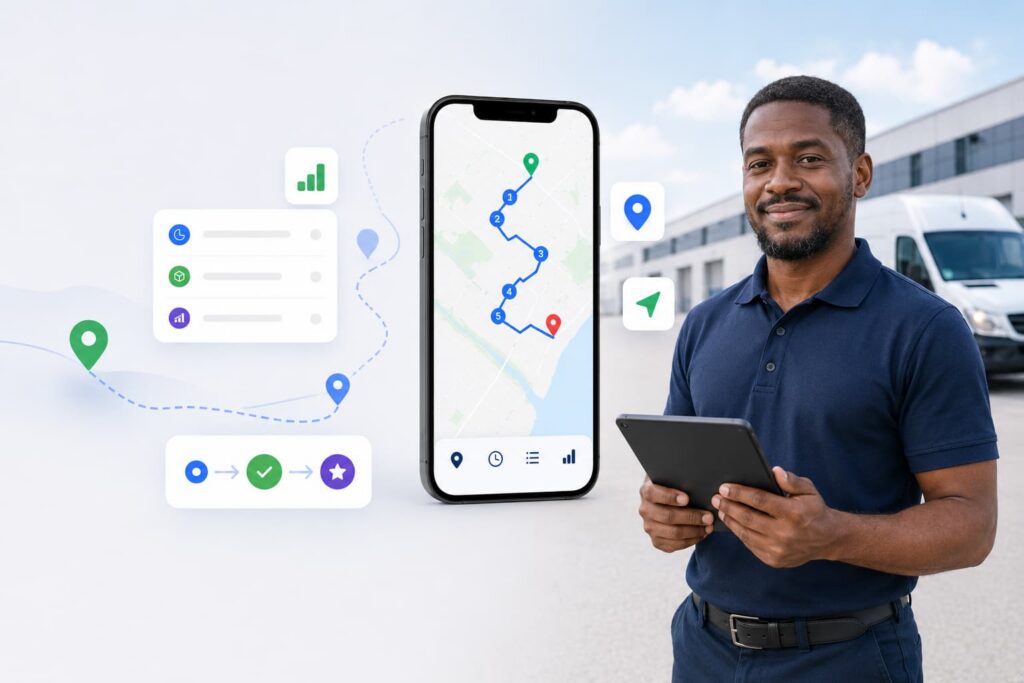
Fleet efficiency is a measurable business outcome that directly influences profitability, customer experience, safety, and sustainability. That is why fleet management is a laborious task. Every day brings new challenges such as rising fuel costs, maintenance demands, and scheduling conflicts. Hence, fleet managers need to ensure that every mile, driver hour, and gallon of fuel contributes to the company’s bottom line.
Have you ever encountered the same issues? If yes, this guide will help you overcome these problems. Let’s explore 11 actionable ways to boost fleet utilization and efficiency. You’ll learn how to utilize your assets and strengthen communication across teams by adapting to modern operations solutions.
Recommended Reads
Fleet Efficiency: Definition and Key Metrics
Before delving into the practical implementation, let’s understand fleet efficiency and its core components.
Fleet efficiency is the balance between delivering required services (jobs completed, service quality, on-time delivery) and minimizing the total resources consumed to do it (fuel, hours, maintenance, number of vehicles).
Key Metrics:
- Vehicle utilization rate — proportion of time a vehicle is actively used for revenue-generating work versus idle or parked.
- Fuel economy and fuel cost per mile — direct cost indicators.
- Idle time — lost productivity and fuel waste.
- Route efficiency/miles per stop — operational routing performance.
- On-time delivery rate — customer-facing service measure.
Interesting Stats: The fleet management market size has grown rapidly in recent years. It has grown from $20.87 billion in 2024 to $23.84 billion in 2025 at a compound CAGR of 14.2%.
Why Does Fleet Efficiency Matter More Than Ever?
Interestingly, more than 60% of fleet-operating businesses in North America already depend upon management software (like Arrivy) for improved efficiency. It shows why fleet efficiency has become a strategic priority in field operations. Several trends make it clear:
- Businesses are now facing reduced profit margins because of rising fuel and maintenance costs. Hence, efficient fleet planning is mandatory to reduce the operating expenses of fleets.
- If your business is not eco-friendly, it cannot sustain in the long run. Hence, it is important to invest in smarter operations to reduce carbon footprints while enhancing fleet efficiency.
- Customer expectations for faster and predictable deliveries have been rapidly growing. On-time performance and accurate arrival windows are now part of the brand promise. A report by McKinsey&Company highlights last-mile expectations as a leading factor shaping investment.
- Small inefficiencies can lead you towards various negative impacts. A few minutes of extra idle time per vehicle, or poorly matched capacity, results in revenue lost or delayed jobs, creating increased costs.
How to Improve Fleet Efficiency?
If you’re aware of your fleet management issues but unsure how to resolve them, this section will be helpful. The 11 practical ways to enhance your fleet efficiency are as follows:
Key Points:
- Maximize Asset Awareness
- Understand Your Expenses
- Effective Fuel Management
- Ensure Alignment and Open Communication
- Prioritize Vehicle Maintenance
- Automate Processes
- Empower Team Members
- Efficient Routing Strategies
- Effective Scheduling
- Maximize Connectivity with Mobile Apps
- Prioritizing Vehicle Safety for Timely Arrivals
1. Maximize Asset Awareness
According to the 2025 Fleet Technology Trends Report, 59–87% of fleets report using GPS tracking/telematics for maximum asset awareness. Hence, if you plan to utilize your resources effectively, you need to know the real-time location of your vehicles, trailers, or drivers. It is important because blind spots lead to duplicated routes, increased idle time, and poor allocation decisions.
For instance, telematics deployments in public and private fleets demonstrate measurable benefits in asset visibility and efficiency. NREL’s research shows that telematics is a key enabler for data-driven fleet decisions. This is how fleet efficiency helps maximize asset awareness:
- Install or integrate GPS/telematics across all revenue vehicles and trailer assets where feasible.
- Track location and state: en route, loading/unloading, idle, maintenance hold.
- Use dashboards that show active vs. spare capacity and flag underused assets.
Measurable KPIs:
- Percentage of fleet with real-time tracking
- Average utilization hours per vehicle per day
- Percentage of idle hours vs. drive hours
Quick Wins:
- Reassign underutilized vehicles from low-demand routes to reallocate busy routes.
- Use trailer tracking to avoid unnecessary empty miles.
2. Understand Your Expenses (Total Cost of Ownership)
According to a 2025 digital-transformation analysis, 83% of fleet managers agree that data analytics is essential to improve operational efficiency. You can achieve maximum resource utilization by combining the right hours, assets, and cost. Hence, Total Cost of Ownership (TCO) categorizes fuel, depreciation, maintenance, insurance, and labor into a single view, allowing you to see the real expense of running each vehicle. This is how fleet efficiency makes your expenses trackable:
- Move from ad hoc spreadsheets to centralized TCO modeling linked to fleet data.
- Include indirect costs (downtime, administrative time) when calculating per-vehicle cost.
- Segment your fleet by vehicle class, route type, and duty cycle to match assets to tasks correctly.
The KPIs you will get:
- Cost per mile/cost per job
- Depreciation schedule vs utilization
- Maintenance cost per mile
Your Quick Wins:
- Reassign high-cost, low-utilization units.
- Adjust replacement cycles based on actual operating patterns rather than fixed schedules.
3. Effective Fuel Management
Fuel is often regarded as the second-largest controllable expense after labor. If you make improvements in driving behavior, route selection, and idle management, it can significantly increase your savings. Various studies document large potential savings from fuel-efficient driving and routing, with case studies showing 35% improvements in fuel use for disciplined fleets. This is how intelligent fleet management will help you:
- Monitor fuel consumption by vehicle and route
- Set idling thresholds and automated alerts when a vehicle exceeds acceptable idle time.
- Train drivers on economical driving techniques and provide scorecards.
The measurable KPIs are:
- Fuel cost per mile
- Average idling minutes per shift
- Percentage of drivers meeting eco-driving benchmarks
Quick Wins you will achieve:
- Introduce a monthly driver leaderboard for fuel-efficient driving.
- Re-route to avoid known congestion hotspots at peak times.
4. Ensure Alignment and Open Communication
60% of fleet companies say customer retention increases due to enhanced digital communication channels. Hence, the fleet managers, drivers, and customers should have transparent communication for efficient operations. Clear and timely communication reduces unplanned downtime and poor last-minute decision-making. Here is how it helps:
- Standardize communication protocols: who escalates issues, which channels to use, and what timeframe for replies.
- Use mobile apps and messaging integrated with your dispatch system, so drivers and dispatchers see the same information.
- Communicate ETA changes proactively to customers.
Measurable KPIs include:
- Response time to driver queries
- Percentage of incidents resolved without escalation
- Customer satisfaction related to visibility/ETA accuracy
Your Quick Wins:
- Implement a single channel for job exceptions (e.g., delays, missed deliveries) and require structured notes.
- Use automated SMS/email updates to customers for ETA changes, reducing calls to dispatch.
5. Prioritize Vehicle Maintenance
In the US, one of the top three operational risks is vehicle breakdown, which constitutes 14% of the total risk. If vehicle maintenance is not efficiently handled, it can cause revenue loss. Usually, reactive maintenance increases downtime. Hence, preventive and predictive maintenance are important to prevent small faults from becoming revenue-stopping failures. Here is how efficient fleet management helps:
- Move from calendar-based servicing to condition-based scheduling using telematics or remote diagnostic data.
- Track common failure points and root-cause trends by vehicle class.
- Set automated service reminders integrated with work-order management.
KPIs you can track:
- Mean time between failures (MTBF)
- Mean Time to Repair (MTTR)
- Average downtime per unscheduled incident
- Maintenance cost per mile
Quick Wins you will achieve:
- Use failure trend reports to pre-order parts and reduce repair turnaround.
- Prioritize inspections for vehicles on longer, more demanding routes.
6. Automate Processes
According to a digital-transformation report, 72% of fleet managers say automated reporting significantly reduces administrative workload. If you are still relying on manual workflows (paper logs, disconnected spreadsheets, siloed systems), it can make your decision-making slow and obscure. Decision-making is the most important step in any operation; hence, automation helps you to centralize data and accelerate your actions. This is how it helps:
- Consolidate scheduling, dispatch, invoicing, and tracking into a single platform or tightly integrated systems.
- Replace manual paperwork with digital forms and automated job status updates.
- Use automation to triage exceptions so human attention focuses on the most valuable problems.
The measurable KPIs include:
- Time spent on administrative tasks per week
- Percentage of jobs updated automatically (vs. manual)
- Error rate in billing or scheduling
Your Quick Wins will be:
- Automate job confirmations and proof-of-delivery capture to reduce disputes and billing delays.
- Use rule-based automation to push tasks to drivers based on proximity and availability.
7. Empower Team Members
Technology alone cannot guarantee changed outcomes unless it is integrated and utilized efficiently. Training, accountability, and incentives help in the maximum utility of modern technology. Here is how efficient fleet management helps:
- Provide role-specific training: eco-driving for drivers, exception handling for dispatchers, and analytics basics for supervisors.
- Use short, recurring coaching sessions based on telematics and performance dashboards.
- Create clear expectations and tie KPIs to incentives (safety, efficiency, on-time performance).
The measurable KPIs include:
- Percentage of staff trained on new systems
- Improvement in driver scorecards over time
- Employee retention rates (linked to job satisfaction and clarity)
Quick Wins you will achieve:
- Launch a monthly micro-training focused on one factor (e.g., reducing idle time).
- Run paired-ride sessions where a supervisor rides with drivers for direct feedback.
8. Efficient Routing Strategies
Efficient route planning, when paired with real-time visibility and AI optimization, can reduce direct operating costs by 35 to 40 percent.
Better routes = fewer miles, more jobs per shift, and happier customers.
If the routing is planned efficiently, it will greatly impact the utilization of your assets. Here is how efficient routing helps in fleet management:
- Use route optimization that understands service windows, vehicle capacities, driver hours, and traffic patterns.
- Incorporate real-time constraints (traffic, weather, exceptions) and re-optimize during the day as necessary.
- Match the vehicle class to the route type (don’t send a heavy-duty truck when a smaller van is faster and cost-effective).
KPIs you can track:
- Jobs per vehicle per shift
- Average miles per stop
- On-time delivery rate
Your Quick Wins:
- Apply simple cluster-based routing to group nearby stops and reduce drive time.
- Use historical trip data to create time-of-day routing rules (avoid certain arterials at specific times).
9. Effective Scheduling
A well-planned schedule reduces idle time and balances workloads across the fleet. According to key 2025 insights, 62% of fleets said GPS tracking is “extremely beneficial” for improving operational efficiency and daily management. Here is how effective scheduling helps:
- Maintain a single scheduling source of truth that helps in vehicle maintenance windows, driver shifts, and anticipated job durations.
- Build flexibility: hold a small pool of deployable vehicles or drivers to address spikes without scrambling the whole roster.
- Use historical data to predict peak days and allocate capacity in advance.
KPIs you can measure:
- Percentage schedule adherence
- Number of schedule-driven exceptions per week
- Average time to reassign jobs when exceptions occur
Your Quick Wins include:
- Tag priority customers and design invariant rules for prioritizing their tasks during capacity shortages.
- Publish a daily “capacity map” to the operations team that shows available vs. committed hours.
10. Maximize Connectivity with Mobile Apps
According to a 2025 fleet-management digital transformation report, 65% of fleet companies use mobile apps for vehicle management and reporting. Mobile app is the frontline interface for your drivers. It replaces paperwork and helps capture proof of service, ensuring that the data is synced in real time. Here is how modern fleet management helps:
- Deploy mobile apps that integrate with the back-office: status updates, signature capture, photos, and issue reporting.
- Keep interfaces simple: drivers should require minimal taps to update status or report exceptions.
- Store a history of jobs and vehicle notes for maintenance and dispute resolution.
KPIs you can track:
- Percentage of jobs with electronic POD
- Average time to close an exception reported by the driver
- Driver app adoption rate
Quick Wins include:
- Turn on photo capture for problem deliveries to reduce disputes.
11. Prioritizing Vehicle Safety for Timely Arrivals
As per a recent report, 88% of fleets now use telematics for safety. Hence, safety and efficiency must coincide for optimized fleet management. It is because safer driving reduces accidents, insurance costs, and downtime. Additionally, when drivers operate predictably, ETA accuracy also improves. Here is how it helps:
- Utilize in-vehicle sensors and behavior scoring for training (speed, harsh braking, idle).
- Set safety thresholds and require retraining for drivers who exceed risk tolerances.
- Tie safety metrics into performance reviews and incentives.
KPIs you can track:
- Incident rate per million miles
- Percentage of drivers with a safety score above the threshold
- Insurance premium trend
Your Quick Wins:
- Implement immediate post-incident reviews focused on learning from mistakes.
- Offer micro-incentives for drivers who maintain clean safety records.
How Arrivy Helps You Run a More Efficient Fleet
Arrivy brings scheduling, dispatching, tracking, and reporting together in one platform so all teams work from the same data. Arrivy can help you manage your fleet most efficiently as follows:
| Feature | How It Works | Practical Results & Example |
|---|---|---|
| Dashboard & Task Monitoring | Centralized view of schedules, dispatches, live tracking, and reports. Supports drag-and-drop task reassignment. | Managers optimize crew deployment in real time (e.g., redirecting a nearby technician to a high-priority job). |
| Real-Time Tracking & Customer Portal | Provides live GPS tracking for managers and real-time ETA visibility for customers via automated SMS/email notifications. | 5x higher customer experience scores. |
| Integrations & Webhooks | Syncs with HubSpot, Zoho, and telematics. Triggers webhooks for template field updates. | Automated CRM updates reduce manual data entry by 4 hours/week. |
| Automated Notifications | Event-triggered alerts (scheduled, en route, completed). Customizable templates. | 50% reduction in no-shows; customers confirm arrivals 2x faster. |
| Route Planning Pro | Optimizes routes by location, time, and workload. Supports multi-select tasks and step-by-step progress tracking. | Shorter routes; real-time adjustments for traffic delays. Leading to saving 50K annually on losses. |
| Performance Analytics | Tracks task completion rates, travel time, and crew efficiency—exports to CSV file. | Identifies 15% travel time savings on high-volume routes (2,000+ tasks/day). |
| Crew Performance Tools | Monitors punctuality, linked task chains, and skill-based assignments. | Rewards top performers (e.g., 95% on-time starts) with targeted incentives. |
| Engagement Insights | Measures notification open/response rates. Tracks customer portal logins. | Adjusts messaging timing to boost response rates. |
| Automated Alerts & Audits | Flags delays in linked tasks. Logs all job events for compliance. | Prevents 50% of cascading delays; simplifies dispute resolution. |
Ready to identify hidden inefficiencies in your fleet?
Arrivy can help you do that.
Calculating Fleet Efficiency with Arrivy
Understanding fleet utilization is key to improving efficiency and measuring ROI. According to a recent report 45% of 1,200 U.S. fleet managers achieved a positive ROI in less than 11 months with fleet management solutions.
Arrivy simplifies this process by providing detailed reports and insights that can help your business calculate the Fleet Asset Utilization Rate with accuracy.
Fleet Asset Utilization Formula:
Utilization Rate (%) = (Total Active Hours ÷ Total Available Hours) × 100
Total Active Hours
Total time a fleet asset is actively used, e.g., driving, loading, or performing service tasks. Derived from Arrivy’s Time Report combining task and travel hours.
Total Available Hours
Maximum operational time for an asset.
Example Calculation
If your truck operates for 50 active hours in a week and is available for 120 hours, the utilization rate is:
(50 ÷ 120) × 100 = 41.67%
Your truck is productively used about 42% of the time — a clear indicator of fleet efficiency.
Conclusion:
In today’s competitive transportation landscape, mastering fleet efficiency is essential for long-term success. Real improvements come from balancing strategy and execution by maintaining asset visibility, optimizing routing and scheduling, monitoring costs in real time, and keeping vehicles well-maintained.
Empowering drivers, fostering clear communication across teams, and promoting a culture of safety all contribute to better utilization and more reliable operations. When supported by the right technology, such as intelligent automation and predictive maintenance tools, these efforts lead to measurable gains in productivity and performance.