 Login







AI Summary
Starting a plumbing company raises four immediate questions:
- What work will you take?
- Who is legally qualified to perform and supervise it?
- How much cash will you need before customers pay?
- And how will you keep booked jobs moving when schedules change?
The choices differ for a plumber working independently and an owner hiring a team. This U.S. guide covers both, although requirements vary by state and locality.
Is Starting a Plumbing Company Worth It?
Plumbing work includes repairs, replacements, maintenance, and construction. The U.S. Bureau of Labor Statistics projects 7% employment growth for plumbers, pipefitters, and steamfitters from 2025 to 2035. This points to continued demand for skilled workers, although a new business still needs to compete for customers.
However, emergency calls, hiring, callbacks, property damage, and vehicle costs create risks. Repeat customers and property management contracts may provide steadier work, but late payments can still strain cash flow.
Owners with the right credentials can do plumbing work themselves, while others handle the business and hire qualified plumbers. Both approaches require proper licensing, supervision, and clear responsibility for technical work.
How to Start a Plumbing Business in 12 Steps
Step 1 – Choose Your Plumbing Market and Business Model
Choose your customers first, since different plumbing markets need different staff, equipment, and scheduling.
| Market | Typical customers | What the work requires | |||
|---|---|---|---|---|---|
|
Homeowners, landlords
|
Fast scheduling, stocked service vans, customer updates |
|||
|
Facilities and property managers
|
Site access, job records, qualified coverage, account billing |
|||
|
Builders, general contractors
|
Plans, permits, project crews, longer payment cycles |
|||
|
Homeowners, businesses, contractors
|
Specialist qualifications, training, diagnostic equipment |
Decide whether you’ll perform plumbing work yourself, hire qualified plumbers to do the work, or run the company with a licensed plumbing professional.
Define your business: “We serve [customer] with [services] in [area], with [person or role] responsible for technical work.”
Step 2 – Check Local Demand
Research 10–15 competing plumbers, and compare their services, response times, coverage, and recent reviews. Repeated complaints about missed appointments, unexpected charges, or poor follow-up could reveal a gap, but confirm it with potential customers.
What customers value also depends on the job. Someone facing a burst pipe will prioritize a quick response, while a homeowner replacing a water heater may compare several quotes. Property managers, meanwhile, may place greater value on reliable response times and clear service records. Understanding these priorities helps you choose where to find your first customers, whether through local search, referrals, property managers, or contractors.
Step 3 – Define Your Services and Service Area
Define your services, exclusions, diagnostic fees, hours, service area, and emergency response. For example, you might offer fixture repairs and routine drain troubleshooting in selected ZIP codes, while excluding excavation or gas work until you have the proper licenses, equipment, and staff.
A job 45 minutes from your starting location can require 90 minutes of travel if you return to the same location. Base your service area on actual routes, not distance alone.
Step 4 – Plan Around the Jobs You Can Handle
Create a basic business plan covering your target customers, services, pricing, staffing, marketing, and expenses. Estimate how many jobs your team can realistically complete each month.
Capacity example: For example, if a plumber works 160 paid hours per month but spends only 60% of that time on billable jobs, you have 96 billable hours available. At two billable hours per job, that allows about 48 jobs. If 60% of qualified enquiries become jobs, you need roughly 80 enquiries to fill the schedule.
Assign business decisions (sales, funding, dispatch) and technical decisions (repair methods, code compliance, inspections) to the appropriate people.
Step 5 – Calculate Startup Costs and Cash Reserves
Separate your budget into setup costs, ongoing expenses, and cash reserves:
- Setup costs: Registration, recruitment, vehicles or deposits, tools, inventory, insurance deposits, and a website.
- Monthly operating costs: Wages, employer costs, fuel, vehicle payments, storage, marketing, administration, software, and insurance.
- Working capital: Money for payroll and suppliers while invoices remain unpaid, plus reserves for callbacks and breakdowns.
A licensed plumber with tools and a van may need less funding than an owner hiring two plumbers and buying two vehicles. Obtain actual quotes rather than assuming you already have the equipment.
Include payroll taxes, benefits, workers’ compensation, vehicle costs, and paid nonbillable hours in both hiring budgets and service prices, not just wages.
Step 6 – Register the Company and Set Up Financial Records
Choose a business name and structure (sole proprietorship, LLC, partnership, or corporation) based on legal, tax, and administrative needs. Complete required registrations, obtain a tax ID where needed, open business banking, and set up bookkeeping and payroll. The IRS issues EINs for free.
Record revenue, materials, paid hours, invoices, and receivables by job. Company registration does not authorize you to contract for or perform plumbing work, so verify trade requirements separately.
Step 7 – Confirm Licensing, Supervision, Permits, and Insurance
Check with your state plumbing or contractor board and local building department before advertising or accepting regulated work.
| Requirement | Who it affects | Where to verify | ||||||
|---|---|---|---|---|---|---|---|---|
|
Company |
State trade or contractor board |
||||||
|
Individual workers |
State trade board |
||||||
|
Company, technical lead, trainees
|
Trade board and local authority |
||||||
|
Specific jobs |
Local building department |
||||||
|
|
|
||||||
|
Covered work on pre-1978 properties
|
U.S. EPA or authorized state |
Step 8 – Prepare Your Staff, Vehicles, and Suppliers
Before your first appointment, verify worker credentials, supervision, insurance, safety procedures, and authorized services. If hiring from day one, the qualified team and supervision must already be in place. Step 12 covers later hiring.
Stock vans with essential tools, needed testing equipment, protective gear, and common fittings. Work with reliable suppliers and rent specialist equipment until demand justifies buying it.
Step 9 – Set Prices and Get Customer Approval
Match pricing to the job. Charge an inspection or diagnostic fee when the problem is unclear. For repairs with unpredictable labor or material needs, charge based on actual time and parts. Use fixed prices for straightforward, clearly defined jobs. Maintenance agreements can suit recurring work with a clear scope.
Prices must cover wages and employer costs, travel, materials, nonbillable time, overhead, payment fees, and callbacks. If your total estimated job cost, including allocated overhead, is $240 and you want a 25% margin above that cost, divide $240 by 0.75. Your target price is $320 before applicable taxes. Adding a 25% markup instead would produce $300. Your actual profit will depend on whether you’ve accounted for all relevant business expenses.
Quotes should include findings, approved work, exclusions, price, changes, and payment terms. Get approval before additional billable work, as required by local rules.
Step 10 – Turn Local Searches and Referrals Into Bookings
Your website should show your service area, hours, phone number, qualifications, and key services. Set up an eligible Google Business Profile.
Ask satisfied customers for honest reviews and build referrals through property managers, builders, and related trades. Assign someone to answer enquiries and follow up on unapproved estimates; increasing traffic achieves little if calls go unanswered.
Track how many inquiries turn into booked jobs, completed work, and customer payments. Focus on which marketing channels bring paying customers, not just website visits.
Step 11 – Keep Every Job Organized From Enquiry to Payment
Use one process to keep the office, plumber, and customer informed:
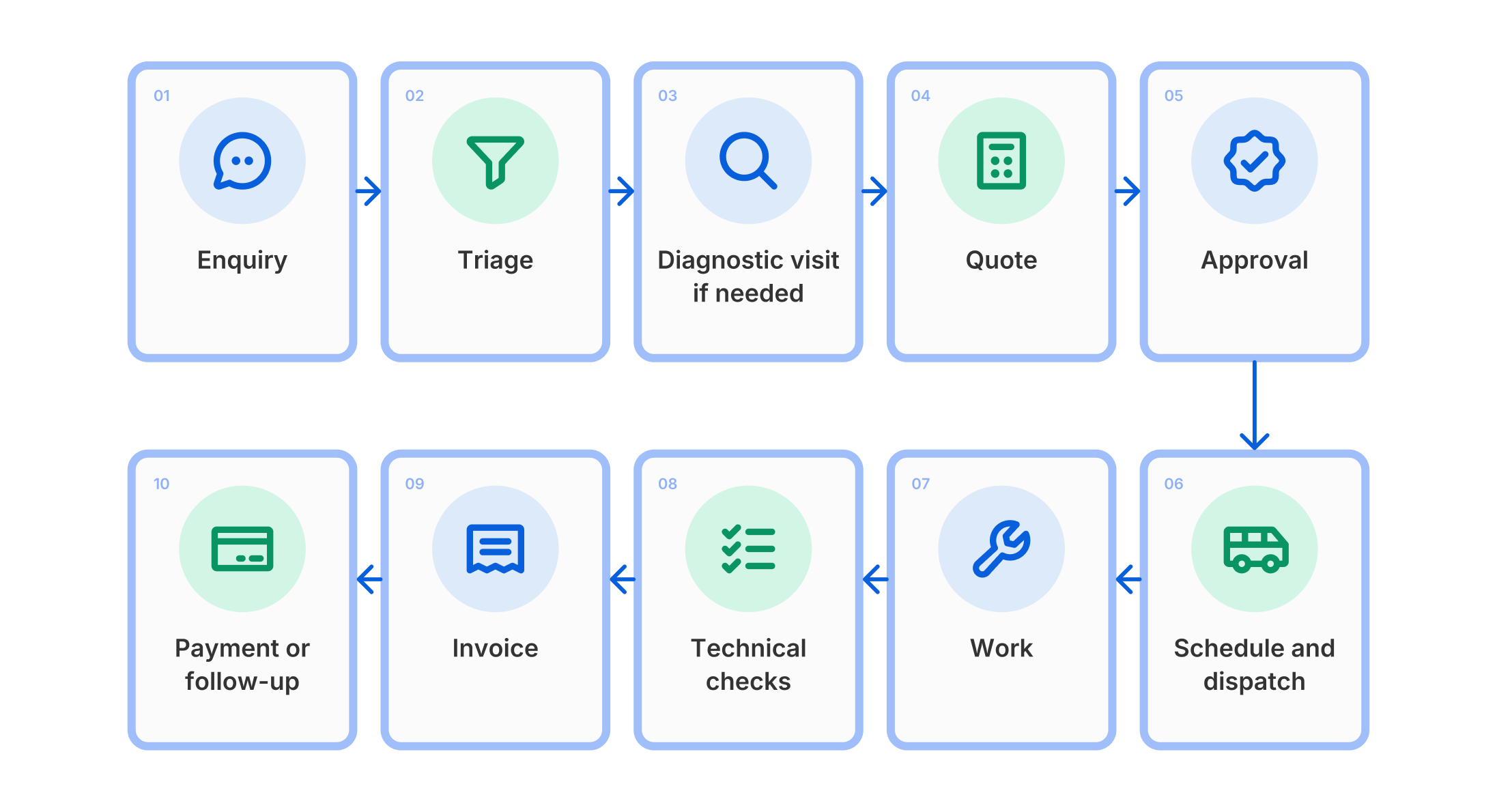
Before the visit: Record customer details, address, access, symptoms, approved scope, required parts, and the qualified plumber assigned. If the problem is unclear, keep the diagnosis separate from repair approval.
During and after work: Keep findings, photos, parts, test or inspection results, required signatures, and exceptions. Office staff can check the records, but qualified professionals must judge technical compliance.
When plans change: If a plumber is unavailable, parts are delayed, or repairs take longer than expected, update the schedule and notify the customer. Get approval before changing the agreed scope or price.
Before closing: Compare completed work with the approved scope, invoice promptly, record payment status, and assign follow-up.
Step 12 – Grow Without Losing Control of Quality or Cash
Hire another plumber when you have enough consistent work, money to cover their wages, and the required supervision in place. Set up onboarding, credential checks, absence cover, and field documentation before adding vans.
Review enquiry conversion, billable hours, job costs, punctuality, callbacks, overdue invoices, and repeat customers. If revenue rises but payments slow or callbacks increase, fix those problems before expanding.
What Does It Cost to Start a Plumbing Business?
Startup costs depend on location, existing equipment, vehicles, services, staff, insurance, and payment terms. These October 2026 planning examples are not industry averages:
| Launch model | Assumed setup costs | Assumed cash needs for three months | Total example | ||||
|---|---|---|---|---|---|---|---|
|
$8,000
|
$15,000
|
$23,000 |
||||
|
$25,000
|
$54,000
|
$79,000 |
Replace these figures with local quotes, payroll costs, loan payments, and reserves. The BLS reported median annual pay of $63,800 in May 2025 for plumbers, pipefitters, and steamfitters combined, excluding the full cost of employment in your market.
When Does a Plumbing Business Need Scheduling Software?
A solo plumber with few appointments may manage with a calendar and basic records. As a plumbing business adds technicians, handles more emergency appointments, or manages frequent schedule changes, coordinating work through calls, texts, and spreadsheets can become increasingly difficult.
If an urgent leak comes in while both plumbers are booked, dispatch needs to see availability, movable appointments, customer commitments, and unfinished jobs. A calendar shows times but may lack the status and field records needed to respond.
Arrivy’s plumbing job management software connects scheduling, dispatch, technician updates, customer ETAs, work orders, and digital forms. Consider it when gaps between these steps cause missed appointments or extra administration.
| Mistake | Better approach | ||
|---|---|---|---|
|
Verify company requirements and who oversees technical work |
||
|
Keep reserves for payroll and delayed payments |
||
|
Begin with defined services and a practical service area |
||
|
Include travel, administration, overhead, and callbacks |
||
|
Rent until demand justifies a purchase |
||
|
Document the updated scope and customer approval |
||
|
Track outstanding invoices and follow up |