 Login
Login



















Plumbing success now depends on operations, not just fixing pipes. Competitors pull ahead with better scheduling, customer handling, and smart growth. If you’re using spreadsheets or growing a team, these 10 strategies help you cut no-shows, add more jobs per day without new hires, win emergency work, avoid liability issues, and increase profits.
- ✔How to reduce no-shows and stop wasting time on “where’s my plumber?” calls
- ✔Ways to fit 15-25% more jobs into each day without hiring more staff
- ✔Strategies to win emergency calls and build customer loyalty
- ✔Methods to protect your business from costly liability claims
- ✔Data-driven approaches to expand profitably (instead of just getting busier)
Here’s how top plumbers do it:
1. Give Customers Real-Time Visibility Into Your Service
One of the biggest pain points for homeowners hiring a plumber is the uncertainty. When will the plumber arrive? Are they on their way? Did they get delayed at another job?
This anxiety creates a poor customer experience before your technician even arrives. Meanwhile, your office staff wastes valuable time fielding customer inquiry calls throughout the day.

The solution:
Implementing real-time tracking and automated customer notifications is the first step towards improving your operations. Modern plumbing businesses use field service management software to send customers automatic updates at key moments:
- ✔Confirmation when the job is scheduled
- ✔Notification when the plumber is en route
- ✔Live tracking link showing the technician’s ETA
- ✔Completion notification with invoice details
This level of transparency immediately sets you apart from competitors. Customers feel informed and in control, which reduces anxiety and builds trust in your professional journey.
Real-world impact:
Plumbing companies that implement automated customer communication see drastic improvements in customer satisfaction scores. When customers can track their plumber’s arrival like they track a food delivery, they’re far more likely to leave positive reviews and recommend your services.
With platforms like Arrivy, you can automate this entire communication flow. Customers receive text or email updates automatically as your plumber moves through their day, without any manual effort from your office team. This frees up your resources to focus on booking new jobs instead of answering “when will you arrive?” calls.
Run Your Plumbing Business Without the Chaos
See how modern plumbing companies reduce no-shows, schedule smarter, and run more jobs per day.
2. Eliminate Scheduling Conflicts and Wasted Drive Time
If you’re still using spreadsheets or paper schedules to coordinate your plumbing team.
You’re likely experiencing common pain points:
- —Double-booked technicians
- —Plumbers crisscrossing the town inefficiently
- —Last-minute schedule changes that throw the entire day into chaos
- —Technicians arriving at jobs without the right parts or information
These scheduling inefficiencies frustrate your team and directly cost you money through wasted fuel, overtime pay, and missed revenue opportunities.

The solution:
Adopt intelligent scheduling and dispatch software. Professional plumbing scheduling software provides several critical capabilities:
- ✔Visual calendar management: See all your technicians’ schedules in one place, making it easy to spot conflicts, gaps, and opportunities to optimize workload.
- ✔Skills-based assignment: Assign jobs based on each plumber’s expertise. Send your water heater specialist to installations and your drain cleaning expert to clog emergencies.
- ✔Location-based dispatch: Automatically identify which technician is closest to each job site, reducing drive time and allowing you to fit more jobs into each day.
- ✔Dynamic rescheduling: When emergencies arise or jobs run long, quickly reassign work with drag-and-drop simplicity instead of making frantic phone calls.
Real-world impact:
Plumbing companies that implement professional scheduling software typically increase their daily job capacity by 15-25% simply by eliminating wasted drive time and optimizing technician routes.
For example, if your plumber spends an extra hour per day driving due to poor routing, that’s 5 hours per week or 260 hours per year of lost productivity, equivalent to 6.5 weeks of full-time work lost to inefficient scheduling.
Arrivy’s scheduling platform visualizes all appointments in one calendar, prevents double-booking, and uses GPS tracking to optimize dispatch decisions. When you can see exactly where each plumber is in real-time and how much time they have between jobs, you make smarter scheduling decisions that maximize revenue.
3. Standardize Your Service Delivery Process
Many plumbing businesses operate inconsistently. One technician might complete a water heater installation one way, while another follows a completely different process. Some remember to check for additional issues, and others focus only on the immediate problem.
This inconsistency creates several problems:
- —Varying service quality leads to inconsistent customer experiences
- —You miss upsell opportunities when technicians skip steps
- —Newer technicians struggle without clear procedures to follow
- —You can’t identify what’s working (or what’s not) across your team
The solution:
Create standardized workflows with digital forms and checklists. Professional plumbing businesses use digital forms to ensure every technician follows the same high-quality process on every job. These forms can include:
- ✔Pre-arrival checklists: Confirm the technician has all necessary tools, parts, and customer information before leaving for the job.
- ✔Diagnostic checklists: Ensure technicians check all relevant systems, not just the immediate problem. (This is where many upsell opportunities hide.)
- ✔Safety protocols: Document that proper safety procedures were followed on every job.
- ✔Customer approval forms: Capture customer signatures digitally for estimates, work authorization, and completion sign-offs.
- ✔Post-job checklists: Ensure the work area is cleaned, customer questions are answered, and maintenance recommendations are discussed.
Real-world impact:
Standardized processes drastically improve your bottom line. When every technician follows a checklist that includes checking water heater age, testing water pressure, and inspecting visible pipes, you’ll uncover far more legitimate upsell opportunities.
Arrivy’s digital forms work both online and offline, so your technicians can complete checklists even in basements with no cell signal. All data syncs automatically when they reconnect, giving you complete visibility into whether your processes are being followed consistently.
4. Respond Faster to Emergency Calls
Emergency plumbing calls about burst pipes, severe leaks, and backed-up sewage represent some of the highest-value opportunities in your business. Homeowners in crisis are willing to pay premium rates for immediate service, and a job well done in an emergency often leads to a customer for life.
But if your dispatch process is slow, you lose these valuable calls to faster competitors.
The solution:
Optimize and simplify your emergency dispatch process. Fast emergency response requires three things:
- ✔Immediate technician location visibility: Know exactly where your on-call plumber is and how quickly they can reach the emergency.
- ✔Instant communication: Notify your technician of the emergency immediately through their mobile app, not through a phone call.
- ✔Rapid route optimization: Provide turn-by-turn directions so your plumber gets there as quickly as possible.
Real-world impact:
Plumbing companies that respond to emergency calls within a few minutes of the initial customer contact win the job almost every time, even if their arrival time is similar to competitors’. Speed of response communicates professionalism and reliability.
With real-time GPS tracking through platforms like Arrivy, you can see exactly where every technician is at any moment. When an emergency call comes in, you can identify the closest available plumber, reassign them with a few clicks, and notify the customer of the exact ETA, all within minutes.
This speed wins more emergency jobs and builds your reputation as the plumbing company that actually shows up when people need help most.
Recommended Reads
5. Turn Every Service Call Into a Relationship-Building Opportunity
Most plumbing businesses think of each job as a transaction. They fix the problem, collect payment, and move to the next call. But the most successful plumbing companies treat every service call as an opportunity to build a long-term customer relationship.
The difference is significant. According to industry research, acquiring a new plumbing customer costs 5-7 times more than retaining an existing one. Yet many plumbing businesses invest heavily in marketing to attract new customers while doing little to stay connected with past customers.
The solution:
Implement systematic follow-up and stay-in-touch communication. Here’s what top-performing plumbing companies do differently:
- ✔Immediate post-job follow-up: Within 24 hours of completing a job, send a thank-you message, recap of work performed, and care instructions. This shows professionalism and gives customers easy reference information.
- ✔Maintenance reminders: Set up automated reminders for recommended service intervals. For example, if you install a water heater, remind the customer to schedule annual maintenance in 11 months. If you unclog a drain, suggest a preventive drain cleaning in 6 months.
- ✔Seasonal check-ins: Send helpful tips at strategic times, like winterization reminders in fall or water heater efficiency tips when utility bills spike, etc.
- ✔Anniversary messages: A simple “It’s been one year since we installed your new water heater. Hope it’s working great!” keeps your company top-of-mind.
- ✔Request reviews at the right moment: Don’t wait weeks to ask for a review. Send the request within hours of job completion when the positive experience is fresh in the customer’s mind.
Real-world impact:
Plumbing companies with systematic follow-up processes see higher customer retention rates and generate significantly more repeat business and referrals.
Arrivy automates this entire follow-up process. The system can automatically send post-job thank-you messages, feedback surveys, and review requests based on job completion without manual effort. You can also set up automated maintenance reminders that trigger based on service history, ensuring you stay connected with customers at exactly the right moments.
6. Make Data-Driven Decisions About Your Business
Many plumbing business owners make critical decisions based on gut feeling rather than data. They might think, “Technician A seems busier than Technician B,” or “We seem to get more calls on Mondays,” but they don’t have concrete numbers to back up these impressions.
This lack of visibility leads to missed opportunities and poor resource allocation:
- —You can’t identify your most profitable service types
- —You don’t know which technicians are most efficient
- —You can’t spot patterns in customer demand
- —You struggle to forecast staffing needs during busy seasons

The solution:
Track key performance metrics across your entire operation. Successful plumbing businesses monitor metrics like:
- ✔Average jobs completed per technician per day
- ✔Average drive time between jobs
- ✔First-time fix rate (jobs completed on first visit)
- ✔Average time spent on different job types
- ✔Revenue per job by service type
- ✔Conversion rate on estimates
- ✔Average ticket size by technician
- ✔Revenue per customer over time
- ✔Average response time to inquiries
- ✔On-time arrival rate
- ✔Customer satisfaction scores
- ✔Review ratings and volume
Real-world impact:
When you can see that water heater replacements generate 3x the revenue per hour compared to drain cleaning, you can adjust your marketing and scheduling priorities accordingly.
Arrivy provides real-time dashboards and reporting so you can track these metrics continuously. You can see at a glance which jobs are running behind schedule, which technicians are most productive, and where bottlenecks exist in your operation.
This visibility allows you to make informed decisions about hiring, pricing, marketing spend, and operational improvements, turning your plumbing business from a guessing game into a data-driven growth machine.
7. Reduce No-Shows and Last-Minute Cancellations
Few things are more frustrating than having a plumber drive across town to a scheduled appointment, only to find no one home. Or discovering at 7 AM that three jobs cancelled overnight, leaving gaps in your schedule that are now too late to fill.
No-shows and last-minute cancellations waste fuel, reduce technician productivity, and create revenue gaps that are difficult to recover.
Common causes of no-shows:
- —Customers forget about their appointment
- —Customers schedule with multiple companies and choose the first to arrive
- —Customers feel uncertain about whether you’re actually coming
- —Poor communication leaves customers confused about the appointment time

The solution:
Implement automated appointment reminders and confirmations. Professional plumbing businesses reduce no-shows through systematic communication:
- ✔Immediate booking confirmation: Send a confirmation message as soon as the appointment is scheduled, with date, time, service description, and technician name if known.
- ✔24-hour advance reminder: The day before the appointment, send a reminder with arrival window and any preparation instructions (“Please ensure we have clear access to your water heater”).
- ✔Morning-of notification: Send an update the morning of the service with the expected arrival window.
- ✔En-route notification: When the plumber is 30 minutes away, send a “We’re on our way!” notification with live tracking link.
Real-world impact:
Plumbing companies that implement automated reminder systems see no-show rates drop by 30-50%, which is a massive improvement in efficiency.
Additionally, automated confirmations give customers an easy way to reschedule if needed. A customer who receives a reminder 24 hours in advance has time to reschedule if something comes up, whereas a customer with no reminder might simply forget and not be home.
Arrivy sends automated appointment reminders via text or email at whatever intervals you configure. This happens automatically based on the appointment schedule, with no manual effort from your office team. Customers can even confirm or request reschedules directly through the messages, simplifying the entire process.
What You’ve Learned So Far?
- ✓Customer communication reduces anxiety and frees up your office staff
- ✓Smart scheduling adds 15-25% more job capacity without hiring
- ✓Standardized processes ensure consistent quality and uncover upsell opportunities
- ✓Fast emergency response wins high-value jobs
- ✓Systematic follow-up builds long-term customer relationships
- ✓Data tracking replaces guesswork with informed decisions
- ✓Automated reminders slash no-show rates
8. Expand Your Service Area Strategically
Many plumbing business owners wonder whether they should expand their service area to generate more revenue. It’s tempting to say “yes” to jobs outside your normal territory, especially during slow periods. But unplanned expansion often backfires.
The problem with unplanned expansion:
- —Long drive times eat into profitability
- —You can’t provide consistent service when you’re too spread out
- —Marketing becomes more expensive (you need separate campaigns for each area)
- —Emergency response times suffer in distant areas
- —Customer density is too low to build route efficiency
The solution:
Expand strategically with data to guide decisions. Before expanding your service area, analyze:

- ✔Current customer density: Where are your existing customers concentrated? Expansion should fill in gaps or extend naturally from high-density areas, not jump to random distant locations.
- ✔Drive time data: What’s the actual drive time from your central location to the proposed expansion area? If it’s more than 45 minutes, you may need to hire locally or establish a satellite location to serve that area profitably.
- ✔Job frequency: Is there enough demand in the new area to justify regular service? One job per month in a distant suburb probably isn’t worth the expansion.
- ✔Competition analysis: What’s the competitive landscape in the proposed area? Expanding into a saturated market is harder than filling an underserved need.
- ✔Route optimization potential: Can you cluster jobs in the new area to minimize drive time? Expanding to an area where you can schedule 3-4 jobs per day makes more sense than scattered one-off jobs.
Real-world impact:
Plumbing companies that expand strategically by utilizing data on drive times, customer density, and job clustering potential maintain their profitability as they grow. Those that expand haphazardly often find that revenue grows but profit margins shrink due to excessive drive time and operational complexity.
Arrivy’s GPS tracking and routing data show you exactly where your technicians spend their time. You can analyze actual drive times to different areas, identify where job density is highest, and make informed decisions about where to focus your expansion efforts. The system also helps optimize routes as you expand, ensuring technicians in new territories stay efficient.
9. Build a Reputation Through Consistent Excellence
Your reputation is your most valuable asset in the plumbing business. In an industry where customers often feel vulnerable and uncertain about who to trust, a strong reputation for reliability, quality, and professionalism separates thriving companies from struggling ones.
But reputation isn’t built through occasional great service, but through consistent excellence on every single job.
The challenge:
How do you ensure consistent quality when you’re not on every job site?
Many plumbing business owners started as technicians themselves. They knew their work was excellent because they did it personally. But as you hire employees and grow your team, maintaining that same level of quality becomes more difficult.
The solution:
Create systems that ensure consistent execution and capture proof of quality. Here’s how leading plumbing companies maintain consistency at scale:
- ✔Documented procedures: Create clear, step-by-step procedures for common jobs. New technicians follow the proven process instead of improvising.
- ✔Quality control checklists: Require technicians to complete quality checks before leaving each job site. Did they test all connections? Check for leaks? Clean the work area? Get customer sign-off?
- ✔Photo documentation: Have technicians photograph before/after shots and critical work points. This serves multiple purposes: proves quality of work, helps with future service on the same property, provides training examples, and gives you evidence if customers dispute work quality.
- ✔Customer feedback collection: Systematically collect feedback after every job, not just occasionally. This gives you early warning if a technician is struggling or if a new process isn’t working well.
- ✔Regular performance reviews: Review each technician’s metrics, including their completion time, customer ratings, callback rate, and upsell success, to identify who needs additional training or recognition.
Real-world impact:
Plumbing companies with documented processes and quality control systems maintain high customer satisfaction scores even as they scale from 3 technicians to 15. Companies without these systems see satisfaction scores decline as they grow because quality becomes inconsistent.
Additionally, systematic feedback collection generates a steady stream of positive reviews. When every customer receives a feedback request within hours of job completion, you’ll collect far more reviews than competitors who only occasionally ask.
Arrivy’s digital forms and photo capture features make it easy to standardize quality control. You can require technicians to upload before/after photos, complete quality checklists, and capture customer signatures, all through their mobile device. The system automatically sends feedback surveys after job completion, helping you build a robust collection of reviews while catching any service issues quickly.
Consistency Is What Builds a Plumbing Brand
Standardized jobs, photo proof, and customer feedback protect your reputation.
10. Protect Your Business With Complete Job Documentation
Plumbing work carries inherent liability. Water damage claims, permit disputes, warranty questions, and payment disagreements can arise months after a job is completed. Without proper documentation, these situations can become expensive for you.
Many plumbing businesses operate with minimal documentation:
- —Handwritten invoices with vague descriptions
- —No photos of work performed
- —Missing customer sign-offs
- —Incomplete records of parts used and time spent
- —No documentation of customer decisions or change orders
This lack of documentation creates serious risks:
- Payment disputes: “I never agreed to that price” or “You said it would cost $X” becomes your word against theirs.
- Liability claims: “Your plumber damaged my tile/drywall/fixture” is hard to defend without photographic evidence of conditions before you started work.
- Warranty questions: “When did you install this?” or “What exactly was replaced?” requires good records to answer accurately.
- Permit issues: “Where’s the documentation that this work was completed to code?” can create problems during home sales.
The solution:
Maintain comprehensive digital records of every job. Professional plumbing businesses capture:
- ✔Detailed job notes: What work was performed, what parts were used, what was recommended but declined, any relevant observations about the property’s plumbing system.
- ✔Before/after photos: Visual proof of conditions before work began and after completion. Include photos of any preexisting damage, challenging conditions, or work in progress.
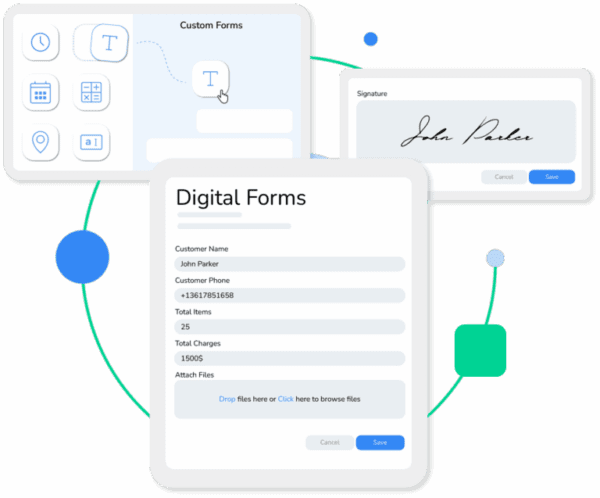
- ✔Customer signatures: Digital sign-off on estimates, work authorization, completion acceptance, and any change orders or additional work.
- ✔Time stamps and location verification: Proof of when technicians arrived, how long they worked, and verification that they were on-site.
- ✔Materials inventory: Complete record of all parts and materials used, for warranty tracking and inventory management.
Real-world impact:
When a customer disputes a charge six months after the job, you can pull up detailed notes, photos, and their digital signature authorizing the work. The dispute resolves in minutes instead of turning into a costly legal issue.
Similarly, when a customer calls about a problem with work you completed a year ago, you can instantly access complete job history, see exactly what was done, what parts were installed, and what recommendations were made at the time. This allows you to provide informed service and honor legitimate warranty claims while protecting yourself from unreasonable demands.
Arrivy creates a complete digital record of every job automatically. Technicians capture notes, photos, customer signatures, and work details through their mobile app, even offline in basements without cell service. Everything syncs to the cloud and is permanently archived with complete time/date/location stamps. You have instant access to a comprehensive job history whenever you need it, protecting your business and enabling better customer service.
Your Next Steps
Growing a plumbing business requires more than just excellent technical skills. You need efficient operations, consistent customer communication, data-driven decision making, and systems that ensure quality at scale.
The plumbing companies that are thriving in today’s competitive market have embraced field service management technology that optimizes operations, improves customer experience, and provides the visibility needed to make smart growth decisions.
Here’s how to get started:
If you’re just beginning to explore software solutions:
Start by identifying your biggest pain point. Is it scheduling chaos? Missed follow-ups? No-shows? Pick one area from this guide and focus on solving that first. Success builds momentum.
If you want to talk through your specific situation:
Every plumbing business has unique challenges. Maybe you’re managing multiple service areas, struggling with seasonal demand fluctuations, or trying to maintain quality as you scale.