

















Struggling to meet rising customer expectations while manual routing slows you down?
You are not alone; a recent survey found that 43% service-based companies expect their providers to innovate with modern route technology to meet their customers’ increasing demands. As customers are becoming specific about their service expectations, your business must modernize its operations to stay competitive.
If your company is struggling to meet these evolving demands, field service route optimization could be the solution.
Recommended Reads
What Is Field Service Route Optimization?
Field service route optimization refers to the process of organizing technician schedules and travel routes from a starting point to one or more destinations, ensuring productivity, reducing travel time & cost, and providing timely service delivery for the customers.
💡
Did You Know?
Up to 20% of e-commerce packages aren’t delivered on the first attempt.
Stop the Revenue Loss by learning how smart route optimization helps you earn more
Definition and Key Difference from Simple GPS Routing
Field service route optimization is a data-driven planning process that determines the most efficient yet effective routing for field operations. Unlike basic GPS navigation, it provides features such as technician skills, job duration, task priority, and real-time conditions. Efficient route optimization enables teams to complete more jobs in less time by minimizing travel, balancing workloads, and ensuring that service level agreements (SLAs) are met.
Field service route planning is a multi-dimensional optimization system that may incorporate GPS routing as one component, while GPS routing is a single-purpose navigation feature. Here are 3 key differences between Field Service Route Optimization and GPS Routing:
| Features | Field Service Route Optimization | GPS Routing |
|---|---|---|
| Optimization Scope | Considers multiple variables (technician expertise, parts inventory, customer time windows) | Only considers distance and traffic conditions |
| Resource Management | Coordinates entire workforce schedules and job assignments | Only provides navigation for individual vehicles |
| Business Integration | Integrates with CRMs, job-day inventory, and workforce systems | Typically operates as a standalone navigation tool |
GPS routing can be functional in limited cases, but for comprehensive route planning, field service route planning is mandatory, as it provides real-time route execution.
A common challenge in field service operations is maintaining the gap between planned efficiency and on-ground execution.
“Despite the tremendous advances in routing optimization over the last decade, there remains an important gap
between periodic route planning and real-time route execution.”
— Beryl Tomay, VP for Last Mile Delivery, Amazon
Field service route planning bridges this gap and maintains an effective workflow through smart routing.

The Evolution from Manual Planning to AI-driven Optimization
If you manually plan your routes using Google Maps, Excel sheets, whiteboards, or paper schedules, everything is sorted for the day. But unforeseen circumstances, such as last-minute schedule changes, traffic, and unexpected job complexities in the field, turn everything into chaos.
To overcome these challenges, an efficient route planning software like Arrivy is required. Otherwise, your business may face issues such as higher fuel costs, last-mile delivery delays, operational inefficiencies, and increased fleet maintenance expenses—ultimately leading to lower technician productivity, customer dissatisfaction, and reduced profitability.
Considering that last-mile delivery alone accounts for nearly 41% of total supply chain costs, even small inefficiencies in route planning can have a major financial impact on your business. Hence, it is high time to abandon manual planning and move towards smart routing.
On the contrary, the AI-driven, smart route planning ensures:
- Saving Your Time: Calculates the best travel routes in seconds.
- Prioritizing What Matters the Most: Considers job priority, technician location & proximity, and service time windows.
- Intelligently Learns Patterns: Continuously learns from past performance and traffic patterns for intelligent solutions.
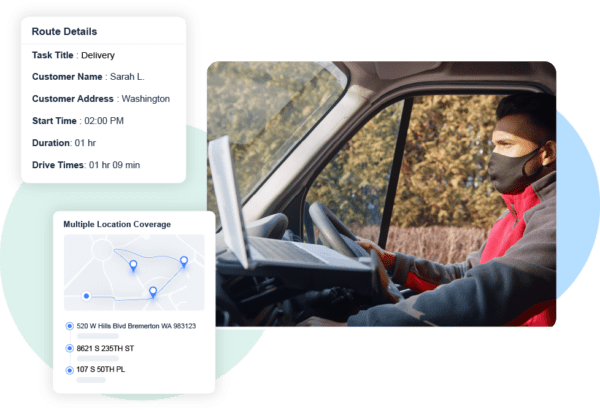
How Route Optimization Fits into Modern Field Service Workflows
Modern field service workflows require an integrated system that connects scheduling, workforce allocation, real-time GPS tracking, customer communication, and inventory management. Field service route planning services serve this purpose in the following ways:
Dynamic Workforce Scheduling
Modern route optimization software automates job assignments based on multiple live factors such as:
-
- Real-time locations
- Parts inventory and job requirements
- Emergency or high-priority job reshuffling
For example, a Roofing dispatcher can instantly identify which technician is nearby with the right tools and skill set for an urgent repair.
Customer-Centric Operations
Customer experience is built into the system to ensure transparency and accountability. The software uses:
- Live traffic data and predictive analytics to calculate accurate ETAs
- Historical performance metrics to modify job duration estimates
- Automated notifications via SMS/email to update customers about delays or arrival times
Business Rule Automation
The platform automatically implements operational policies and business rules, such as:
- Service-level agreements (SLAs) and priority routing
- Territory or zone-based restrictions using geofencing
- Certification and compliance check before assigning jobs
For example, a plumbing company can automatically assign after-hours emergency jobs to on-call technicians who meet the required compliance standards.
Real-Time Route Adjustments
When plans change—whether due to traffic, cancellations, or urgent requests— the system recalculates routes and updates technician schedules accordingly. Updates are sent instantly, keeping both dispatchers and crews in sync while minimizing idle time and travel distance.
Integrated Data Ecosystem
Route optimization works as part of a connected Field Service Management (FSM) ecosystem. It coordinates with CRM, ERP, and inventory systems to ensure every technician has the correct information and essential tools before reaching a job site. This interconnected data flow modernizes static route planning into a responsive, data-driven workflow.
Analytics and Performance Insights
After every job, the platform collects metrics like travel time, job duration, and fuel consumption. These insights enable field managers to identify recurring bottlenecks, measure technician productivity, and refine routing algorithms for operational efficiency. These analytics also help to improve the overall business productivity.
Mobility and Field Connectivity
Technicians access their optimized routes, job details, and real-time updates directly through mobile apps. They can update job statuses, upload photos, or communicate with dispatchers without making calls. This mobility ensures instant coordination between field and back-office teams, avoiding phone tags and improving responsiveness and accountability.
Your Toolkit for Ultra-Fast Route Planning
Business success does not happen in isolation—it needs revolutionary technology that makes wonders.
Key Components of Efficient Route Planning
Ready to move beyond manual routing? Here are some features worth exploring in field service route optimization.
Smart Dispatching and Technician Matching
Field service route optimization enables smart dispatching by automatically assigning the right technician to each job based on factors like:
- Proximity to the task location
- Technician qualifications matching job requirements
- Availability within the task’s time window
- Vehicle/equipment requirements for the job
For technician matching, the system considers:
- Certified skills from technician profiles
- Historical performance data (for example, completion rates for specific job types)
- Current workload balance across the team
The optimization algorithms process these constraints in real-time to create the most efficient assignments while meeting service-level expectations. This eliminates manual guesswork in dispatching while improving first-time fix rates and resource utilization. This is why 72% government fleet managers in the US rely on route optimization for enhanced resource allocation.
Real-Time Tracking and Adaptive Routing
Field service route optimization provides real-time tracking and adaptive routing through these key capabilities:
Real-Time Tracking:
- Live GPS updates from technician mobile devices show exact locations on dispatcher maps
- Automatic status updates (En route, On Site, Completed) feed into the activity feed
- ETAs adjust based on actual progress and traffic conditions
Adaptive Routing:
- Automatically reroutes technicians when:
- New high-priority tasks emerge
- Delays occur (traffic, extended job times)
- Last-minute cancellations happen
- Considers real-time factors like:
- Road closures/accidents via traffic data integration
- Vehicle restrictions (For example, truck routes)
- Technician availability changes
The system continuously optimizes routes throughout the day, simultaneously preserving original time windows. Dispatchers can manually approve or disapprove suggested reroutes.
Predictive ETAs and Automated Customer Notifications
Field service route optimization provides predictive ETAs and automated customer notifications through these integrated features:
Predictive ETAs:
- Calculates accurate arrival times using:
- Real-time GPS tracking of a technician
- Traffic patterns for the route
- Job duration estimates from similar past tasks
- Continuously updates ETAs as conditions change
- Automatically includes buffers between jobs to avoid late arrivals
Automated Customer Notifications:
- Triggers multi-channel alerts (SMS/email) at key milestones
- Includes: Technician photo/credentials, real-time map with vehicle tracking, and updated arrival window
- Reduces phone tags and “who is coming” anxiety
The system links these features together; if adaptive routing changes a technician’s path, both the ETA and customer notifications update automatically without dispatcher intervention.
System Integrations
Field service route optimization provides system integrations through these key mechanisms:
Pre-Built Connectors:
Native integrations with finance systems, mapping platforms, and communication tools for smooth data flow across operations.
API-first Connectivity:
Connects with platforms like CRM platforms, ERP systems, and workforce management tools, sending real-time updates to connected apps.
Benefits of Route Optimization for Field Service Teams
If you are still not sure about the significance of field service route planning for your business, then let’s dive into the 5 most powerful benefits of smart routing as follows:
1. Reduced Travel Time and Fuel Cost
Route optimization significantly enhances last-mile efficiency by calculating the most efficient routes for task completion, taking into account factors such as distance, time constraints, vehicle limitations, driver availability, traffic, and road closures. Built for high-density service/delivery environments, the system ensures that drivers follow the shortest paths while maintaining schedule adherence. This approach effectively reduces return visits and idle time, leading to lower fuel costs. The smart routing provides
2. More Jobs Completed Each Day
The route optimization provides a user-friendly app for drivers/technicians, enabling them to communicate with dispatchers and customers, avoiding phone tags. Additionally, the multi-stop route planning feature reduces travel time, allowing technicians to spend more time doing work instead of traveling. Smart routing can decrease travel time between jobs up to 28% ensuring that more jobs are completed each day.
3. Better Visibility for Dispatchers and Managers
The ultra-fast and efficient route optimization provides clear visibility for dispatchers and managers. Real-time adaptability enables the back office to make dynamic changes. Through smart routing, you can monitor the entire workforce and vehicles with live GPS tracking, instantly reassign jobs between routes, track progress against schedules, and review end-of-day performance stats.
4. Enhanced Customer Experience and Business Profitability
An efficient customer experience is a major driving factor towards a successful business. The modern route optimization reduces delivery time to 30-40% & ensures on-time deliveries to 95%. Smart routing ensures that your customers are happy with the service quality provided. It ensures timely delivery while meeting service level agreements (SLAs). It also minimizes missed deliveries through ETA alerts that notify customers when a driver/technician is nearby. Your business can improve its profitability through smart routing as it reduces delays, increases the number of tasks per day, and minimizes fuel costs.
5. Smaller Carbon Footprint
Field service route optimization not only reduces your business costs but also contributes to a better world by supporting sustainable goals.
It is alarming to note that the transport sector alone makes 23% of carbon dioxide (CO2) emissions. Field service route optimization paves the way towards sustainable field service operations. As discussed earlier, smart routing reduces fuel consumption, which also helps businesses take a step toward smaller carbon footprints.
How to Implement Smart Routing in Your Operations
To ensure the maximum output, consider the following practices while implementing smart routing for your operations:
Prioritize jobs effectively: Use smart routing software to assign priority based on job urgency, required service, and customer SLAs.
Utilize real-time data: Select a system equipped with real-time GPS tracking and traffic updates to facilitate dynamic route adjustments throughout the day.
Use skill-based job assignments: Go beyond simple location-based job assignments by routing jobs to technicians with the right expertise to improve the first-time fix rate.
Integrate with other systems: Ensure your routing platform can connect easily with your other business software to align the flow of information.
Continuously analyze performance: Track and review key performance indicators (KPIs) to identify inefficiencies and upgrade your routing strategy over time.
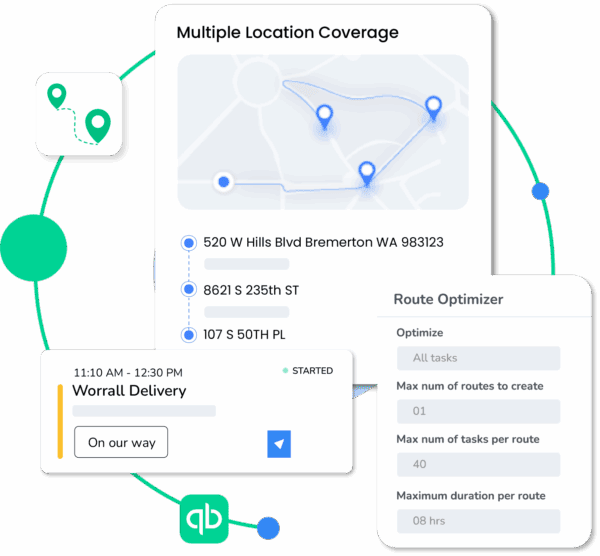
How Arrivy Supports Efficient Field Service Routing
Arrivy’s Route Optimization is an intelligent system designed to maximize efficiency for field service operations by automating and refining the planning of multi-stop routes. It provides Uber-like visibility to field operations and saves 80% of time on repeats. Additionally, due to increased team productivity, Arrivy helps complete 2000+ tasks per day. Here’s a detailed breakdown of Arrivy’s smart routing workflow:
8 Core Functionality Features of Arrivy Route Optimization
| Feature | Key Capabilities |
|---|---|
| 1. AI-Powered Route Creation and Optimization | • Drag-and-drop Functionality: Full control over task assignments through manually adjusting route start/end times. • Automatic Optimization: AI calculates the most efficient routes. • Pre-assignment Capabilities: Lock specific teams or equipment to routes before optimization. |
| 2. Interactive Interface for Real-Time Visibility | • Map View: Geographic visualization of all routes; color-coded pins for task types; directional arrows for optimized paths. • Timeline View: Visual schedule of all tasks; drag-and-drop time adjustments; detect time conflicts or overlaps. • Route Details Panel: Displays total duration, distance, depot info, and assigned crew/equipment. |
| 3. Experiment and Publish Workflow | • Non-destructive Editing: Test unlimited route configurations; compare optimization scenarios without affecting live data. • Publish Controls: One-click publishing of finalized routes; optional customer notifications for time updates; audit trail for all modifications. |
| 4. Search and Filtering | • Unified search across task details, customer information, and location data. • Synchronized highlighting across all views. • Advanced filters for time windows, task types, and resource requirements. |
| 5. Team and Resource Management | • Team Explorer: View team availability across multiple days; assign based on efficiency; access capacity planning tools. • Resource Allocation: Assign vehicles/equipment; track resource utilization; prevent double-booking. |
| 6. Customization and Configuration | • Route Constraints: Set maximum tasks per route, route duration, and time buffers between tasks. • Depot Management: Manage multiple depots, customize departure/return times, and configure vehicle-specific depots. |
| 7. Multi-Session Planning | • Save incomplete route plans. • Share drafts for team collaboration. • Access session history for review and version tracking. |
| 8. Integrations and Workflow | • Arrivy Forms: Attach digital forms to routes; pre-populate form data; include route-specific documentation. • Version Control: Undo/redo changes; create snapshots; compare route versions easily. |
Conclusion: Staying Ahead with Intelligent Route Planning
Field service route optimization transforms routine operations into intelligent, data-driven workflows that enhance technician productivity, minimize costs, and strengthen customer trust. Whether your goal is to improve first-time fix rates, cut fuel expenses, or deliver exceptional customer experiences, smart routing is the foundation that makes it possible. With 80% of customers rating service quality equal to or higher than product value, meeting customer requirements is no longer optional for field service businesses. Smart routing helps you achieve this—enabling you to stay ahead of competitors through intelligent route planning and stronger customer retention.