


















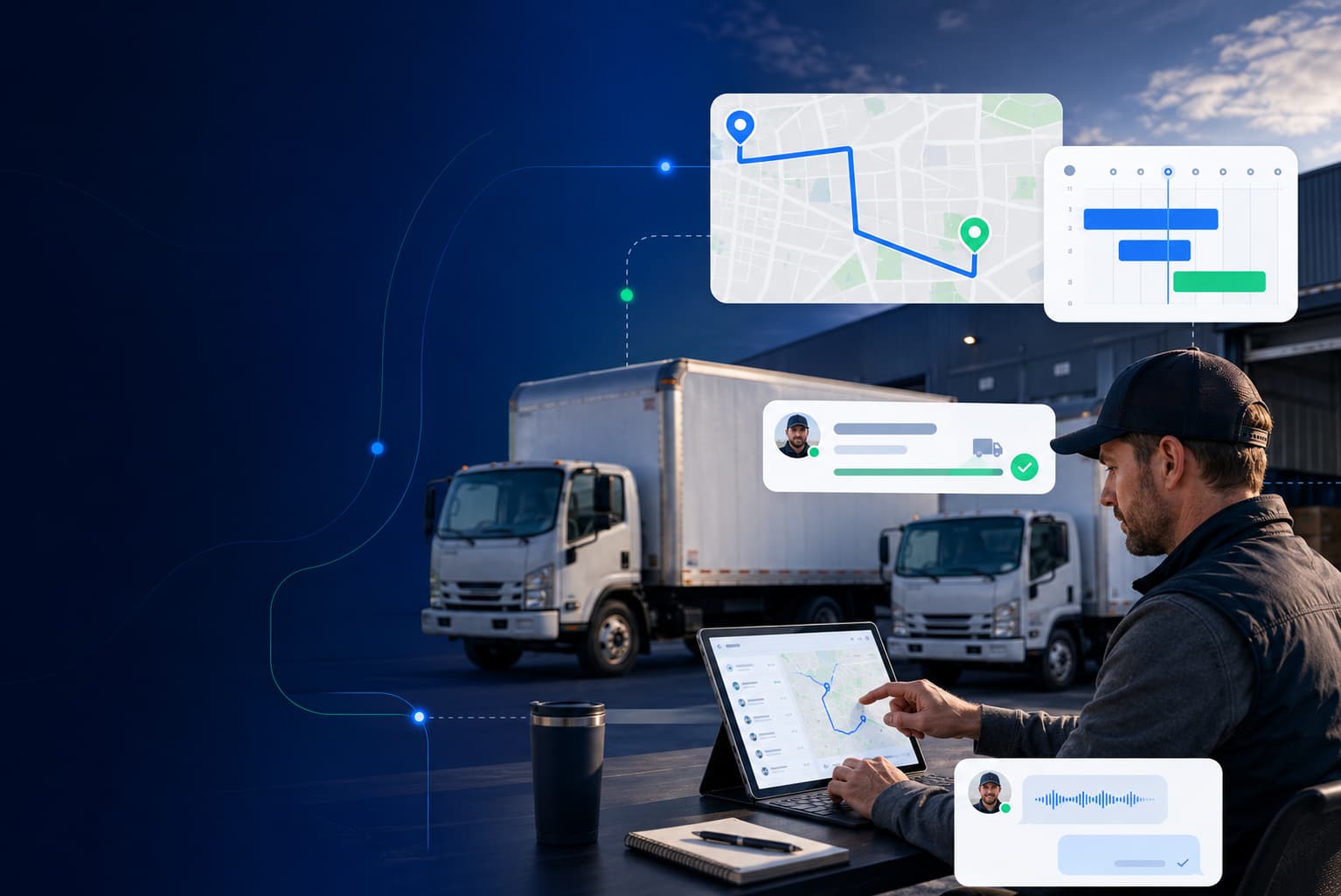


The challenge for most small trucking companies is keeping operations organized as the business grows.
Driver assignments, route planning, customer communication, delivery tracking, and proof of delivery often rely on separate tools and manual processes. What works for a small fleet becomes harder to manage with every new truck and customer.
Dispatch software helps centralize those daily operations.
This guide compares the best dispatch software for small trucking companies in 2026, including Arrivy, Truckbase, TruckLogics, TruckingOffice, Workyard, and Connecteam. We’ll compare their features, pricing, strengths, and ideal use cases to help you find the right fit for your fleet.
Quick Answer:
Dispatch software for small trucking companies helps dispatchers assign drivers, schedule loads or delivery jobs, track vehicles, plan routes, communicate with drivers, share customer updates, collect proof of delivery, and reduce manual check calls.
The right platform depends on how your trucking business operates. Some platforms focus on freight management, while others are built for delivery execution, customer communication, or workforce coordination.
Best Dispatch Software for Small Trucking Companies
Arrivy: Best for local trucking and delivery teams that need dispatch visibility, route planning, customer ETA updates, delivery tracking, and proof of delivery.
Truckbase: Best for growing freight carriers that need dispatch, invoicing, driver settlements, truck tracking, and carrier management.
TruckLogics: Best for owner-operators and small carriers that need dispatch, load management, invoicing, expenses, and maintenance tracking.
TruckingOffice: Best for small fleets that need dispatch, load planning, invoicing, mileage, and back-office workflows.
Workyard: Best for fleets that mainly need GPS workforce tracking, time tracking, and scheduling.
Connecteam: Best for small teams that need driver scheduling, communication, forms, and mobile workforce coordination.
Recommended Reads
•What Is Dispatch Software? How It Works, Features, Benefits, and Use Cases
•Best Dispatching Software for Field Service Businesses in 2026
•How Construction Dispatch Software Streamlines Job-Day Execution?
What Is Trucking Dispatch Software?
Trucking dispatch software is a dispatch management platform that helps trucking companies assign drivers, schedule loads or delivery jobs, track vehicle locations, manage routes, communicate updates, and monitor delivery progress from one system.
Instead of managing dispatch activities across multiple tools, dispatchers can view active jobs, driver status, route information, customer updates, and proof of delivery in one place. This improves visibility across daily operations and reduces the administrative work required to keep deliveries moving.
Dispatch Software vs. TMS: What’s the Difference?
Dispatch software focuses on daily operations such as driver assignments, route planning, delivery tracking, and customer communication. A transportation management system (TMS) manages broader freight operations, including load planning, compliance, accounting, and carrier management.
| Feature | Dispatch Software | Transportation Management Software (TMS) |
|---|---|---|
| Primary focus | Daily dispatch operations | End-to-end transportation management |
| Driver assignment | ✓ | ✓ |
| Route planning | ✓ | ✓ |
| Driver tracking | ✓ | ✓ |
| Customer updates | ✓ | Varies by platform |
| Proof of delivery | ✓ | Varies by platform |
| Load management | Limited or workflow-specific | ✓ |
| Accounting tools | Usually through integrations | Often built in |
| Compliance management | Limited | ✓ |
| Best for | Dispatch-focused teams | Freight carriers and larger trucking operations |
If your priority is improving dispatch visibility, driver coordination, customer updates, and proof of delivery, dispatch software is often the better starting point. Companies with complex freight operations, compliance requirements, and accounting workflows may benefit from a full TMS.
What to Look for in Dispatch Software
Every dispatch platform is built for a different type of operation. Some focus on freight management and compliance. Others focus on dispatch visibility, route planning, and delivery execution. The best dispatch software combines driver scheduling, route planning, dispatch management, customer communication, and proof of delivery in one workflow.
Before choosing a platform, look for these capabilities:
Easy Driver Assignment: Dispatchers should be able to assign jobs quickly and adjust schedules when priorities change.
Real-Time Driver Visibility: Knowing where drivers are and which jobs are in progress helps reduce delays and improve decision-making.
Route Planning and Optimization: Efficient routes reduce unnecessary miles, fuel costs, and delivery delays.
Proof of Delivery: Photos, signatures, and delivery confirmations create a clear record of completed work and help resolve disputes.
Mobile App for Drivers: Drivers should be able to receive assignments, update job status, and submit delivery information from the field.
Invoicing and Accounting Support: Integrations with accounting systems help reduce manual data entry and speed up billing workflows.
ELD and Compliance Support: For fleets with compliance requirements, built-in tools or integrations can simplify recordkeeping and reporting.
Integrations: The best dispatch software fits into your existing workflow by connecting with CRM, accounting, fleet management, and communication tools.
Pricing That Fits Small Fleets: Small trucking companies often need software that delivers operational value without enterprise-level costs.
How We Selected the Best Dispatch Software for Small Trucking Companies
We evaluated six dispatch software platforms based on the features small trucking companies use every day. Our review covered dispatch scheduling, driver visibility, route planning, customer communication, proof of delivery, mobile access, invoicing, integrations, pricing, ease of use, scalability, and overall value for small fleets.
We also looked at how each platform fits different trucking businesses. Some platforms support freight carriers with compliance requirements. Others work better for delivery operations that need dispatch visibility, customer updates, proof of delivery, and fleet coordination. Our goal was to identify which platform works best for each type of operation instead of ranking features alone.
Quick Comparison: Best Dispatch Software for Small Trucking Companies
Every platform supports a different type of trucking operation. Use this comparison to narrow your options before reviewing each platform in detail.
| Software | Best For | Main Strength | Best Team Type |
|---|---|---|---|
| Arrivy | Local trucking and delivery dispatch | Real-time dispatch visibility, customer updates, and proof of delivery | Delivery fleets and customer-facing operations |
| Truckbase | Freight carriers | Dispatch-centric fleet and carrier management | Growing trucking companies |
| TruckLogics | Owner-operators and small carriers | Dispatch, invoicing, and load management | Independent trucking businesses |
| TruckingOffice | Dispatch and back-office workflows | Dispatch and administrative management | Small fleets |
| Workyard | GPS workforce visibility | Time tracking, GPS visibility, and scheduling | Field-based operations |
| Connecteam | Scheduling and communication | Workforce coordination and mobile communication | Small teams and mixed operations |
Review the detailed breakdown below to compare features, pricing, advantages, and limitations before making your decision.
Best Dispatch Software for Small Trucking Companies in 2026
Each platform below solves a different dispatch challenge. Choose software based on how you manage drivers, deliveries, routes, and customer communication, not the number of features it offers.
1. Arrivy: Best for Local Trucking Dispatch, Customer Updates, and Proof of Delivery
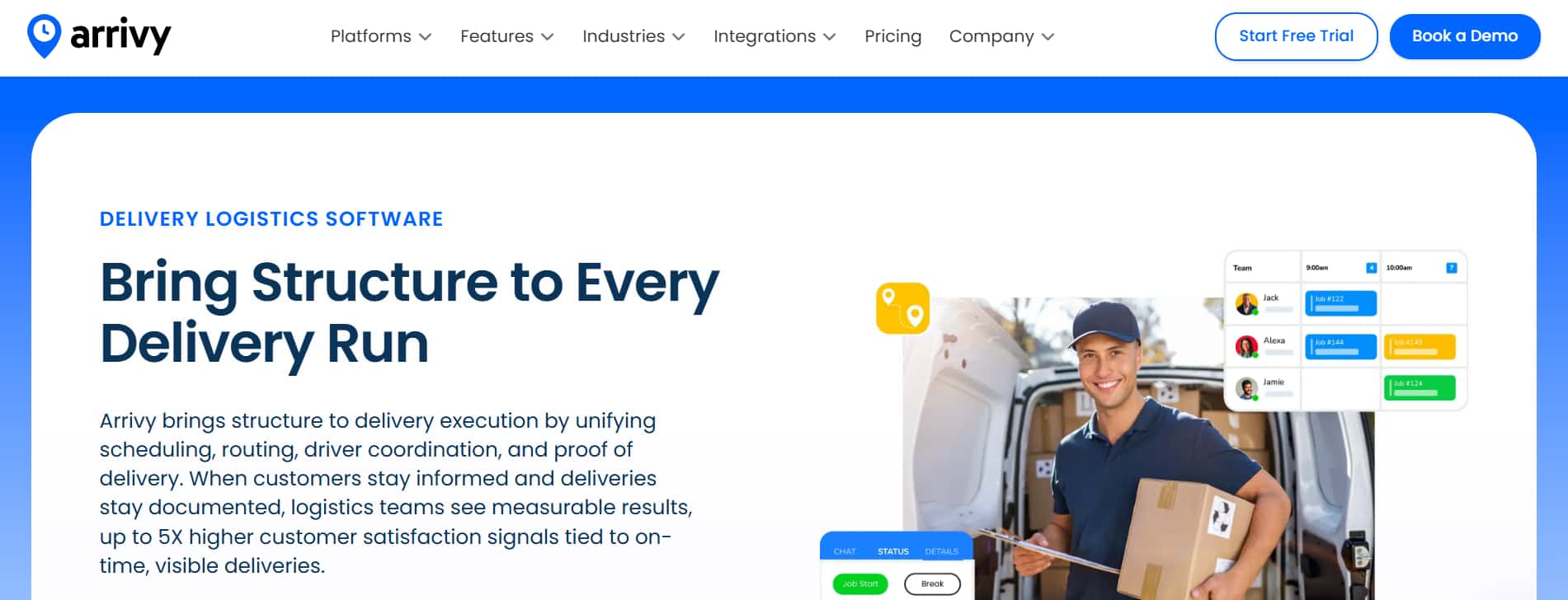
Arrivy is an operations management platform that helps businesses schedule, dispatch, execute, and track work across field teams and delivery operations. For small trucking companies, it provides a centralized system for dispatching drivers, tracking deliveries, managing routes, sharing customer updates, and collecting proof of delivery.
Choose Arrivy if your business handles scheduled deliveries and needs dispatch visibility, route planning, customer updates, and proof of delivery in one platform.
As trucking operations grow, dispatchers often manage driver assignments, route changes, customer communication, delivery documentation, and reporting across multiple systems. Arrivy brings these activities into a single workflow, helping teams maintain visibility across daily operations while reducing manual coordination.
The platform combines dispatch scheduling, route optimization, driver tracking, customer notifications, proof of delivery, digital forms, reporting, and business system integrations to support end-to-end delivery execution.
Unlike traditional trucking management systems that focus on freight operations and back-office workflows, Arrivy is designed for customer-facing delivery operations where dispatch visibility, real-time updates, and proof of delivery are priorities.
Pros
- Strong dispatch scheduling and delivery coordination tools
- Real-time visibility into driver activity and delivery status
- Customer communication and ETA updates are built into the workflow
- Route optimization helps reduce unnecessary miles
- Supports proof of delivery with photos, signatures, and documentation
- Centralizes dispatch, delivery tracking, and reporting
- Integrates with CRM, accounting, and business systems
Cons
- Not a full transportation management system
- Advanced freight compliance workflows may require additional tools
- Some advanced capabilities are available on higher-tier plans
Pricing
Arrivy pricing starts at $25 per user per month, with a minimum of 3 users. Businesses with more advanced operational requirements can choose higher-tier plans based on team size and workflow needs.
See How Arrivy Improves Trucking Dispatch
Explore Arrivy
2. Truckbase: Best for Growing Trucking Companies
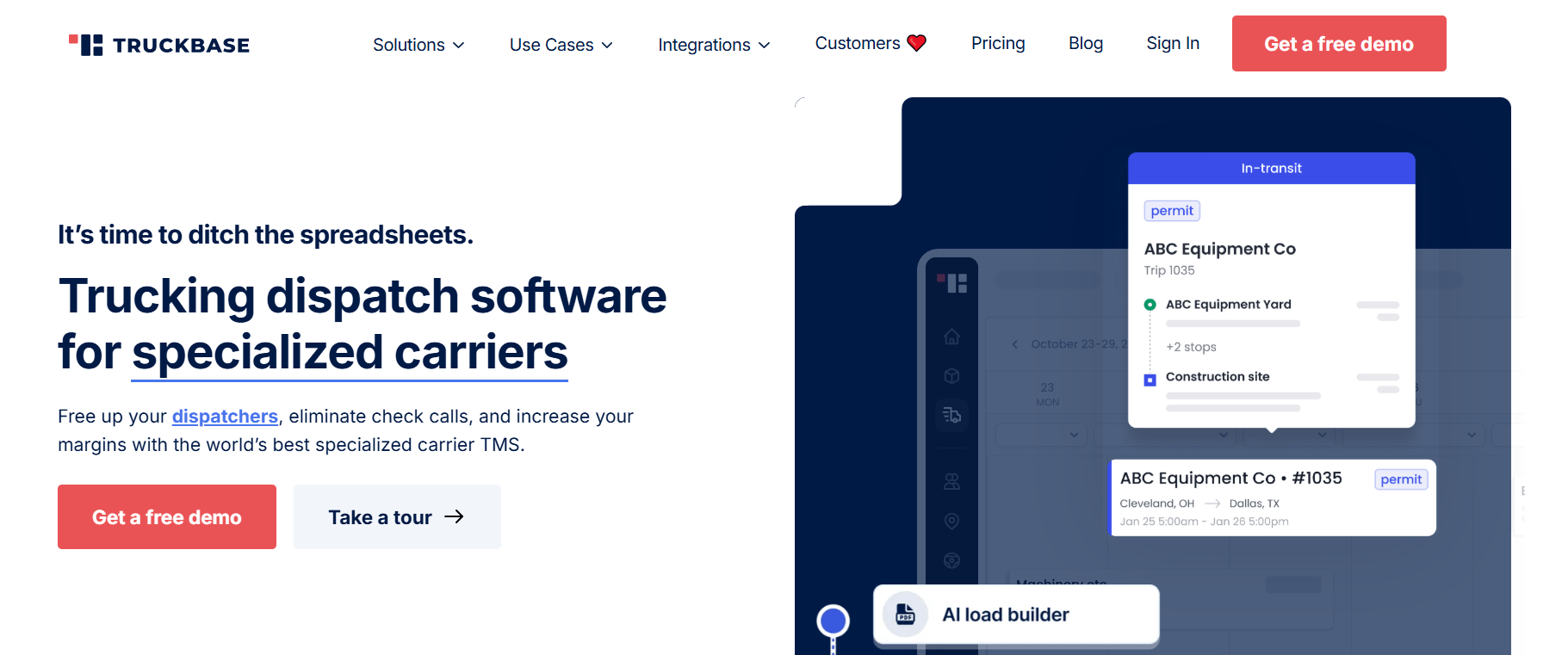
Truckbase is a trucking management platform built for asset-based carriers that need dispatch, invoicing, driver settlements, truck tracking, and fleet management in one system. It focuses on helping growing trucking companies manage both dispatch operations and back-office workflows without relying on multiple disconnected tools.
Choose Truckbase if you manage a growing freight operation and need dispatch, invoicing, driver settlements, and carrier management in one system.
Pros
- Built specifically for trucking carriers
- Combines dispatch and financial workflows in one platform
- Supports driver settlements and invoicing
- Includes ELD and trucking-specific integrations
- Strong fit for growing asset-based fleets
Cons
- Pricing is not publicly available
- Less focused on customer communication workflows
- Limited proof of delivery capabilities
- Route optimization is not a primary focus
Pricing
Truckbase offers custom pricing based on fleet size and operational requirements.
3. TruckLogics: Best for Owner-Operators and Small Carriers
TruckLogics is a trucking management platform designed for owner-operators, leased operators, brokers, and small carriers. It combines dispatching, load management, invoicing, expense tracking, maintenance management, and driver settlements in a single system, making it a practical option for businesses that want trucking-specific operational and financial tools.
Choose TruckLogics if you are an owner-operator or small carrier looking for dispatch, load management, invoicing, maintenance tracking, and expense management.
Pros
- Built specifically for small trucking businesses
- Combines dispatch, accounting, and maintenance tools
- Supports both FTL and LTL operations
- Includes driver settlements and expense tracking
- Integrates with major trucking tools and load boards
Cons
- User interface feels dated compared to newer platforms
- Route optimization capabilities are limited
- Advanced reporting options are less robust than those of some competitors
- Larger fleets may outgrow the platform
Pricing
TruckLogics plans for owner-operators start at $35.96 per month when billed annually.
4. TruckingOffice: Best for Dispatch and Back-Office Management
TruckingOffice is a trucking management platform designed for owner-operators and small fleets. It combines dispatching, load management, invoicing, expense tracking, maintenance records, and business reporting in a single system. Its focus is on helping smaller trucking companies manage daily operations and administrative tasks without enterprise-level complexity.
Choose TruckingOffice if you want one platform to manage dispatch, load planning, invoicing, maintenance records, and other back-office tasks.
Pros
- Affordable pricing for small fleets
- Combines dispatch and administrative workflows
- Supports both FTL and LTL operations
- Includes invoicing and expense tracking tools
- Easy for owner-operators and small fleets to adopt
Cons
- Interface feels outdated compared to newer platforms
- Limited customer communication features
- Fewer integrations than some competitors
- Route optimization requires an additional add-on
- Limited advanced analytics and reporting
Pricing
TruckingOffice pricing starts at $25 per month for owner-operators with 1 to 2 trucks.
5. Workyard: Best for GPS Visibility and Workforce Tracking
Workyard is a workforce management platform focused on GPS tracking, employee scheduling, time tracking, and labor cost visibility. While it is not built specifically for trucking companies, small fleets and delivery teams use it to improve workforce visibility and monitor driver activity in the field.
Choose Workyard if your priority is GPS tracking, employee scheduling, time tracking, and workforce visibility instead of trucking-specific dispatch tools.
Pros
- Strong GPS visibility and workforce tracking
- Accurate time and mileage tracking
- Scheduling and task management tools
- Supports payroll and accounting integrations
- Useful for field-based teams that need workforce visibility
Cons
- Not built specifically for trucking companies
- No trucking-specific dispatch workflows
- Limited load management capabilities
- No built-in ELD compliance tools
- Customer communication features are limited
Pricing
Workyard pricing starts at $6 per user per month when billed annually.
6. Connecteam: Best for Scheduling and Team Communication
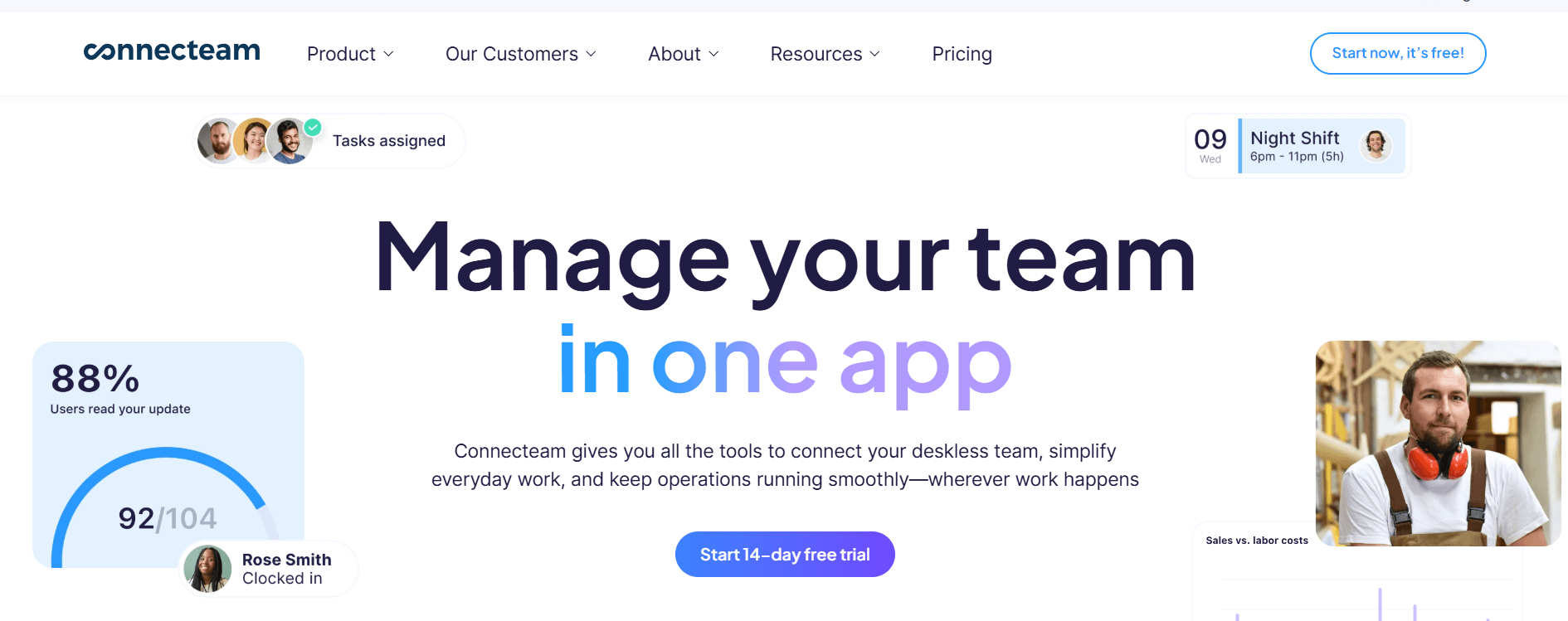
Connecteam is a workforce management platform that helps businesses manage scheduling, communication, time tracking, and daily operations from a single mobile app. While it is not designed specifically for trucking companies, small fleets use it to coordinate drivers, manage schedules, track time, and improve communication between dispatchers and field teams.
Choose Connecteam if you need driver scheduling, team communication, mobile forms, and workforce coordination for a small field team.
Pros
- Easy-to-use mobile app
- Strong team communication tools
- Scheduling and workforce management in one platform
- Includes GPS time tracking and task management
- Free plan available for small teams
Cons
- Not built specifically for trucking operations
- No dedicated load management functionality
- Limited dispatch-specific features
- No built-in ELD compliance support
- Route optimization is not a core capability
Pricing
Connecteam offers a free plan for up to 10 users. Paid plans start at $29 per month for up to 30 users.
How to Choose the Right Dispatch Software for Your Trucking Business
Start by identifying your primary operational need. If your business manages local deliveries with frequent customer updates, choose software built for dispatch visibility and proof of delivery. If you manage freight operations, look for dispatch, invoicing, compliance, and carrier management tools. Workforce management platforms are a better fit when scheduling, GPS tracking, and team communication are your top priorities.
Pricing, integrations, ease of use, and scalability should also factor into your decision, especially if you expect your fleet to grow over time.
Conclusion
The right dispatch software helps small trucking companies improve visibility, reduce manual coordination, and keep deliveries moving efficiently.
Arrivy, Truckbase, TruckLogics, TruckingOffice, Workyard, and Connecteam each address different operational needs. Some focus on freight management and back-office workflows, while others prioritize dispatch visibility, customer communication, workforce tracking, or proof of delivery.
Evaluate your current processes, growth plans, and operational priorities before making a decision. The best dispatch software is the one that fits your daily workflow, supports your team, and helps your business operate more efficiently as your fleet grows.