





















AI Summary
Field service management software helps UAE businesses schedule technicians, dispatch jobs, manage work orders, optimise routes, track field activity, document completed work, communicate with customers, and monitor operational performance.
This guide compares Arrivy, Zoho FSM, Dynamic FSM, JobPilot, Joblogic, and QuickAMC using the same operational criteria rather than ranking products by feature count alone.
- Arrivy is our best overall field service software in UAE for businesses that need scheduling, dispatch, crew management, route optimisation, live field visibility, digital forms, customer communication, and integrations to work together across the same operational workflow.
- Zoho FSM is particularly strong for businesses already operating within the Zoho ecosystem and organisations that value UAE-specific tax configuration and UAE data-centre availability.
- Dynamic FSM is a strong option for technician-intensive HVAC, MEP, telecom, utilities, and maintenance companies that prioritise dispatch, routing, offline field work, parts management, and on-site billing.
- JobPilot is built specifically for MENA field-service companies and provides regional workflows, multi-branch capabilities, live operations, and AED-focused commercial processes.
- Joblogic is particularly well suited to facilities-management and maintenance businesses that need asset registers, planned preventive maintenance, compliance, and field-service management within the same system.
- QuickAMC is a UAE-based option for businesses primarily looking to digitise technician scheduling, work orders, recurring maintenance, tracking, and basic field operations.
The best platform depends on the operating model. Companies should evaluate how software handles actual field scenarios rather than choosing the product with the longest feature list.
Why Field Service Software Matters in the UAE?
Field-service operations in the UAE present a distinctive set of challenges.
A technician may complete one service call in Dubai before travelling to Sharjah for another. HVAC and MEP companies may need to manage both planned maintenance and urgent breakdowns. Facilities-management businesses can be responsible for large numbers of customer sites, assets, technicians, subcontractors, and recurring service agreements.
As these operations grow, manual scheduling, spreadsheets, calls, messages, and disconnected applications become harder to control.
The UAE field service management market reflects this shift toward more structured digital operations. MarketsandMarkets estimates that the UAE FSM market was worth $88.4 million in 2025 and could reach $163.1 million by 2030, representing a projected 13% compound annual growth rate. (View the MarketsandMarkets UAE FSM report) The research identifies digital transformation, cloud adoption, mobile workforce optimisation, IoT, and real-time operational visibility as major factors driving adoption.
Field service management software can help organisations bring together:
The objective is not simply to digitise a calendar.
A strong FSM platform should help the business manage the complete operational lifecycle.
Disclosure
Arrivy publishes this comparison and is one of the products evaluated. For that reason, each platform has been compared using the same operational criteria and current publicly available vendor documentation. Where another platform has a stronger capability or greater UAE-specific localisation, that advantage is identified.
The purpose of the ranking is not to suggest that Arrivy is the right choice for every organisation. It is to determine which platform offers the strongest overall fit for connected field operations while explaining where specialised alternatives may be better suited.
Quick Comparison: Best Field Service Software in UAE
The ratings below are editorial scores based on the evaluation criteria described later in this guide. They reflect overall fit for field-service operations rather than customer-review scores from a third-party platform.
| Company | Best For | Basic Plan / Starting Price | Editorial Rating |
|---|---|---|---|
| Arrivy | Connected multi-crew field operations | $25/full-access user/month | 4.8/5 |
| Zoho FSM | UAE localisation and Zoho ecosystem | $30/month Standard | 4.6/5 |
| Dynamic FSM | HVAC, MEP and technician-heavy operations | Custom quote | 4.5/5 |
| JobPilot | MENA multi-branch field-service companies | $31/user/month billed yearly | 4.3/5 |
| Joblogic | Maintenance, assets and facilities management | From £45/user/month billed annually | 4.4/5 |
| QuickAMC | UAE-based technician and work-order management | Custom scalable pricing | 4.1/5 |
How We Evaluated the Best Field Service Management Software in UAE?
We evaluated each platform based on how well it supports the real operating cycle of a field-service organisation.
We evaluated each platform based on how well it supports real field-service operations in the UAE, using official product pages, feature documentation, pricing, integrations, and mobile capabilities. We also reviewed Capterra ratings and user feedback to better understand ease of use, support, reliability, and overall value. Our comparison focused on scheduling, dispatch, technician management, routing, work orders, field visibility, forms, customer communication, reporting, integrations, scalability, and UAE relevance.
The comparison considered:
We did not treat similar-sounding capabilities as equivalent.
For example:
This distinction matters because two platforms may both advertise “routing” or “tracking” while delivering substantially different functionality.
Top 6 Field Service Management Software in UAE
1. Arrivy — Best Overall for Connected Field Operations
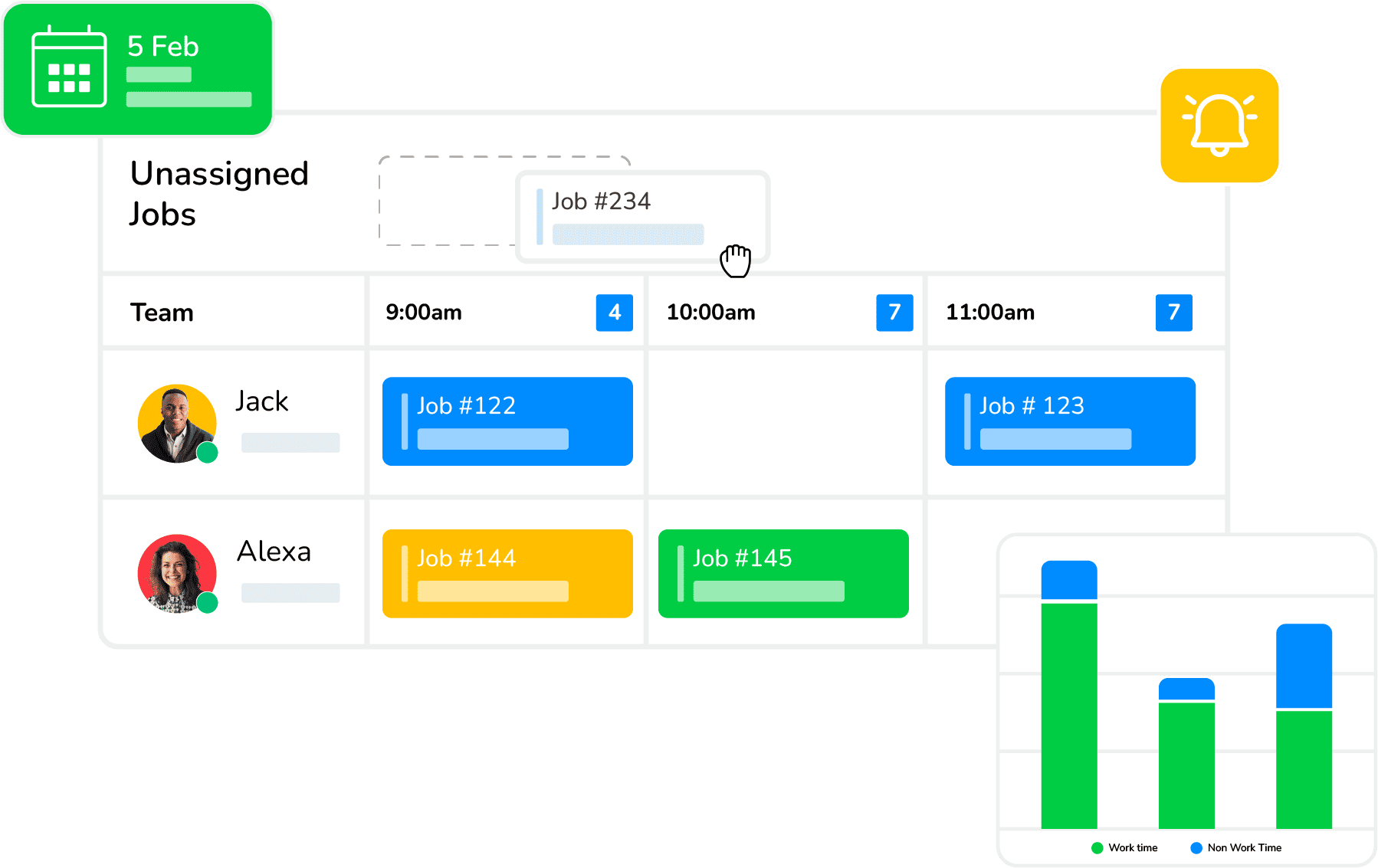
Arrivy is an operations and field service management platform built around the work that happens between a job being created and that job being completed. Its field-service workflow connects the office, dispatcher, technicians or crews, customers, and the other business systems surrounding the job.
This operational focus is particularly relevant to businesses managing several crews, changing schedules, multiple service areas, customer appointments, installations, recurring work, or complex field jobs. Rather than treating scheduling as a standalone calendar, Arrivy connects scheduling and dispatch with crew management, routes, live job activity, forms, customer updates, and operational reporting.
Pros
- Strong scheduling-to-completion workflow
- Multi-crew and multi-person assignment
- Real-time dispatcher and field visibility
- Genuine route planning and optimisation
- Strong proof-of-service functionality
- Digital forms and photos
- Offline form capture
- Customer ETA and status communication
- Broad integration ecosystem
- APIs and webhooks
- Multi-location operational support
Cons
- Some advanced capabilities require Premium or higher plans
- SMS outside the US and Canada may involve additional costs
- Deep asset-management requirements may require another connected platform
Pricing
Arrivy offers three main pricing tiers. The Standard plan starts at $25 per full-access user per month and includes scheduling and dispatch, customer and crew experience tools, notifications, and reporting. The Premium plan starts at $50 per full-access user per month and adds digital forms, route planning, advanced reporting, and advanced integrations. The Enterprise plan uses custom pricing and is designed for businesses that need custom integrations, API access, webhooks, and dedicated support. Standard and Premium begin with a minimum of three full-access users. Arrivy also offers a 14-day free trial without requiring a credit card.
Best For
Arrivy is best suited to growing field-service businesses that need to manage the full job journey in one connected workflow, from scheduling and dispatch to crew coordination, routing, field work, proof of service, customer updates, and completion.
Where Arrivy Fits Best
Arrivy is particularly well suited to organisations whose primary challenge begins after the work has been sold or created.
Consider an HVAC company operating across Dubai, Sharjah, and Abu Dhabi.
The company may already use:
Replacing every system is unnecessary.
Arrivy is designed to become that operational execution layer.
This is also useful for construction, solar, installation and repair, cleaning, moving, logistics, roofing, and other organisations coordinating multiple people and appointments in the field.
2. Zoho FSM — Best for UAE Localisation and the Zoho Ecosystem
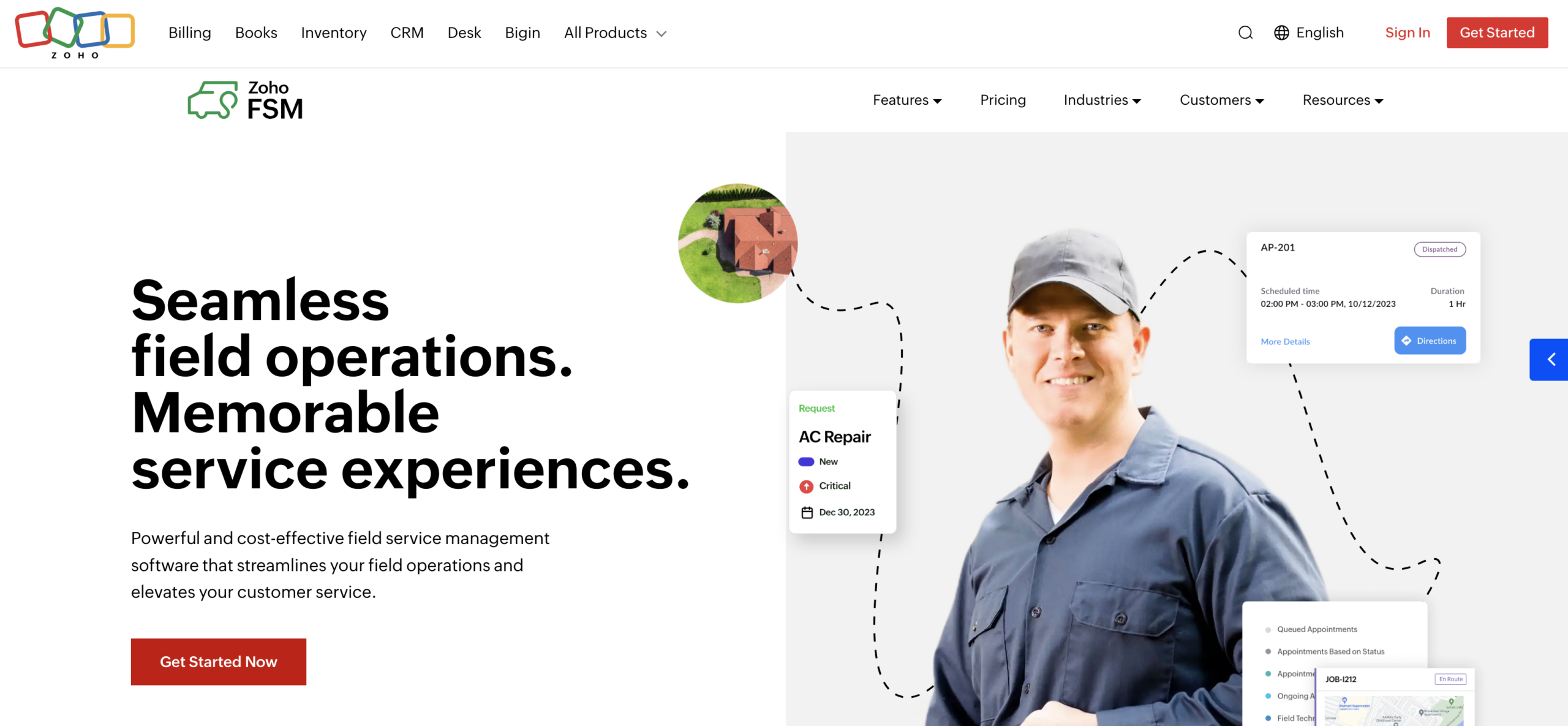
Zoho FSM is a dedicated field service management platform that covers the complete service lifecycle, including customer records, requests, estimates, work orders, service appointments, scheduling, dispatch, field agents, invoicing, payments, and reporting.
The platform’s Dispatch Console provides Gantt, Grid, Map, and Calendar views, while field agents can be assigned using factors such as skills, location, availability, and territory.
Zoho FSM has particularly strong UAE relevance.
The software is currently available through a dedicated UAE data centre, and Zoho provides a UAE-specific tax edition.
Pros
- Dedicated UAE data centre
- UAE-specific VAT functionality
- Broad FSM feature set
- Strong work-order functionality
- Live field-agent location
- Asset and maintenance functionality
- Zoho CRM and Books integrations
- WhatsApp functionality on applicable plans
- Skills and territory management
Cons
- Route optimisation is not currently equivalent to mature dedicated route-optimisation tools
- Pricing increases with appointment volume
- Advanced workforce features require higher plans
- Businesses outside the Zoho ecosystem may need more configuration
- Offline capabilities should be tested against exact field requirements
- DESC compliance may matter for certain government-linked organisations
Zoho notes that FSM is currently not DESC compliant because of third-party mapping dependencies. The company also states that DESC requirements primarily apply to Dubai government departments, government-owned or government-aided organisations, or entities explicitly required to comply.
Pricing
Zoho FSM offers four pricing tiers. The Free plan costs $0 and covers basic field service management needs. The Standard plan starts at $30 per month and adds features such as maps, location tracking, crew management, and customisation. The Professional plan starts at $45 per month and includes job sheets, asset management, maintenance plans, and more advanced appointment capabilities. The Premium plan starts at $55 per month and adds skills management, shifts, workforce insights, and more advanced workforce functionality. Zoho’s pricing is also volume-based, so appointment requirements can increase the total monthly cost.
Best For
Zoho FSM is best suited to UAE companies already using the Zoho ecosystem and looking for strong local support such as UAE-specific tax handling and local data-centre availability. It is also a good fit for businesses managing assets, maintenance plans, and broader field-service workflows in one platform.
3. Dynamic FSM — Best for HVAC, MEP and Technician-Centric Operations
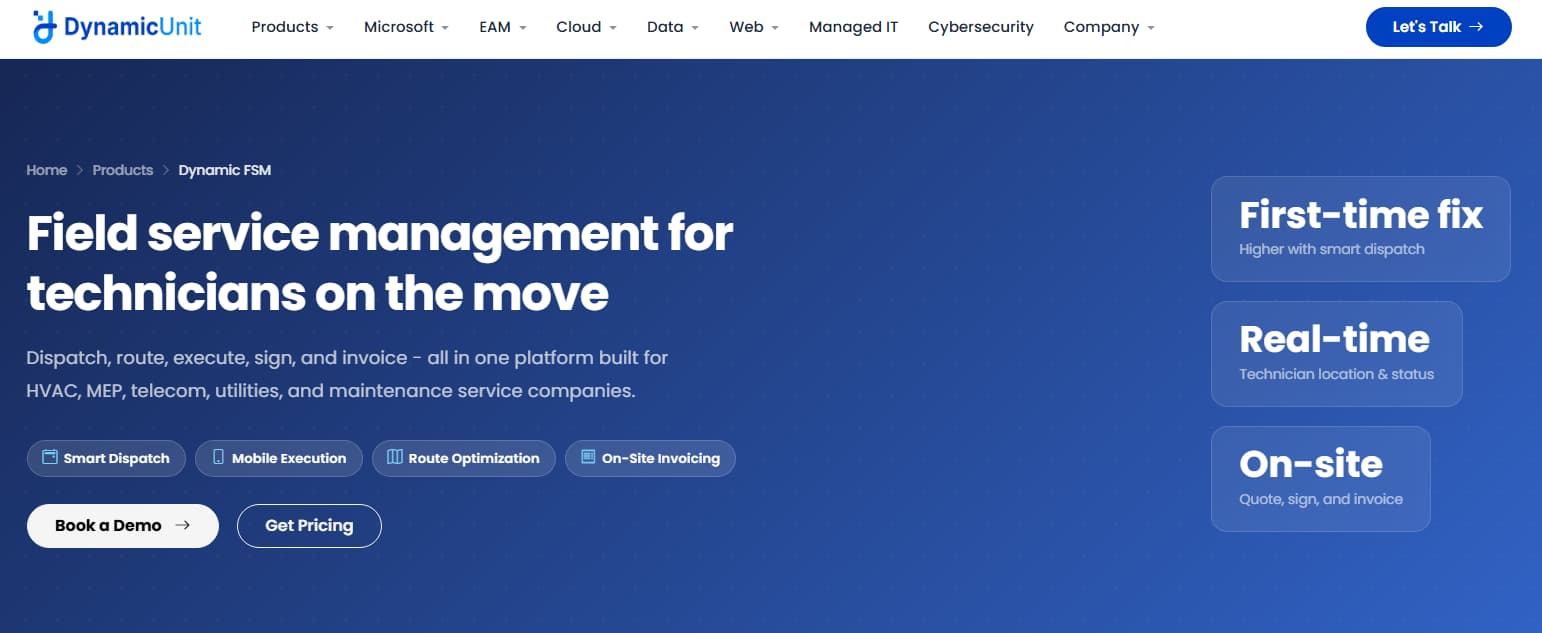
Dynamic FSM is an enterprise SaaS field-service platform designed around technicians performing installation, maintenance, and repair work.
The vendor specifically targets HVAC, MEP, telecom, utilities, and maintenance-service organisations in the UAE and wider region.
Pros
- Strong UAE and regional service positioning
- Skills-aware dispatch
- Genuine multi-stop route optimisation
- Fully offline field workflows
- Parts and stock-van management
- On-site invoices and payments
- Customer signatures and photos
- Arabic and English support
- Strong HVAC and MEP fit
Cons
- Pricing is not publicly fixed
- Implementation fees apply
- More technician-service focused than broad multi-industry operations
- External integration requirements should be verified
Pricing
Dynamic FSM uses a per-technician SaaS subscription, with separate dispatcher and administrator tiers. A fixed implementation fee also applies. Exact pricing requires a customised quote based on operational scope.
Best For
Dynamic FSM is best suited to HVAC, MEP, and telecom businesses that need strong technician management and field-service operations.
It is particularly strong where technician skills, route optimisation, parts availability, first-time fix rates, and immediate billing are major operational priorities.
4. JobPilot — Best for MENA Multi-Branch Field Operations
JobPilot positions itself specifically as a field-service operations platform for businesses across the MENA region.
It combines job scheduling, live dispatch, technician management, customer management, quotations, invoicing, financial reporting, and multi-branch operations.
Its current product examples use AED, regional customer information, Dubai service locations, technician statuses, and UAE-oriented field-service scenarios.
Pros
- Built specifically for MENA field-service businesses
- AED-oriented workflows
- Multi-branch and multi-city functionality
- Live technician status
- Quotations and invoicing
- Regional support
- Transparent published entry pricing
- Financial and operational reporting
Cons
- Public technical documentation is less extensive than larger global vendors
- Offline capabilities need additional verification
- Route-optimisation depth should be demonstrated before purchase
- Some advanced integration capabilities require Enterprise
Pricing
JobPilot offers three main pricing plans. The Starter plan starts at $31 per user per month, billed yearly, and is best suited for small teams moving away from spreadsheets and manual coordination. The Professional plan starts at $63 per user per month, billed yearly, and is designed for growing service businesses that need live tracking and reporting. The Enterprise plan uses custom pricing and is intended for larger organisations managing multiple branches or operations across different cities.
JobPilot states that all plans include unlimited jobs and customer records.
Best For
JobPilot is best suited to MENA businesses that need regional field-service workflows, multi-branch management, and live technician status visibility.
5. Joblogic — Best for Maintenance, Assets and Compliance
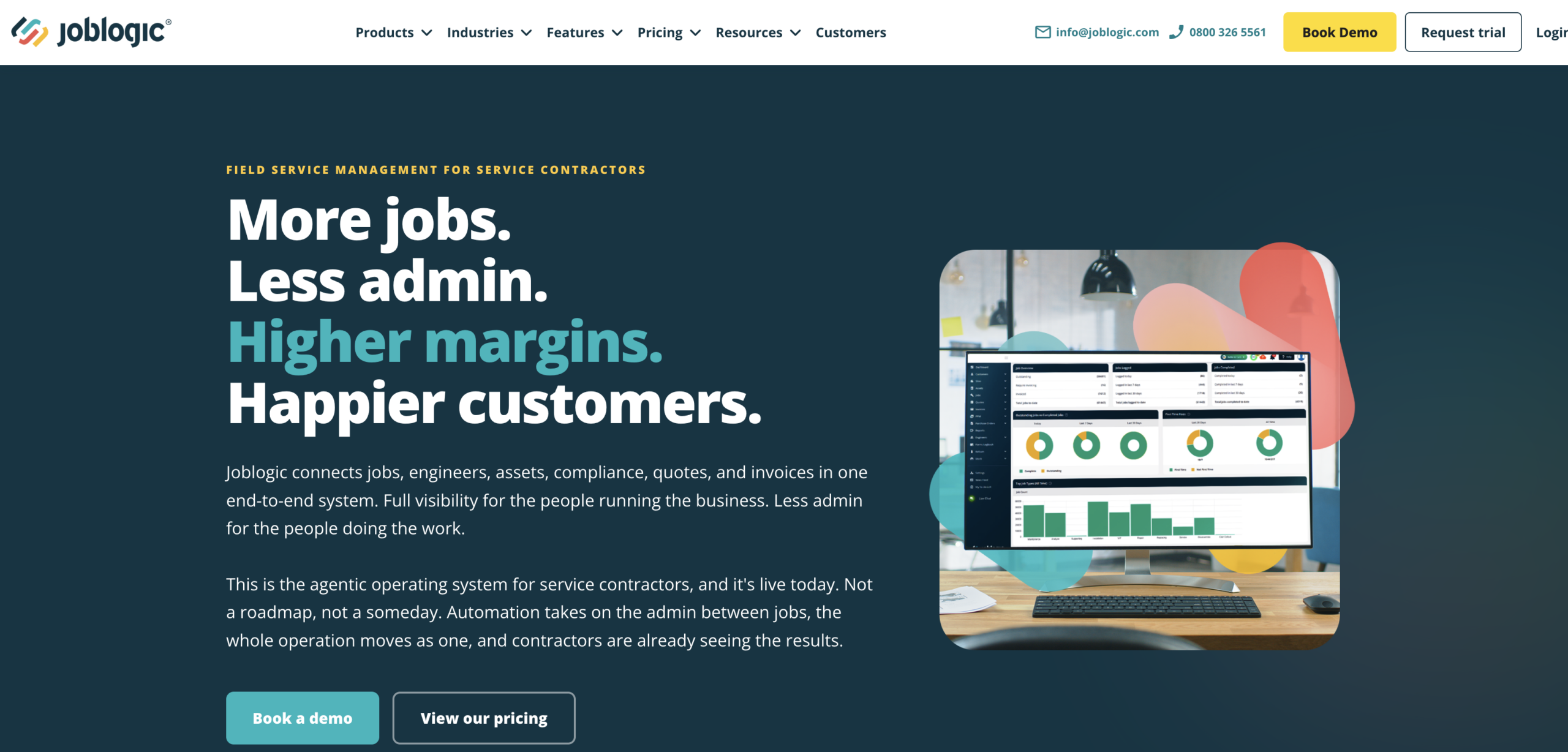
Joblogic combines field service management with job management, asset management, planned preventive maintenance, compliance, and CAFM functionality.
Its UAE-facing product pages position the platform around managing the entire lifecycle of a work order while connecting office teams with field engineers.
Pros
- Strong asset-management capability
- PPM contract management
- Route scheduling
- Engineer tracking
- Fully offline mobile app
- Strong electronic forms
- Customer portal
- Compliance functionality
- Extensive reporting
Cons
- More complex than many small field-service businesses need
- Several important capabilities require Premium or Enterprise
- UAE-specific pricing is not directly published
- Strong maintenance focus may be excessive for simpler service workflows
Pricing
Joblogic offers three main pricing options. The Standard plan starts from £45 per user per month, billed annually, and is designed for reactive jobs and core field-service management. The Premium plan requires a custom quote and adds capabilities such as PPM, route planning, engineer tracking, and contract management. The Enterprise plan uses custom pricing and is aimed at larger businesses with multi-site, compliance-heavy, or more complex operational requirements.
Standard includes customer and site management, assets, jobs, quotes, invoices, a mobile app, forms, recurring jobs, and standard reporting. Premium adds capabilities including PPM contracts, route scheduling, engineer tracking, timesheets, and audits.
Best For
Joblogic is best suited to facilities management companies, HVACR businesses, and building maintenance providers that need strong maintenance and field-service capabilities.
6. QuickAMC — Best UAE-Based Core FSM Option
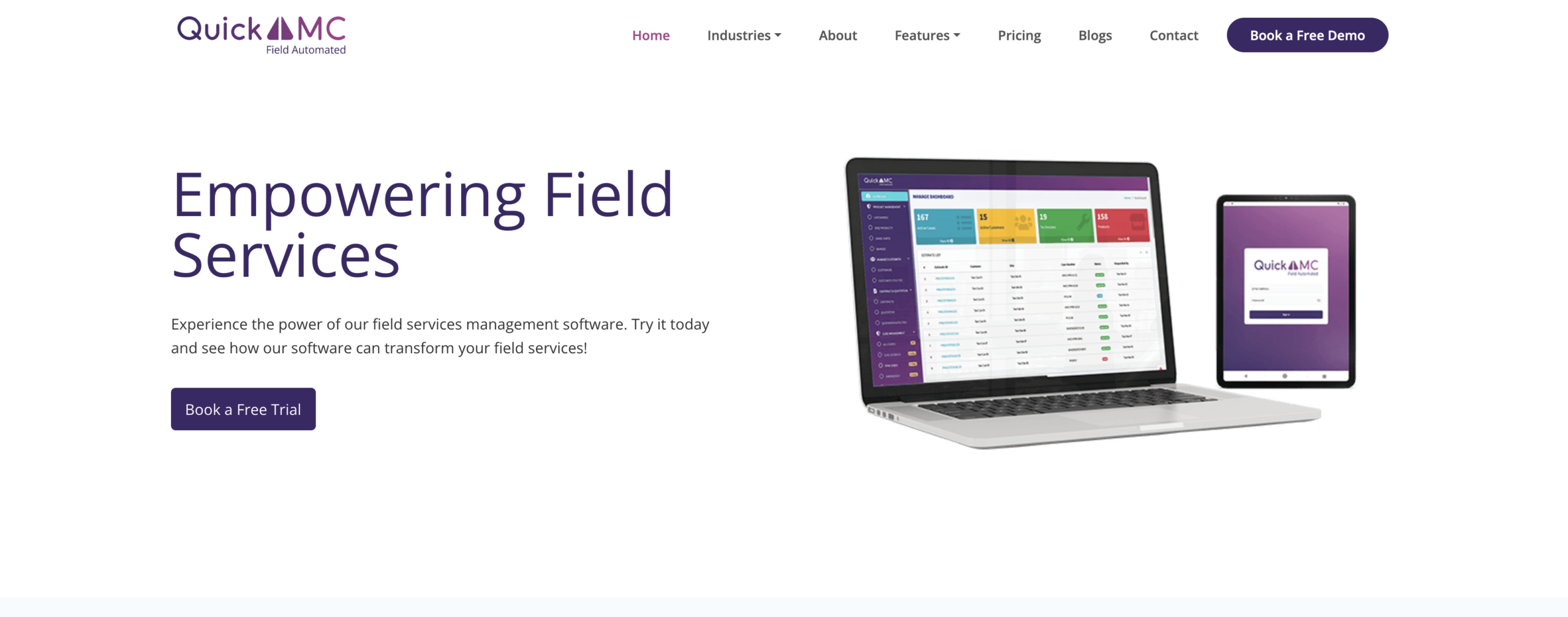
QuickAMC is a Dubai-based field service management platform focused on technician management, work orders, scheduling, tracking, recurring maintenance, and operational automation.
It positions itself specifically for businesses operating in industries such as:
Pros
- Based in Dubai
- Strong UAE industry relevance
- Technician and work-order management
- Scheduling and tracking
- Recurring maintenance
- Route-planning use cases
- Free trial
- Scalable custom plans
Cons
- Public technical documentation is limited compared with larger vendors
- Offline functionality is not clearly documented
- API and integration capabilities require verification
- Customer-experience depth should be tested
- Pricing requires direct vendor engagement
Pricing
QuickAMC does not publish a fixed starting price. It offers a free trial and custom scalable plans, with one year of free hosting, unlimited users and services, and no stated hidden charges. Businesses should still obtain a written quote defining implementation, support, integrations, hosting, and any configuration requirements before comparing total cost.
Best For
QuickAMC is best suited to UAE organisations looking for a locally positioned platform for technician management and scheduling.
What Should UAE Businesses Look for in Field Service Software?
1. Scheduling That Handles Real-World Changes
Field-service schedules change throughout the day because of delays, urgent jobs, technician absences, or customer rescheduling. The software should make it easy to reorganise work while keeping appointments visible. Evaluate how well the platform handles scheduling and dispatch when plans change.
2. Technician and Crew Availability
Businesses should be able to assign work based on technician availability, skills, workload, location, working hours, and crew membership. This becomes more important as the workforce grows. Arrivy’s crew management helps coordinate teams working across multiple jobs.
3. Dispatch and Real-Time Field Visibility
Dispatchers should be able to see who is available, travelling, on-site, delayed, or ready for another job. A dispatch dashboard gives managers better visibility without relying on constant calls and messages.
4. Genuine Route Optimisation
Showing jobs on a map is different from actually optimising routes. Good route optimisation should consider technician location, travel time, job priority, appointment windows, and multiple stops. Arrivy provides dedicated route planning and optimisation for field operations.
5. Mobile and Offline Field Work
Technicians should be able to access job details, forms, photos, signatures, service history, and job statuses from their mobile devices. Businesses should also check exactly what can still be completed when internet connectivity is unavailable.
6. Proof of Service
A completed status alone may not be enough to confirm that work was properly carried out. Businesses may need photos, signatures, checklists, timestamps, service reports, or inspection records. Arrivy’s digital forms help standardise this information.
7. Customer Communication
Field service software should help keep customers informed through confirmations, reminders, ETA updates, status notifications, and completion messages. Arrivy’s customer experience tools connect these updates with actual field activity.
8. Work-Order Management
Work orders should connect job instructions, scheduling, field activity, documentation, and completion in one process. Businesses with recurring services should also check whether jobs can repeat automatically. Arrivy’s work-order management supports this workflow.
9. Integrations
Field service software should work with the systems a business already uses, such as CRM, accounting, calendars, document storage, and fleet-management tools. Arrivy’s integrations help connect field operations with the wider technology stack.
10. UAE Localisation
UAE businesses should check whether they need features such as AED support, UAE VAT, Arabic, local data hosting, multi-branch management, regional messaging, or local implementation support. The importance of these features will depend on the organisation’s existing systems and operational requirements.
Which Field Service Software Should You Choose?
Why Choose Arrivy for Your Field Service Operations?
Arrivy does not need to replace every platform in a company’s technology stack to improve field operations.
Arrivy is most valuable for businesses that already use separate systems for CRM, accounting, document storage, or fleet management. It helps connect those systems with day-to-day field operations by managing scheduling, dispatch, crews, job progress, customer updates, and completion.
This approach can be particularly valuable for companies that have outgrown simple calendars but do not want to replace every existing business application with a large ERP.
Arrivy also supports industries relevant to the UAE field-service market, including construction, HVAC, solar, installation and repair, logistics, cleaning, roofing, and other service operations.
Conclusion
Choosing the best field service software in UAE is not simply a matter of comparing feature counts.
The right platform depends on how the business actually operates.
Before selecting any platform, businesses should test it against real operational scenarios rather than generic feature demonstrations.
For example: “A technician in Dubai is delayed. An urgent job appears in Sharjah. Another crew finishes early, and two customers need updated arrival times. Show exactly how the platform handles the situation.“
A demonstration like that reveals far more about the quality of scheduling, dispatch, route optimisation, customer communication, and operational visibility than a simple checklist.
See How Arrivy Field Service Operations