
 Login
Login























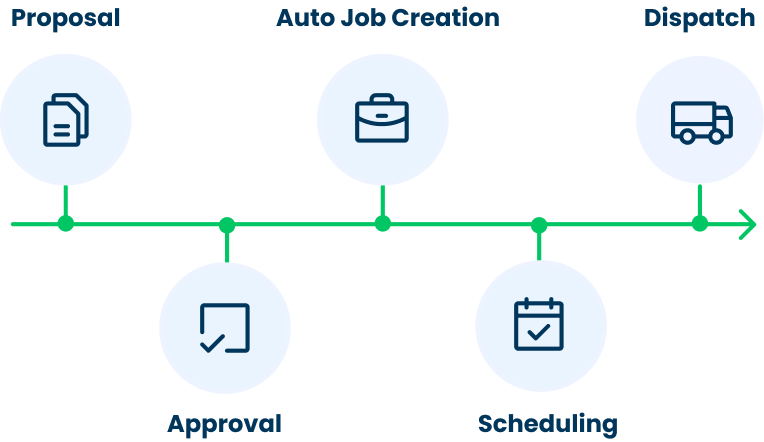
After a client conversation, the next step is sending a proposal.
A business proposal is a formal document that presents your product or service as a solution to a client’s specific need.
This document outlines what you offer, how the work will be done, and what it will cost. It helps the client review everything in one place and make a decision. In service businesses, this often connects directly to scheduling, dispatch, and job execution workflows.
This guide explains what a business proposal is, why businesses use it, and how to write one that gets approved.
What Is a Business Proposal?
A business proposal is a formal document that outlines a solution, scope of work, timeline, and pricing to help a client decide whether to move forward. It brings your discussion into a clear format with pricing and next steps.
Instead of scattered details across calls or messages, everything sits in one place. This reduces confusion and speeds up decision-making.
When Businesses Use Proposals
A business proposal is used at a specific stage in the sales process. You send a proposal when a client shows interest but needs details before approving the work.
Common situations include:
Offering services to a new client
Sharing pricing after a call or site visit
Responding to an RFP (Request for Proposal)
Bidding for a project
Proposing a partnership
In many service workflows, the proposal follows the first interaction. Once shared, it becomes the basis for approval and the next step in execution.
Purpose of a Business Proposal
A business proposal gives the client a clear basis to decide. It organizes your offer into a clear format. The client can review the scope, pricing, and next steps without going back and forth.
In service-based businesses, proposals sent within 24 hours of a site visit often receive higher approval rates than delayed responses, based on industry observations.
The main purposes of a business proposal include:
To Win New Clients
Many deals reach a point where the client needs a clear offer before deciding.
A proposal gives them that clarity. It shows what you will do and what they will get in return.
To Present a Clear Solution
Clients want to see how you will handle their problem.
A proposal connects their requirement to your approach. It shows the steps you will take and the outcome they can expect.
To Define Scope, Deliverables, and Pricing
This is where everything becomes specific.
The proposal lists deliverables, what is included in the work, what falls outside the scope, how long the work will take, and the total cost. This reduces confusion during execution. This is especially important for teams managing multiple jobs and field operations.
To Build Credibility
A structured proposal demonstrates that you work in a clear, organized way.
It gives the client confidence in your process and your ability to deliver.
Types of Business Proposals

The type of business proposal depends on how the client requests it.
Here are the most common types of business proposals:
Solicited Proposals
These are created in response to a formal request from a client.
The client shares a Request for Proposal (RFP) with requirements, scope, and evaluation criteria. You submit your proposal based on those details.
These proposals follow a defined structure and often compete with multiple vendors.
Unsolicited Proposals
These are sent without a direct request from the client.
You identify a potential need and present your solution before the client asks for it. This approach is common in sales outreach.
The proposal needs to be clear and relevant since the client did not request it.
Informal Proposals
These proposals follow a casual request or conversation.
The client may request pricing or details through a call or email. There is no formal RFP.
The proposal is still structured, but the format is more flexible.
Renewal Proposals
These are used with existing clients.
You send a renewal proposal when a contract is about to end. It outlines updated terms, pricing, or scope for continued work.
This type focuses on continuing work with an existing client.
Once you understand the type, the next step is structuring the proposal correctly.
Standard Business Proposal Structure
A business proposal should follow a clear and predictable format. This structure outlines the key sections every proposal should include.
| Section | Details |
|---|---|
| Executive Summary | A short overview of the offer, including the problem and your solution |
| Problem Statement | A clear description of the client’s issue |
| Proposed Solution | Your approach to solving the problem |
| Scope of Work | Deliverables, tasks, and responsibilities |
| Timeline | Key phases, milestones, and duration |
| Pricing | Total cost, pricing breakdown, and payment terms |
| Company Background | Relevant experience and past work |
| Terms and Conditions | Approval process, revisions, and key terms |
| Next Step | Clear instructions on how to proceed |
This structure keeps all key details in one place, so the client can review and respond more quickly.
Pro tip: Make your proposal mobile-ready, as about one-third of users view content on smartphones or tablets.
Example of a Simple Business Proposal
Suppose you run a solar installation business. You visit a residential property in Texas. The house uses around 900 kWh per month and has 1,200 sq ft of usable roof space. After the inspection, you prepare the following proposal:
Executive Summary
The homeowner wants to reduce electricity bills and add backup during outages. The proposed system is designed to offset most of the monthly energy usage.
Problem
The current monthly bill averages $180. The property has no backup during outages.
Proposed Solution
Install a 6 kW solar system based on roof space and energy consumption. The system includes solar panels, a hybrid inverter, and a mounting structure.
Scope of Work
Site inspection, system design, permitting support, equipment supply, installation, wiring, testing, and basic system walkthrough.
Timeline
1 to 2 weeks for approvals and permitting, 2 to 3 days for installation and testing.
Pricing Options
Each option includes a clear pricing breakdown so the customer understands the total cost.
| Standard Plan
6 kW system without battery Total cost: $14,000 |
Premium Plan
6 kW system with battery backup Total cost: $18,500 |
Optional Add-on
Annual maintenance package: $300 |
|---|
Supporting Details
System layout, panel placement diagram, and estimated monthly production of 850 to 950 kWh based on location and sun hours.
Terms and Conditions
Cover warranty coverage, payment schedule, and the approval process for starting the project. For instance, 30 percent is paid upfront, while the remaining amount is paid after installation. 10 to 12-year inverter warranty and 25-year panel performance warranty.
Next Step
The homeowner selects the premium plan and approves the proposal with a digital signature.
Once approved, the proposal details can move directly into scheduling and execution. With tools like Arrivy, businesses can convert approved proposals into scheduled jobs, assign teams, and start work without re-entering data.
Business Proposal vs Business Plan
Many people confuse a business proposal with a business plan. They serve different purposes and are used at different stages.
| Aspect | Business Proposal | Business Plan |
|---|---|---|
| Purpose | To win a specific client or project | To plan and guide a business |
| Audience | External, clients or partners | Internal, founders, or stakeholders |
| Focus | One solution or service | Entire business strategy |
| Timing | Sent before a deal is approved | Created before or during business growth |
| Content | Scope, pricing, timeline, deliverables | Market research, operations, and financial projections |
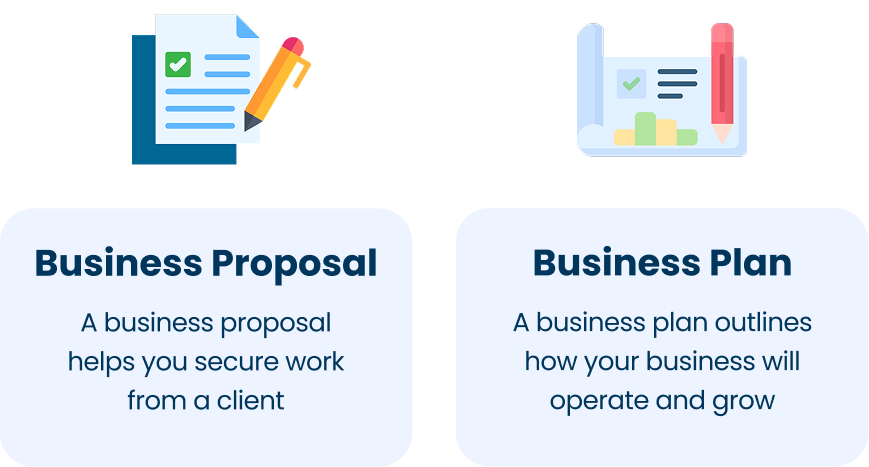
A business proposal helps you secure work from a client, while a business plan outlines how your business will operate and grow.
How to Write a Business Proposal That Wins Clients?
Use this checklist to make sure your proposal is clear, relevant, and easy to approve:
☐ Understand the client’s problem before writing
☐ Keep the content focused on the client’s needs
☐ Explain the solution in clear, simple terms
☐ Show expected results, not only features
☐ Provide clear and detailed pricing
☐ Offer options if the scope allows it
☐ Include past work, examples, or proof
☐ Attach supporting documents if needed
☐ Keep the structure clean and easy to scan
☐ Add a clear next step for approval
A proposal that checks these points is easier to review and more likely to get approved.
Common Mistakes in Business Proposals
Even minor issues in a proposal can impact decisions or lead to rejection.
Watch out for these common mistakes:
Writing a generic proposal without tailoring it to the client
Leaving the scope unclear or missing key deliverables
Using vague or confusing pricing
Setting unrealistic timelines
Writing a weak or unclear summary
Missing a clear next step for approval
Overloading the proposal with unnecessary information
Avoiding these mistakes helps keep your proposal clear, focused, and easier to approve.
Conclusion
A business proposal helps you present your offer in a structured and easy-to-review format. It brings together the problem, your solution, the scope, and the pricing in one place.
When your proposal is specific and easy to review, clients make decisions faster and with more confidence.
Focus on clarity, relevance, and a clear next step. That is what turns a proposal into an approved deal.