





















AI Summary
To start a roofing business, choose your services and market, make sure the company has sufficient roofing expertise, calculate startup costs, register the business, obtain required licences and insurance, establish safety procedures, secure tools and suppliers, create a profitable pricing model, hire dependable crews, market the business, and build systems for managing jobs.
- Choose your roofing market.
- Validate your experience and demand.
- Calculate startup and operating costs.
- Register the business.
- Obtain licences, permits, and insurance.
- Create a roofing safety programme.
- Purchase equipment and secure suppliers.
- Set prices and sales processes.
- Build a dependable team.
- Market, operate, and measure the business.
Knowing how to install or repair a roof is not the same as knowing how to operate a roofing company. Estimating errors, weak cash flow, safety failures, licensing issues, and poor crew coordination can damage a new business even when the workmanship is good.
If you are researching how to start a roofing business, this guide covers planning, startup costs, registration, licences, insurance, safety, equipment, pricing, hiring, marketing, and everyday operations.
Requirements vary by country and often by state, province, county, or municipality, so verify the rules that apply where you plan to work.
Roofing Business Startup Checklist
| Task | What to complete |
|---|---|
| Choose services | Decide whether you will offer repairs, replacement, commercial, residential, or specialist roofing |
| Define service area | Select the areas you can serve efficiently |
| Validate roofing expertise | Make sure technical roofing knowledge exists within the business |
| Calculate startup capital | Estimate equipment, vehicles, insurance, payroll, marketing, and working capital |
| Register the company | Choose and register the correct business structure |
| Verify licensing | Check state, local, or trade-specific requirements |
| Purchase insurance | Confirm liability, workers’ compensation, commercial auto, and other applicable cover |
| Create a safety programme | Establish fall-protection, PPE, ladder, weather, and site procedures |
| Secure suppliers | Set up primary and backup material sources |
| Develop pricing | Calculate labour, materials, overhead, waste, and target profit |
| Build a sales process | Standardize inspection, estimating, approval, and follow-up |
| Establish operations | Define how work moves from inspection through completion |
What Do You Need to Start a Roofing Business?
A roofing company needs more than registration and equipment. You need enough roofing knowledge within the business to understand measurements, roof systems, materials, flashing, ventilation, drainage, waste, installation requirements, and common causes of failure.
Estimating ability is just as important. Errors in roof size, labour, material quantities, tear-off conditions, access, or waste can quickly remove the margin from a project.
A founder without strong roofing experience should employ or partner with an experienced roofing professional. Business registration alone does not qualify someone to perform roofing work.
You will also need:
Your goal is to make sure the business can both sell roofing work and deliver it reliably.
Is Starting a Roofing Business Worth It?
Roofing can offer strong demand because homes and commercial buildings continually need repairs, inspections, maintenance, and replacement.
Residential contractors may work with homeowners, builders, property managers, and insurance-related projects. Commercial companies may serve building owners, facility managers, general contractors, and property-management firms.
But roofing is not automatically profitable.
The business carries significant risks, including:
Profitability depends on accurate job costing, crew productivity, overhead, pricing, customer acquisition cost, rework, and cash collection.
A roofing company can generate substantial revenue and still lose money if estimates are weak or projects repeatedly run over budget.
How Much Does It Cost to Start a Roofing Business?
There is no universal startup figure.
A roofer who already owns a truck and tools may need far less capital than a company launching several crews with vehicles, office staff, paid advertising, and software.
Published U.S. examples also vary widely, from lean launches in the low tens of thousands of dollars to more established setups exceeding $80,000.
Use those numbers only as references.
Separate your costs into:
registration, equipment, vehicles, website, branding, licence applications.
payroll, insurance, fuel, software, marketing, accounting, and vehicle expenses.
materials, labour, disposal, permits, deliveries, rentals, and subcontractors.
Working capital matters because materials and payroll may need to be paid before the customer pays the final invoice.
How to Start a Roofing Business
Step 1: Choose Your Roofing Services and Target Market
Decide what type of roofing work you will perform before trying to serve everyone.
Possible services include:
Then define your customer and service area.
Residential roofing usually involves shorter sales cycles and direct homeowner communication. Commercial projects may involve specifications, bids, vendor requirements, and longer payment terms.
Also limit your initial territory to an area your crews can serve efficiently. Long travel times increase labour, fuel, supervision, and callback costs.
Step 2: Gain Experience and Validate Local Demand
If you are an experienced roofer, assess whether your skills extend beyond installation into estimating, purchasing, sales, crew management, and quality control.
If not, bring that expertise into the business.
Then research your market.
Look at:
Competitor reviews are particularly useful. Repeated complaints about communication, delays, cleanup, or slow estimates can reveal areas where your company can differentiate.
The question is not only whether roofing demand exists. It is whether you can win that work profitably.
Step 3: Write a Roofing Business Plan
Your roofing business plan should define:
Also map the job workflow.
For example:
Include a downside scenario as well.
What happens if sales are slower than expected, a major customer pays late, material costs rise, or weather pushes projects back?
A useful business plan prepares the company for those situations before they happen.
Step 4: Calculate Startup Costs and Secure Funding
Use your business plan to determine how much capital the company actually needs.
Account for:
Then create a cash-flow forecast.
A project may look profitable overall while still requiring significant cash for materials and payroll before the final payment arrives.
Possible funding sources include personal capital, business loans, credit lines, equipment finance, investors, or supplier credit.
Choose funding based on realistic repayment capacity rather than the maximum amount available.
Step 5: Register the Business and Set Up Finances
Choose the business structure appropriate for your location, ownership model, taxes, and liability requirements.
Then create proper financial separation between the company and your personal finances.
Set up:
For every completed roof, you should eventually be able to compare:
Without job-level financial visibility, it becomes difficult to identify which types of work are actually profitable.
Step 6: Obtain Licences, Insurance, Permits, and Bonds
A roofing business license is not governed by one universal system.
Requirements may exist at state, provincial, county, city, or municipal level.
Depending on your location and project type, you may need:
Commercial customers may also require certificates of insurance, safety documentation, vendor registration, or manufacturer credentials.
Do not assume that registering a company gives you permission to perform roofing work. Verify local requirements before accepting contracts.
Step 7: Build a Roofing Safety and Training Programme
Roofing involves falls, ladders, tools, electrical hazards, heat, wind, wet surfaces, and material handling.
Your safety programme should cover:
Safety should also be part of job planning. Before a crew arrives, it should know the roof type, access method, expected conditions, required equipment, known hazards, and who is supervising the work.
Step 8: Purchase Equipment and Establish Supplier Relationships
Buy equipment based on the roofing work you actually perform.
This may include ladders, harnesses, anchors, nail guns, compressors, tear-off tools, measuring equipment, PPE, tarps, trailers, trucks, and specialty equipment.
Avoid purchasing expensive tools before the workload justifies them.
Supplier relationships matter just as much. Evaluate suppliers based on:
Where practical, maintain backup sources for critical materials. One unavailable product should not force you to reschedule an entire week of roofing jobs.
Step 9: Develop Your Pricing and Estimating Process
Every roofing estimate should account for:
Do not copy competitor pricing without understanding your own cost structure.
Also understand the difference between markup and margin.
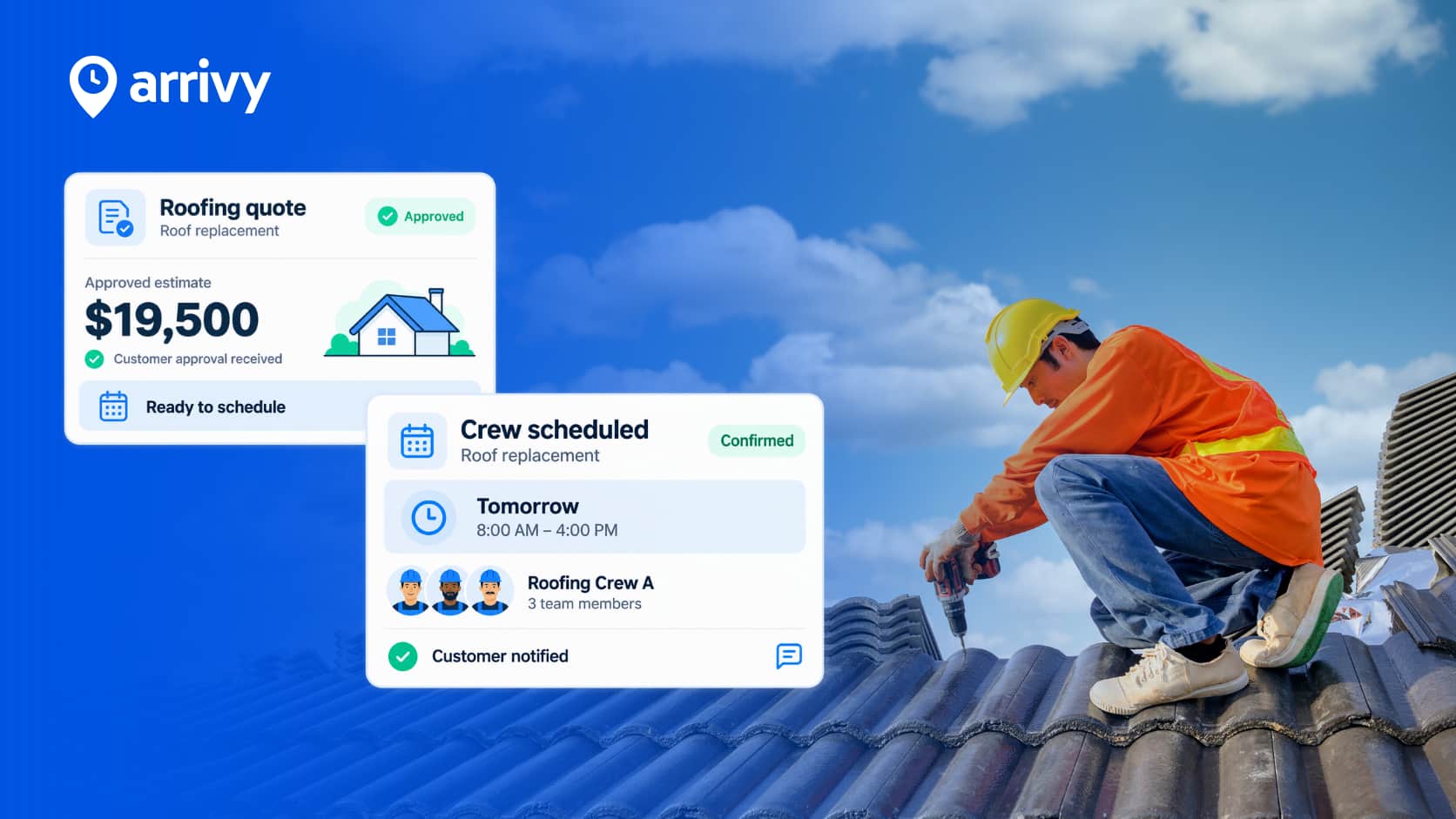
If a job costs $15,000 and you add a 30% markup, the selling price becomes $19,500, but the gross margin is about 23%.
After each project, compare estimated and actual costs. That feedback should improve future pricing.
For businesses that want to standardize quote creation and approvals, Arrivy Quotes can help move approved work into operations without rebuilding job information manually.
Step 10: Hire Employees or Build a Subcontractor Network
Your labour model may include employees, subcontractors, or both.
Whichever structure you use, set clear standards for:
Worker classification rules also vary by jurisdiction, so confirm whether workers should legally be treated as employees or independent contractors.
As the business grows, clearly define who owns sales, scheduling, purchasing, field quality, finance, and customer communication.
Arrivy Crew Management can help growing operations coordinate field resources across multiple jobs.
Step 11: Create a Roofing Marketing and Sales Plan
Potential channels include:
Residential roofing often relies heavily on local search, reviews, referrals, and neighbourhood visibility.
Commercial roofing may depend more on relationships, vendor registrations, property managers, maintenance contracts, and tender opportunities.
Track your sales pipeline:
If leads are strong but estimates are not converting, the issue may be pricing, follow-up, trust, or lead quality rather than marketing volume.
How to Get Your First Roofing Customers
New roofing companies usually lack established reviews, strong organic visibility, and years of referrals, so early customer acquisition requires a focused approach.
Start with existing professional relationships such as builders, tradespeople, suppliers, property managers, and real estate professionals.
Then build local visibility through your Google Business Profile, website, reviews, and completed projects.
After a successful job, make review requests part of the completion process.
Local partnerships can also generate early work. Depending on your market, useful relationships may include:
You can also market around completed jobs using yard signage, neighbourhood mailers, or before-and-after content where appropriate.
If you use paid advertising, measure more than lead volume.
Track:
A smaller number of profitable roofing jobs is more valuable than a large number of low-quality leads.
Step 12: Build Systems to Run the Roofing Business
This is where starting a roofing business becomes running a roofing business.
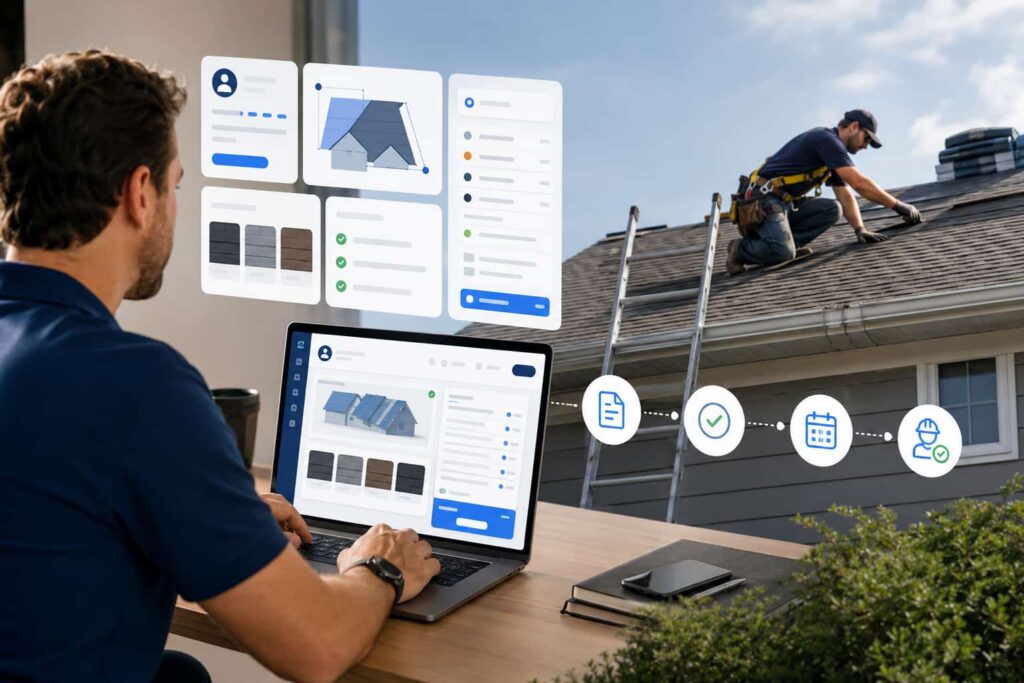
A few projects may be manageable through phone calls, spreadsheets, and shared calendars. That becomes harder when multiple crews, inspections, installations, repairs, and schedule changes are happening at once.
A standard workflow might be:
Each stage should have clear information requirements.
For example, when an approved roof reaches operations, the team should already have the scope, customer details, site notes, material requirements, and scheduling information.
Weather makes this even more important. One delayed installation may affect the customer, crew, material delivery, and several later jobs.
A scheduling and dispatch system can help coordinate those changes, while digital forms can standardize inspections, photographs, notes, safety checks, and completion records.
Manage Roofing Jobs From Estimate to Completion With Arrivy
After a roofing company begins winning more work, disconnected calendars, spreadsheets, calls, and messaging groups become difficult to manage.
Information can easily get separated between sales, estimators, office staff, suppliers, and crews.
Arrivy’s roofing software helps connect the workflow from inspection through field execution.
Roofing teams can use Arrivy to:
For example:
can move through a connected workflow instead of being recreated across separate tools.
Arrivy can also connect operational workflows with systems such as HubSpot, Salesforce, QuickBooks, and CompanyCam through Arrivy integrations. The goal is to create a cleaner handoff between sold work, scheduled work, field execution, and completed jobs.
How to Run a Successful Roofing Business
Once the business is operating, focus on a few disciplines that directly affect profit and execution.
Price From Actual Costs
Update labour, material, waste, overhead, and warranty assumptions regularly.
Compare estimate versus actual cost after every job. If a roof type consistently takes longer or uses more material than expected, adjust future pricing.
Protect Cash Flow
Monitor deposits, supplier payments, payroll, accounts receivable, and days to payment.
A profitable project can still create problems if the business has to pay for materials and labour long before collecting the balance.
Make Safety Part of Every Job
Review roof conditions, access, weather, fall protection, equipment, and hazards before work starts rather than treating safety as annual paperwork.
Document the Job
Store measurements, photos, approved scope, changes, installation records, signatures, and completion information with the project.
This makes disputes, callbacks, and warranty questions easier to resolve.
Standardize Quality Checks
Use simple pre-work, in-progress, and completion inspections rather than relying on crew memory.
Communicate Proactively
Send appointment confirmations, arrival information, delay notices, and completion updates before customers need to call.
Arrivy’s customer experience tools can support those field-service updates.
Measure Performance
Track a small operating scorecard:
These metrics show where growth is creating profit and where it is creating problems.
Conclusion
To start a roofing company, you need the right market, sufficient capital, licensing, insurance, safety procedures, accurate pricing, dependable crews, customer acquisition, and a reliable way to move work from inspection through completion.
Build those foundations before trying to scale quickly.
As project volume increases, the operational challenge shifts toward coordinating crews, schedules, customers, job information, and field execution.
Arrivy roofing software helps roofing businesses manage that workflow without relying on disconnected spreadsheets, messages, and calendars.
Ready to streamline your roofing operations with Arrivy?
Book a demo