





















The gap between marketing and operations often represents a direct revenue leak for service businesses. You’re using ActiveCampaign for marketing, capturing leads, nurturing them, and managing pipelines. But your field operations (scheduling, dispatching, job completion, invoicing) happen separately, either manually or through a scheduling system.
When marketing and operations systems don’t talk to each other:
This manual and rigorous process that you currently follow creates risk, mistakes, and delays. That’s the “revenue leak.” Even if you only miss 5–10% of the opportunities, over a year, that’s serious money.
The Arrivy ActiveCampaign integration eliminates this disconnect. When a deal reaches a specific stage in your ActiveCampaign pipeline, Arrivy automatically creates the corresponding job with all customer data mapped across. And when your tech completes that job, ActiveCampaign triggers your post-service campaigns without any manual handoffs. Read on to find out how this integration plays out across your entire operation and pays in ways you would not expect.
Why CRM and Operations Integration Matter
The manual handoff between sales and operations creates three specific problems:
You Pay for the Same Data Twice
A lead converts in ActiveCampaign with complete customer information, including contact details, service requirements, scheduling preferences, and property specifics. Someone then opens your scheduling system and manually re-enters all of it. If your business is booking 20+ jobs weekly, that’s 3-4 hours of pure data entry. More critically, manual transfer introduces errors like wrong addresses, transposed phone numbers, and missing service notes. Now your tech shows up with incomplete information, or worse, at the wrong place.
Follow-Ups Happen “If Someone Remembers”
After a job is completed, what should happen?
Ideally:
Review request goes out
✓
Maintenance reminder is scheduled
✓
Relevant upsell campaign is triggered
✓
Referral request is sent
That means follow-up is inconsistent. And inconsistent follow-up means you’ll have fewer reviews, missed maintenance contracts, lost upsell revenue, and lower lifetime customer value.
As a result, more than half of potential follow-ups never happen. The opportunity is there, but it just isn’t triggered automatically.
Speed-to-Schedule Determines Conversion Rates
When a lead is ready to book, timing matters more than price in many cases. Businesses that schedule within hours convert at significantly higher rates than those taking 2-3 days. But if your process looks like this:
You’ve already put hurdles in the customer’s way. Every extra step increases delay and lowers the conversion rate.
What is Arrivy ActiveCampaign Integration & How It Works?
The Arrivy–ActiveCampaign integration is a secure, API-based connection between your marketing automation platform and your field service operations system. The integration enables automatic task creation and bidirectional data flow between your CRM and field operations platform.
At a basic level, the integration connects two moments in your business:
Instead of relying on someone to pass information between systems, the process runs automatically.
Let’s look at how it happens practically.
Deal Stage Triggers → Automatic Job Creation
Inside ActiveCampaign, you already use deal stages like
With the integration, you choose which stage should create a job in Arrivy.
For example, when a deal moves to “Won”, Arrivy automatically:
Creates the job
✓
Pulls in customer contact details
✓
Maps the service address
✓
Transfers notes from the sales process
✓
Applies job type or custom fields
Job Status Updates → Marketing Automation Triggers
Now let’s look at what happens after the job.
When your technician updates the job in Arrivy’s mobile app, such as “Marked Complete”, “Delayed”, or “Needs Follow-Up”, that status change can automatically trigger workflows inside ActiveCampaign.
For example:
The key difference here is that the automation is based on what actually happened in the field, and you do not require someone to remember to tag a contact later. Once your technician finishes the job, your marketing runs automatically after that.
Operational Impact
The Operational Lifecycle After Marketing & Operations Connect
The integration does more than automate isolated actions. It restructures how work moves through your organization from initial inquiry to post-service revenue generation.
Below is what that lifecycle looks like when marketing and field operations are fully aligned.
Lead Captured in ActiveCampaign
A customer enters your system through a website form, campaign response, or manual entry.
ActiveCampaign creates the contact record and places the deal into your defined pipeline stage. Your nurture sequences, tagging logic, and scoring models continue to function as designed.
At this stage, nothing changes in your marketing process. What changes depends on what happens next.
Automatic Job Creation in Arrivy
When the deal progresses to a defined stage, such as “Ready to Schedule” or “Won”, Arrivy automatically generates the corresponding service task. Customer information, address, service type, and notes are transferred instantly. Assignment rules can predefine job categories or routing logic.
Note that there is no secondary data entry involved here. Operations is activated the moment sales confirms a deal.
Scheduling and Dispatch Execution
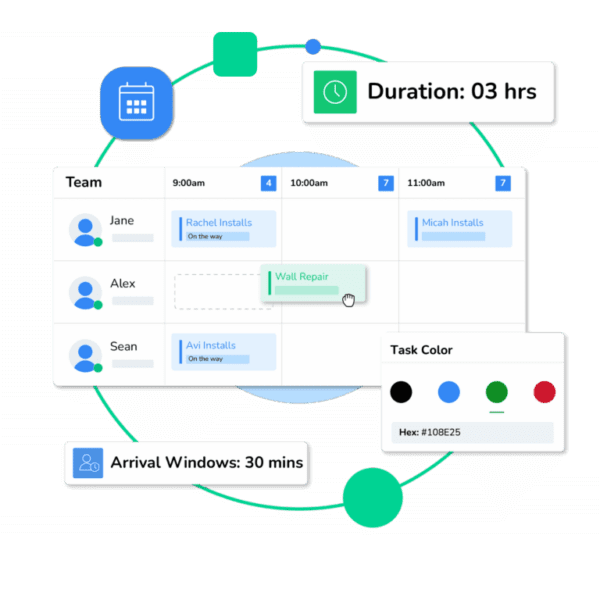
From there, dispatch operates inside Arrivy using structured scheduling tools.
Route optimization ensures efficient daily planning.
This is where integration begins to create measurable operational leverage because scheduling decisions are based on live data and automated coordination.
Customer Communication and Live Tracking
Once scheduled, automated notifications are sent via SMS or email. Customers receive confirmations, reminders, and real-time technician tracking links. If schedules change, updates are communicated automatically.
Communication is tied to job status instead of manual outreach. This reduces inbound query calls and improves overall service transparency.
Post-Service Automation and Revenue Continuity
When the technician marks the job complete, the operational loop closes, and the marketing loop begins again.
Completion triggers:
This way, service delivery becomes the starting point for future revenue, not the end of the interaction.
Key Benefits
You can see which marketing efforts actually work.
Because job data connects back to ActiveCampaign, you can see which campaigns result in completed work. That makes it easier to decide where to invest your marketing budget.
Your team can plan the workload earlier.
When deals automatically turn into visible jobs, operations can see upcoming demand sooner. That helps with staffing, scheduling, and avoiding last-minute overload.
You build a clearer picture of each customer over time.
Marketing activity and service history stay connected. Over time, this creates a more complete customer profile, not just what they inquired about, but what was delivered, when, and how often. That intelligence supports smarter segmentation, better renewal timing, and more precise long-term engagement strategies.
Advanced Automation Scenarios
Beyond basic deal-to-task creation, the Arrivy ActiveCampaign integration supports more structured operational workflows when configured intentionally. For example:
1. Scheduled vs. Unscheduled Workflow Control
Arrivy allows tasks to be created as either scheduled or unscheduled.
This distinction enables different operational paths:
You can use this to separate internal qualification steps from customer-facing confirmations.
2. Automated Customer Communication Based on Scheduling Changes
When a scheduled task is created, Arrivy automatically sends the customer a “Task Created” message via SMS or email. If the date or time changes, a “Task Rescheduled” message is triggered.
This removes the need for manual outreach when appointments shift, and customers stay informed without additional office coordination.
3. Unified Deal and Task Visibility
ActiveCampaign deals remain fluidly linked to Arrivy tasks. This means that sales teams can see operational progress without leaving the CRM, and similarly, operations teams can reference deal context without requesting updates.
This reduces internal status-check communication and keeps both departments aligned without additional meetings or reporting layers.
Why Arrivy Complements ActiveCampaign
The integration creates complete workflow coverage:
Getting Started
At a certain stage, service businesses need cleaner execution more than they need additional leads. If you’re already investing in marketing, this integration ensures that operational execution keeps pace. It gives you visibility into how deals convert into completed work and how completed work turns into long-term revenue.
For most growing operations, that’s the point where the scheduling process needs to change. Setting up Arrivy ActiveCampaign integration takes less than 30 minutes, and most teams are live the same day.
Turn Marketing Wins Into Scheduled Work Instantly
Convert deals into jobs, trigger reviews automatically, and keep marketing aligned with real field activity.