












What if you could produce construction quotes quickly and still trust the numbers once the job starts?
Many contractors rush quotes to meet client expectations, then adjust schedules, reorder materials, or explain cost changes later. These issues usually stem from gaps left unvalidated during the quoting process. Recent data shows that 49% of construction projects finish over budget, largely due to early planning and scope validation gaps.
The solution is a structured quoting process that connects site validation, clear scope definition, and realistic cost planning with actual crew capacity. When these elements are aligned before approval, the quote becomes a reliable execution plan rather than a rough commitment.
Read on to see how to create construction quotes that are both fast to produce and dependable enough to support real project execution.
🔑Key Takeaways
What Is a Construction Job Quote?
A construction job quote is a formal document that states the exact price a contractor will charge to complete a defined scope of work. It is based on verified project details. Once approved, it often becomes the reference point for scheduling, procurement, and contract discussions. Industry research from the Project Management Institute (PMI) shows that projects with stronger upfront planning and scope validation are significantly more likely to meet budget and schedule targets.
The goal of a quote is to show a clear understanding of site conditions, material requirements, labor scope, and project constraints. It signals that the contractor has reviewed the job in enough detail to commit to a specific price under stated conditions.
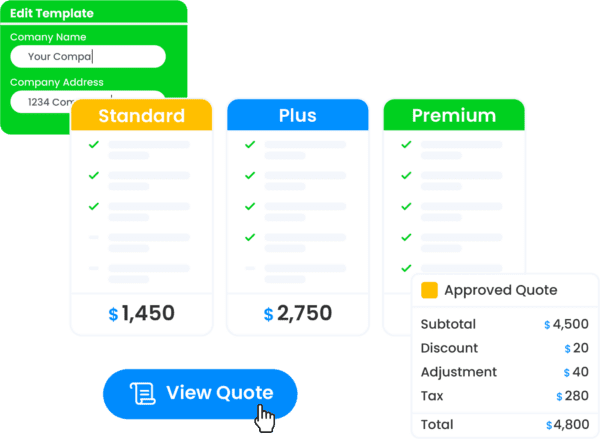
Quote vs Estimate vs Proposal
These three terms are often used interchangeably in construction, but they serve different purposes in the project lifecycle. The table below shows the difference:
| Term | Purpose | Level of Price Certainty | Utility |
|---|---|---|---|
| Estimate | Rough cost projection based on limited details | Low | Early conversations or feasibility checks |
| Quote | Defined price based on a validated scope | High | After site review and scope validation |
| Proposal | Broader document covering scope, approach, timeline, and pricing | Medium to High | When presenting a full project plan to a client |
An estimate helps a client understand the possible budget range. A quote commits to a price for a specific work. A proposal often combines a technical approach, timeline, and commercial terms in a single document.
When Should Contractors Issue a Formal Quote?
Contractors should issue a formal quote only after key project variables are reasonably clear. This usually includes:
Issuing a quote too early may speed up the sales process, but it increases the risk of revisions, change orders, and strained client conversations later. A well-timed quote balances responsiveness with enough validation to support confident execution. Arrivy Quotes supports this approach by helping contractors capture verified site inputs and scope details before finalizing pricing.
Step-by-Step Process to Write a Fast and Accurate Construction Quote
Accurate construction quoting follows a structured workflow. Contractors move from site validation to cost planning and finally to scheduling alignment before presenting a final price. Using a connected system such as Arrivy helps keep site data, scope details, and crew availability in one place so the quote reflects how the project will actually be executed.
Step 1: Validate Site Conditions and Project Scope
Start with a focused site review. Plans rarely capture access limitations, surface conditions, or hidden structural work that affects labor and sequencing. Observing the site helps replace assumptions with verified details. Recent research from the American Society of Civil Engineers (ASCE) highlights that thorough site documentation and digital field records reduce risk exposure and minimize downstream disputes. You can confirm:
Using a connected quoting system, contractors can record site notes, measurements, and photos directly within the quote record. This keeps validated field information tied to the pricing from the beginning.
Step 2: Break Down the Work into Clear Line Items
Once the scope is validated, translate it into defined tasks. Clear line items make costing transparent and reduce miscommunication with clients or subcontractors. The typical breakdown can include:
Structured quoting systems allow teams to build itemized services and bundles. This keeps the scope organized and ensures every task contributing to the cost is visible and editable.
Step 3: Plan Material and Labor Costs Realistically
Material and labor planning should reflect actual site conditions, trade coordination, and realistic crew productivity. Supplier pricing, waste factors, and productivity constraints all influence the final cost. Recent data from the Associated General Contractors of America (AGC) notes continued volatility in material pricing and skilled labor availability, making real-time cost validation essential for accurate quoting. You can account for:
On a $500,000 project, a 3% pricing error can wipe out $15,000 in margin. Modern quoting platforms support item-level quantities and dynamic cost calculations, making it easier to adjust pricing as scope evolves.
Insight: Quote vs Budget vs Final Cost Reality
A client sees the quote. Internally, the team works with a budget. The project eventually reveals the final cost. These three numbers should be close, yet they often drift apart.
The quote reflects the priced scope. The budget reflects how the work will actually be executed with available crews, sequencing, and overhead. The final cost shows whether those execution assumptions were realistic.
When quoting is done with real crew capacity and work sequencing in mind, the quoted price, project budget, and final cost tend to stay aligned rather than diverge during execution.
Step 4: Include Equipment, Overhead, and Profit Margin
Direct construction work is only part of the project cost. Equipment wear, supervision, insurance, and administrative effort all affect profitability. Margin should also reflect project complexity and risk level. Include the following:
Using predefined cost libraries and pricing templates helps maintain consistency across projects while allowing project-specific risk adjustments.
Step 5: Prepare a Clear and Professional Quote Document
After costs are validated, present them in a structured document. Clarity at this stage reduces follow-up questions and aligns expectations before approval. The quote should include:
A professional digital quote document should consolidate pricing, notes, attachments, and terms into a single client-facing record.
Step 6: Align the Quote with Crew Availability and Schedule
A quote must match the actual crew and scheduling capacity. If crews are already committed to other projects, labor hours and timelines will shift even if the cost estimate looks correct on paper. Before finalizing:
Connecting approved quotes directly to scheduling systems prevents scope misalignment and eliminates manual data re-entry.
Execution Reality Check
Step 7: Plan for Change Orders and Scope Variations
Scope changes are common in construction projects. Site discoveries, client revisions, or coordination adjustments can alter the original plan. Preparing for these changes early helps prevent disputes and protects project margins. Before finalizing the quote:
Maintaining revision history and client-approved changes in a centralized system reduces disputes and protects margin when scope evolves.
Common Mistakes in Construction Quotes
Small oversights during quoting often go unnoticed at first but create major pressure during execution. These recurring mistakes affect cost accuracy, scheduling reliability, and overall project margins.
Underestimating Labor Requirements
Labor is often calculated on ideal conditions. Real sites introduce coordination delays, access constraints, and rework. U.S. Bureau of Labor Statistics productivity trends also show that construction labor output varies significantly by trade and site condition, reinforcing the need to base labor hours on real project constraints rather than averages. This extends crew hours beyond the original plan.
Overlooking Indirect Costs
Supervision time, equipment wear, insurance, and administrative effort are part of project delivery. When these are not included, the quote appears competitive but reduces actual profit.
Leaving Scope Boundaries Unclear
Vague inclusions and exclusions lead to different expectations between the contractor and the client. This increases the likelihood of disputes and unplanned change orders.
Ignoring Schedule and Crew Capacity
Pricing a job without checking the current workload can result in overcommitment. Even accurate cost estimates become difficult to execute if crews are not realistically available.
Not Setting a Quote Validity Period
Material prices and site conditions can change. Without a defined validity window, contractors risk honoring outdated pricing that no longer reflects real project costs.
Audit Your Construction Quote Process
Download the Construction Quote Accuracy Checklist and validate your pricing, scope, labor planning, and scheduling assumptions before approval. Reduce revisions, protect margin, and improve execution
How Construction Software Improves Quote Accuracy
Following a structured quoting process is manageable when the project volume is low. As contractors handle more jobs, multiple crews, and frequent revisions, manual spreadsheets and scattered communication make it harder to keep quotes consistent and execution-ready. Studies from the Lean Construction Institute indicate that projects using structured planning and workflow systems are up to twice as likely to finish within budget compared to projects relying on fragmented processes.
Small gaps then start to appear. Material updates are missed, labor assumptions are not aligned with real crew availability, and scope revisions are not fully reflected in the final price. These issues do not come from poor estimating skills but from fragmented workflows.
Construction software helps maintain accuracy by keeping pricing, scope, and planning context connected as workload increases. Instead of rebuilding information at each stage, teams work from a single source of truth that stays aligned from quoting to execution.
In practical terms, this supports:
Using a connected platform allows contractors to scale their quoting process while keeping cost accuracy, scope clarity, and project planning aligned.
Conclusion
Construction quotes influence profit, scheduling, and client expectations long before work begins. If the scope is loosely defined or labor and material assumptions are not validated early, corrections appear later as change orders, delays, or reduced margins.
Inconsistent quoting systems are one of the most common root causes of construction margin erosion. Validated site data, clear line items, realistic cost planning, and alignment with crew availability make the quote an execution-ready plan rather than a rough estimate.
Arrivy Quotes helps maintain this alignment by connecting scope details, pricing, revisions, and scheduling visibility in one workflow. This allows contractors to convert approved quotes into planned jobs with full context, reducing manual rework and improving cost accuracy as project volume grows.
From Quote to Execution
See how construction teams reduce quote revisions and protect margins with structured quoting workflows.