 Login







AI Summary
US contractors are navigating an uneven construction market in 2026. Skilled workers remain difficult to find, AI is gaining ground in administrative and planning tasks, and demand is shifting toward specialized projects such as data centers and energy infrastructure.
Meanwhile, connected technologies and off-site manufacturing methods are changing how projects are executed. According to the US Census Bureau, total construction spending in August 2026 was 1.7% below August 2025 levels, despite increasing 0.9% from July.
For construction business owners and project managers, the challenge is understanding which developments affect their projects and how to respond.
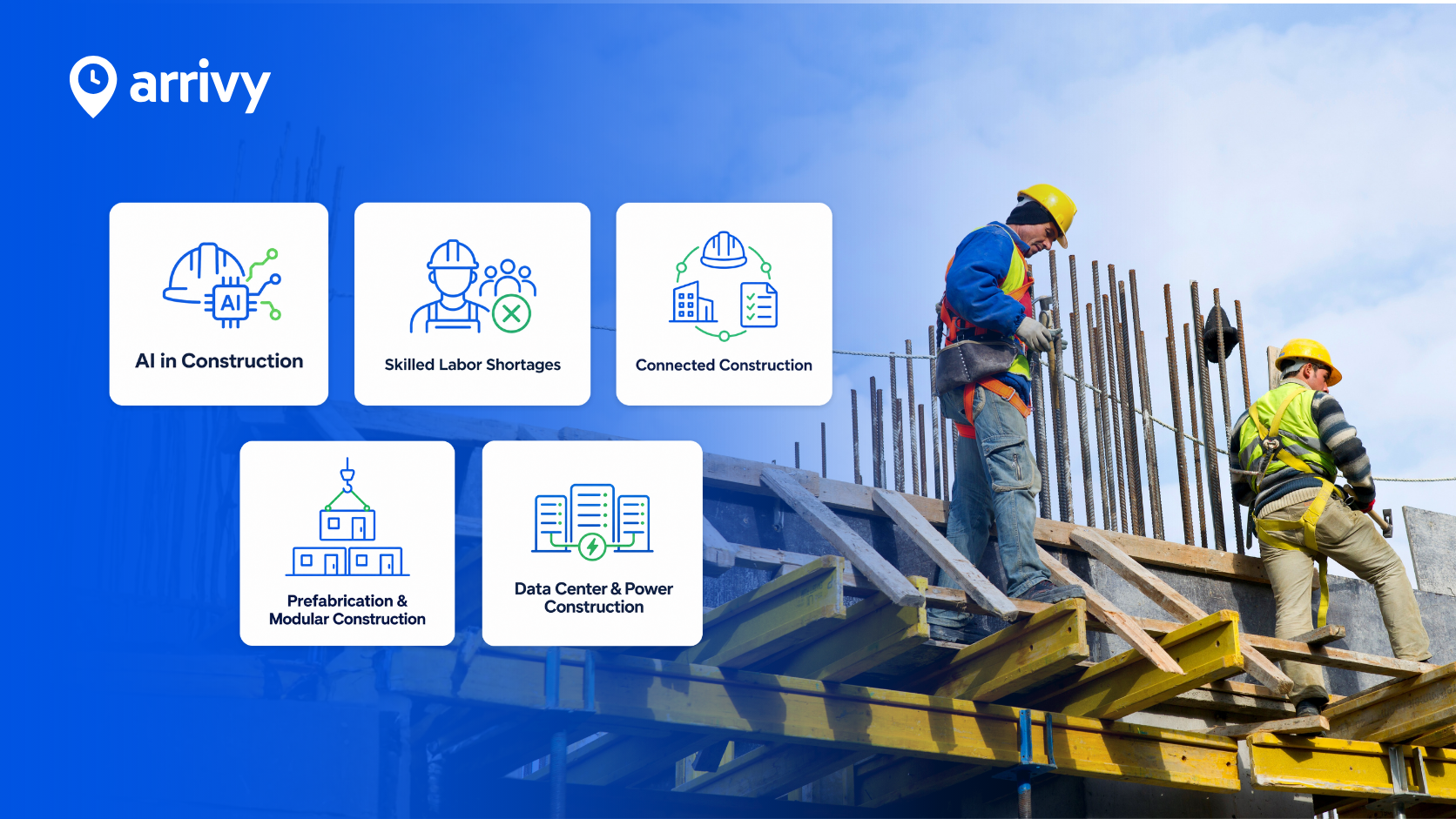
Here are five construction trends in 2026 worth paying attention to.
| Construction trend | What it means for contractors |
|---|---|
|
AI in construction |
New ways to handle repetitive administrative and planning tasks |
|
Skilled-labor shortages |
Greater pressure on crew availability and project schedules |
|
Connected construction |
Better coordination between office teams and field crews |
|
Prefabrication and modular construction |
More dependence on off-site production and installation sequencing |
|
Data center and power construction |
New opportunities alongside greater competition for specialized resources |
5 Construction Trends Shaping Project Delivery in 2026
1
AI Is Finding Practical Uses in Construction Workflows
Among the construction technology trends gaining traction in 2026, artificial intelligence is finding practical applications in administrative work, estimating, and preconstruction planning.
According to the 2026 AGC and Sage Construction Outlook, 61% of surveyed contractors were either using AI or planning to increase their investment in it, up from 44% the previous year. Common applications included office administration, estimating, and preconstruction activities.
For construction professionals, AI can help with:
- Document retrieval: Finding relevant information across contracts, specifications, and project records.
- Reporting: Preparing summaries of progress reports, meeting notes, and project correspondence.
- Estimating and planning: Supporting quantity analysis, cost comparisons, and early-stage planning.
- Risk identification: Highlighting potential inconsistencies, missing information, or scheduling concerns for review.
More advanced applications, including AI-assisted scheduling and autonomous workflow coordination, are also being explored. However, many of these capabilities remain in development or pilot stages.
Human oversight remains essential, particularly when AI-generated information influences technical, financial, or scheduling decisions.
What this means for contractors: The immediate value of AI may lie in reducing administrative workload rather than automating entire projects. Starting with a repetitive task, such as summarizing daily reports, allows contractors to assess whether AI saves time without introducing additional errors.
2
Labor Shortages Are Making Crew Planning More Critical
The construction workforce shortage remains one of the industry’s most persistent challenges in 2026, even as activity has softened in parts of the US market.
A September 2026 survey by the Associated General Contractors of America (AGC) and NCCER found that 42% of respondents reported project delays caused by shortages of their own workers or subcontractors’ workers.
The survey also found that 87% of responding firms had openings for hourly craft positions. Among firms with craft openings, 88% said filling those positions was as difficult as or more difficult than a year earlier.
For contractors, the consequences extend beyond recruitment. When experienced electricians, plumbers, HVAC installers, equipment operators, or other skilled workers are unavailable, projects can face scheduling conflicts, delayed installations, and increased reliance on subcontractors.
A business might have enough projects in its pipeline but struggle to deliver them because several jobs require the same specialized crew during overlapping periods.
Contractors therefore need to understand not just how many employees are available, but which skills those employees possess, where they are assigned, and when they can take on additional work.
Recruitment, training, and retention remain essential long-term responses. However, better allocation of the existing workforce can help contractors manage immediate delivery pressures.
What this means for contractors: Before committing to additional work, review upcoming jobs against actual crew availability, required skills, and subcontractor commitments. A realistic schedule built around available capacity is more useful than one that assumes workers will be available when needed.
3
Connected Construction Is Closing the Gap Between Office and Field
Construction companies have increasingly digitized their drawings, schedules, forms, and project records. But storing information digitally does not necessarily mean everyone working on a project has access to the latest version.
That distinction is driving greater interest in connected construction. Connected construction links project information and workflows so office teams, field crews, subcontractors, and other stakeholders can coordinate using accurate, up-to-date information.
The practical value becomes clear when project plans change. Consider an installation scheduled for Tuesday. A material delivery delay forces the project manager to move it to Thursday.
If the office schedule changes but the assigned crew isn’t informed, workers may arrive at a site where they cannot complete their tasks. Meanwhile, another subcontractor scheduled for follow-up work may still be planning around the original installation date.
Connected workflows help improve coordination across:
- Scheduling: Keeping assigned teams informed about job dates, changes, and responsibilities.
- Field communication: Sharing updates between project managers and crews.
- Job documentation: Making completed forms, site photos, and progress information available to relevant team members.
- Project handoffs: Helping the next team understand what has been completed and what remains outstanding.
These connections are especially valuable when multiple crews work across different locations or when installation activities depend on previous work being finished.
Connected construction also doesn’t necessarily require replacing every existing system. The priority is ensuring critical information moves reliably between the people responsible for project delivery.
What this means for contractors: Review how schedule changes, job updates, and completion records move between the office and field. If workers routinely depend on phone calls, duplicate entries, or outdated documents, those handoffs may be worth improving.
4
Prefabrication Is Changing How Projects Are Scheduled and Delivered
Prefabrication and industrialized construction are gaining attention as contractors look for more predictable ways to deliver projects while managing labor and scheduling constraints.
Although related, these terms describe different approaches:
- Prefabrication: Producing building components, such as wall panels or piping assemblies, off-site before installation.
- Modular construction: Manufacturing larger building sections or modules off-site and assembling them at the final location.
- Industrialized construction: Using standardized designs, manufacturing methods, and repeatable processes to improve building production.
These approaches can shift some construction activity from unpredictable jobsites into more controlled manufacturing environments. Research shows that organizations using industrialized construction report improved finished-project quality and greater schedule and cost predictability compared with traditional projects.
However, moving work off-site does not eliminate coordination challenges. It changes where they occur.
For example, a prefabricated mechanical assembly may arrive ready for installation, but the work still depends on completed site preparation, transportation arrangements, available lifting equipment, and a qualified installation crew.
If the site isn’t ready when the assembly arrives, the project may face storage problems or installation delays. Late design changes can also disrupt factory production and create additional costs.
Industrialized construction therefore places greater importance on early decisions and coordination between manufacturing and on-site activities.
What this means for contractors: Evaluate whether repeatable components or work packages could be produced off-site, then consider how manufacturing schedules, delivery dates, and crew readiness would need to align. Better predictability depends on coordinating those activities, not simply moving construction into a factory.
5
Data Center and Power Projects Are Shifting Construction Demand
While overall construction activity has faced mixed conditions in 2026, data centers and power infrastructure have remained important areas of investment in the United States.
Demand for AI computing infrastructure, cloud services, and electricity capacity has contributed to this shift.
At the beginning of 2026, the AGC and Sage contractor outlook identified data centers and power projects as the strongest areas of expected construction demand.
Data centers recorded a net positive outlook of 57 percentage points, while power projects recorded 34 points. These figures reflected contractors’ expectations for 2026, not actual construction growth rates.
Later developments reinforced the importance of these markets. In an October 2026 construction spending analysis, KPMG identified data center construction as a major source of growth within an otherwise subdued industry.
For qualified specialty contractors, these projects may offer opportunities in electrical installations, mechanical systems, HVAC, power distribution, and other technically demanding work.
However, entering these markets can require specialized experience, equipment, and workforce capabilities. Data center projects, for example, often involve complex power infrastructure, cooling systems, commissioning procedures, and tightly coordinated installation schedules.
Large projects can also compete for skilled workers already in short supply. AGC’s September workforce survey identified demand from data center construction as one contributor to ongoing labor-market pressure.
A growing sector may appear attractive, but pursuing unfamiliar projects without suitable staffing, equipment, or subcontractor relationships can expose a business to delivery risks.
What this means for contractors: Assess opportunities against existing capabilities and workforce commitments. The right project is not simply one in a growing market, but one the business can execute reliably without overextending its resources.
How Arrivy Helps Construction Teams Coordinate Daily Work
The construction trends of 2026 affect businesses in different ways, but two challenges remain particularly relevant to everyday operations:
- Making the most of available crews
- Keeping field teams informed as project plans change.
These are areas where Arrivy’s construction management software can help. Arrivy connects job scheduling, crew assignments, field communication, and work documentation to give construction teams better visibility into daily operations.
With Arrivy, contractors can:
Schedule and assign crews: Plan jobs based on worker skills, location, and availability, and reassign work when schedules change.
Keep field teams informed: Share job details, schedule updates, and work instructions with assigned crews.
Track job progress: Monitor field activities using status updates, photos, and activity records.
Digitize documentation: Capture inspections, checklists, site information, and completion records using digital forms.
Record work hours: Track time by job or crew using field check-ins and GPS-supported attendance records.
Coordinate follow-up work: Create and manage subsequent tasks such as inspections, installations, and maintenance visits.
For contractors managing multiple crews and jobsites, connecting these activities can reduce the need to coordinate work through separate spreadsheets, phone calls, and scattered messages.
Conclusion
The construction trends shaping 2026 reflect an industry balancing new technological opportunities with persistent workforce and delivery challenges.
AI is finding practical applications, connected workflows are improving access to project information, and prefabrication is changing construction processes. Meanwhile, skilled-labor shortages and shifting demand are influencing which projects contractors can pursue and how they plan resources.
Not every trend will affect every business equally. Contractors should focus on developments relevant to their project types, workforce capabilities, and operational needs.